Showing posts with label Drawing 1. Show all posts

Tuesday, 4 November 2014

Drawing 1, Part 2, Observations in Nature, Plants and Flowers in Coloured Pencils

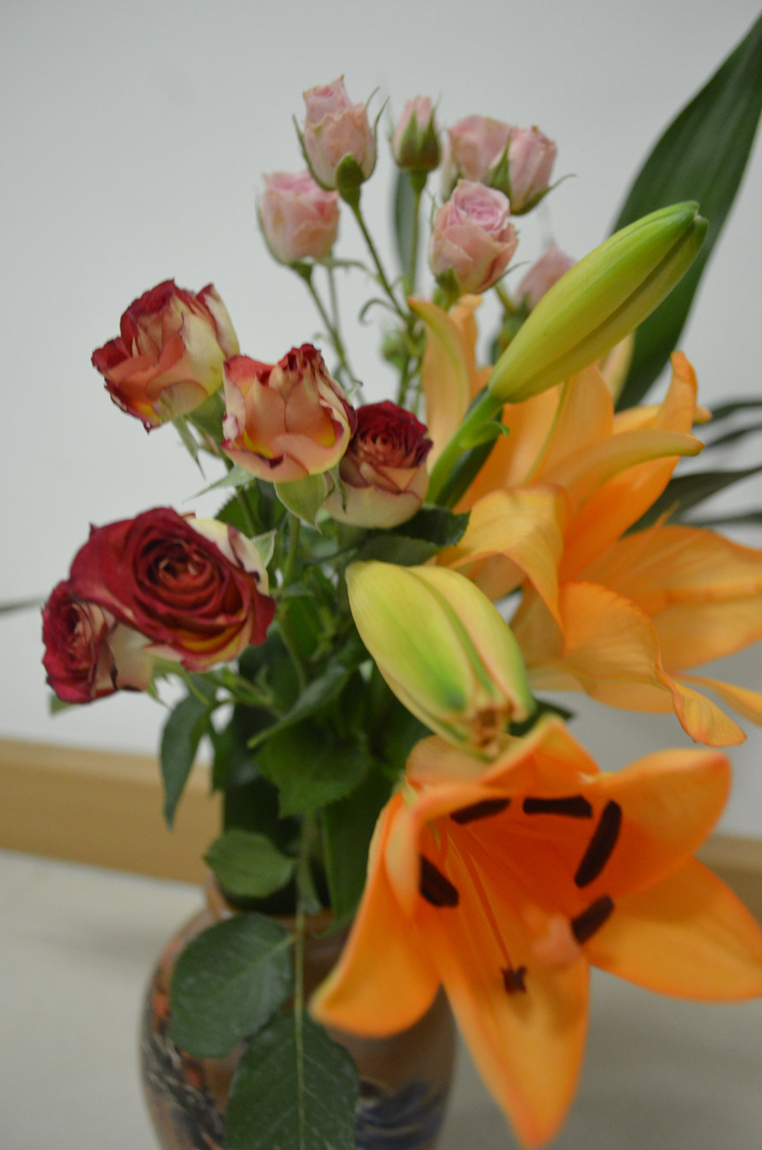
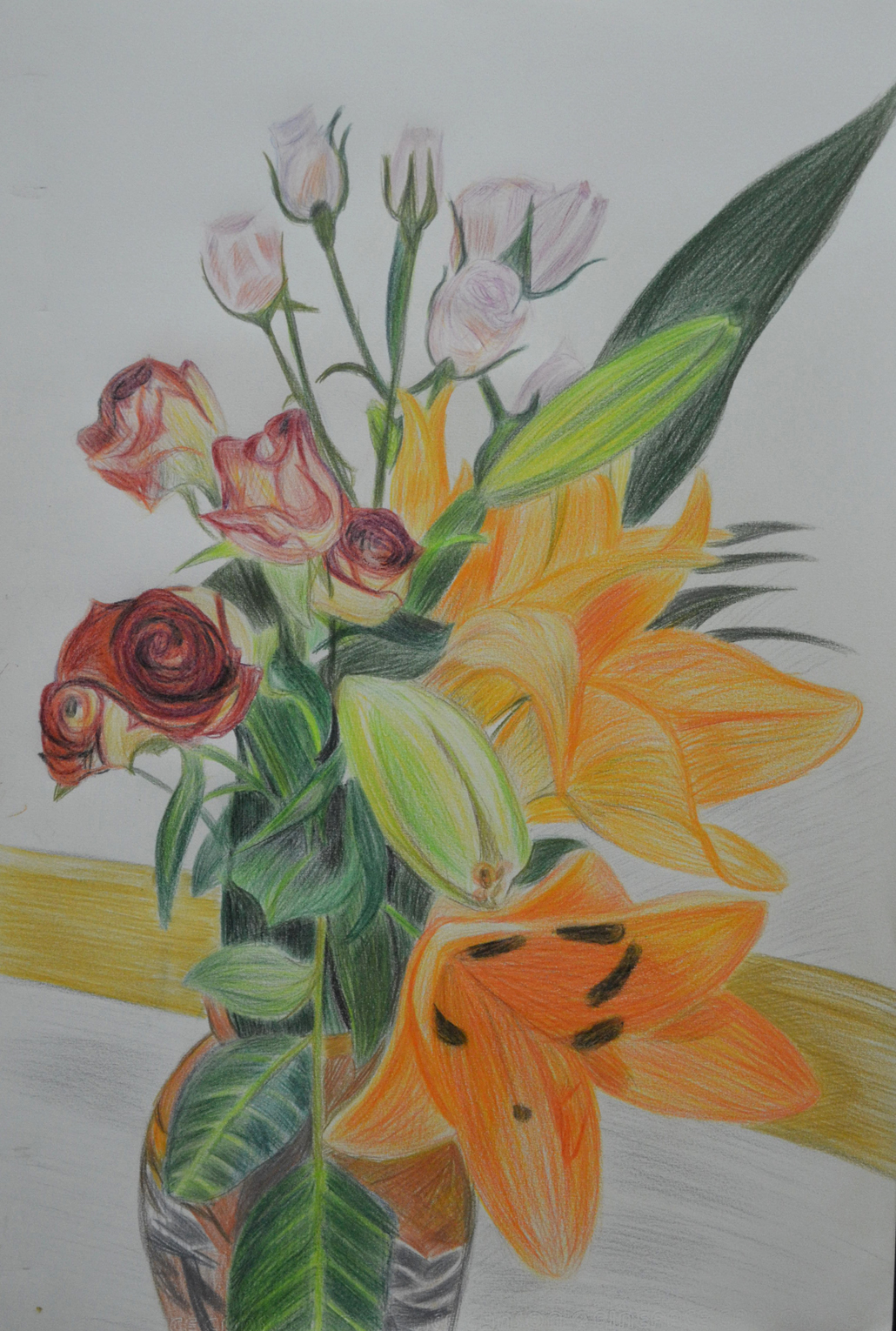
For this exercise I bought an assortment of flowers from the Tops supermarket while I was visiting my kids for a meal for my oldest daughters Birthday. The flowers I chose were orchids and some red and pink roses, I really was not thinking about shapes or colour when I purchased them but I am glad I made the choices that I did. On an A2 sheet of white paper I began to draw.
Roses and Orchids
Roses and Orchids
Now the brief said to experiment with different methods of blending in my sketchbook first, however I thought I had had enough practise blending colour with colour pencils so far in this course so I put pencil straight to paper, for the flowers this was no problem but for the leaves I wish I had done as the brief said and practised a little more.
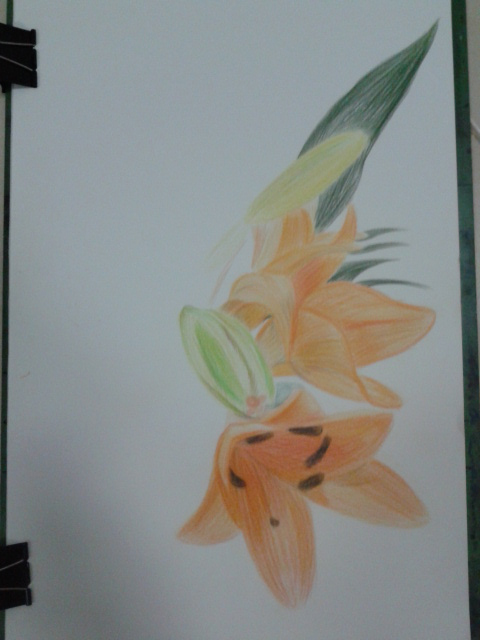
Drawing the Orchid
Drawing the Orchid
I began with a neutral colour for each subject starting with the orchid and working my way around the composition working on the most prominent flowers and leaves first keeping a careful eye on negative space.
Part way through the drawing I read the brief again to find out I had skipped over some valuable instructions:
  • Make the plant the focal point of your drawing but draw the background
  • Do not draw the plant in isolation
  • Draw in the context to give depth and substance to the drawing
The background I had chosen was a plane white wall with brown skirting boards and very pale floor tiles but I decided to carry on and I am glad I did. Using three different types of flowers with large leaves and petals on the orchid the composition and the vase I had placed them in made up the main subject and the background. Placing the largest flowers at the front and the smallest at the back helped me to create a nice three dimensional effect with the large orchid flower taking on the role as the focal point of the drawing.
I used different methods of blending for each of the flowers with layering used on all, the Still Life Group in Tone Exercise early on in this part of the course really helped using 3-4 colours on each flower but starting off with the lightest colour first and working my way to the darkest.
I used long strokes for the orchid to give it a stretching outwards feel and to me it almost seems like it as a life of its own.
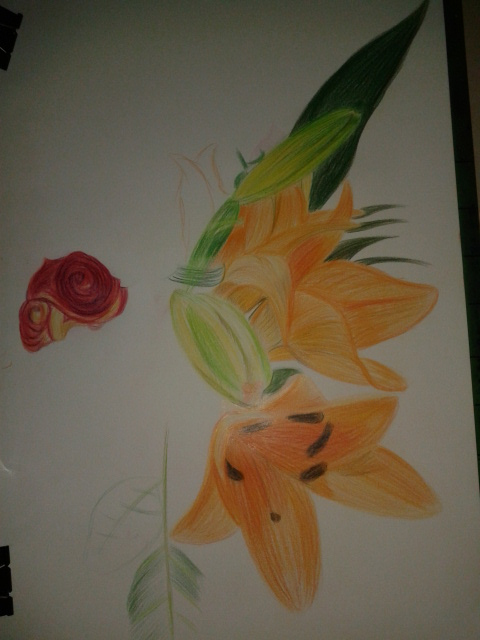
Drawing in the Red Roses
For the red roses I coloured them in a spiral motion then layered the darkest colours over the top rubbing out the colour from time to time to let the lighter colours show through.
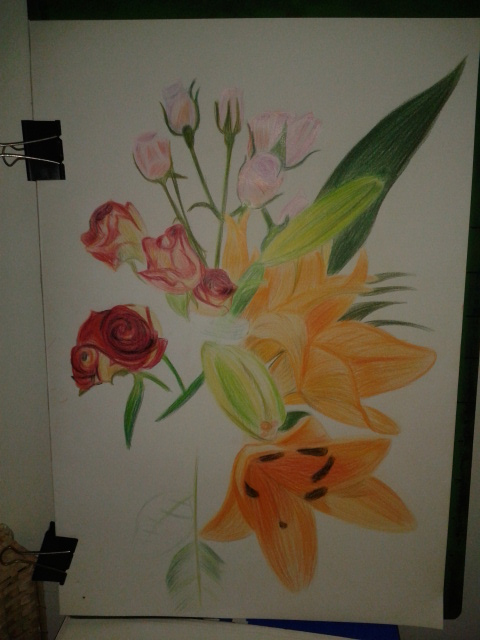
Flowers Complete
Flowers Complete
The pink roses were the most challenging of the lot with the colours and details being so delicate I decided to tackle them in a different way by hatching then squiggling over the top for the flowers where you can see the petals grouped together.
Aspects of the Drawing I am Satisfied with:
I am really happy with the 3 dimensional feel of the drawing and the way the different solutions I came up with to tackle each type of flower pad off. I am also very happy with way the drawing came together using the practise I had from the Negative Space in a Plant Exercise helped me to piece the drawing together like a jigsaw.
Plants and Flowers in Coloured Pencil
Aspects of the Drawing I am not happy with:
As always I wish I had read the brief again and again until I was clear on what I had to do but then this would have lead to a one or two plant composition  which would have probably been a lot less challenging.
I wish I had practised blending colours in my sketch book if just for the leaves and stems, although not all the leaves and stems are clearly visible I can see that I definitely could have improved on the blending on those parts of the flowers.
The final drawing is very sketchy although this is a big difference from some of the final drawings in part 1 of this and I know I allowed the the sketchy artist I researched earlier to influence me in this exercise I would have preferred a more realistic finished  drawing.

Drawing 1, Part 2, Observations in Nature, Drawing Plants and Flowers, Negative Space in a plant

I don't have any plants at all in my apartment and was quite worried about where I would get one from without having to travel to the outskirts of Bangkok to find a suitable pot plant for this exercise.
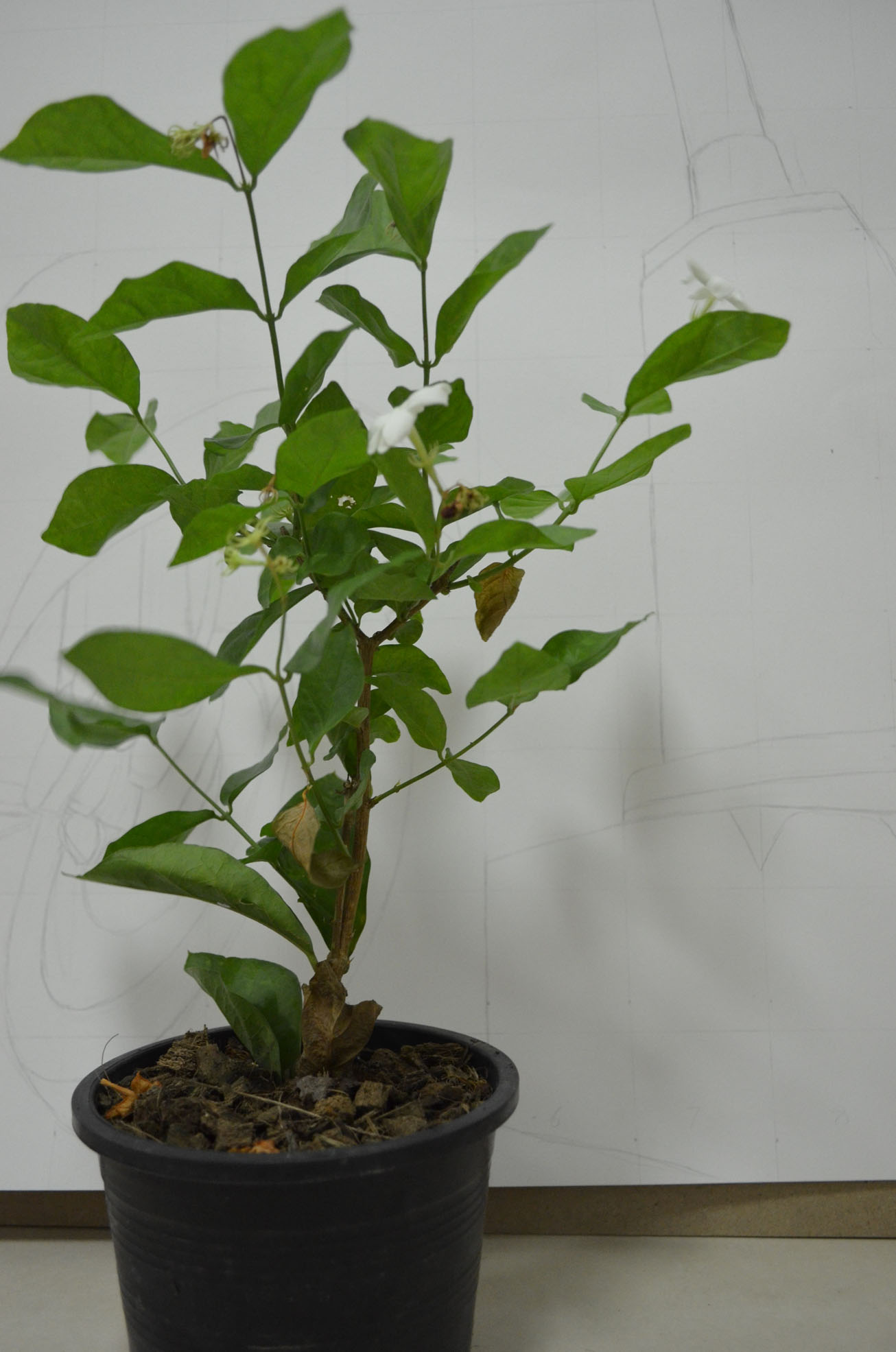
My Subject - Jasmine
Luckily it was mothers day here in Thailand (12th August - the Queen's birthday) and while my girlfriend was shopping in Tesco she came across some Jasmine plants, Jasmine is the Queens flower and at only 49 baht (just over a pound) they were a bargain and I'd definitely picked the nest time of year to do this exerise.
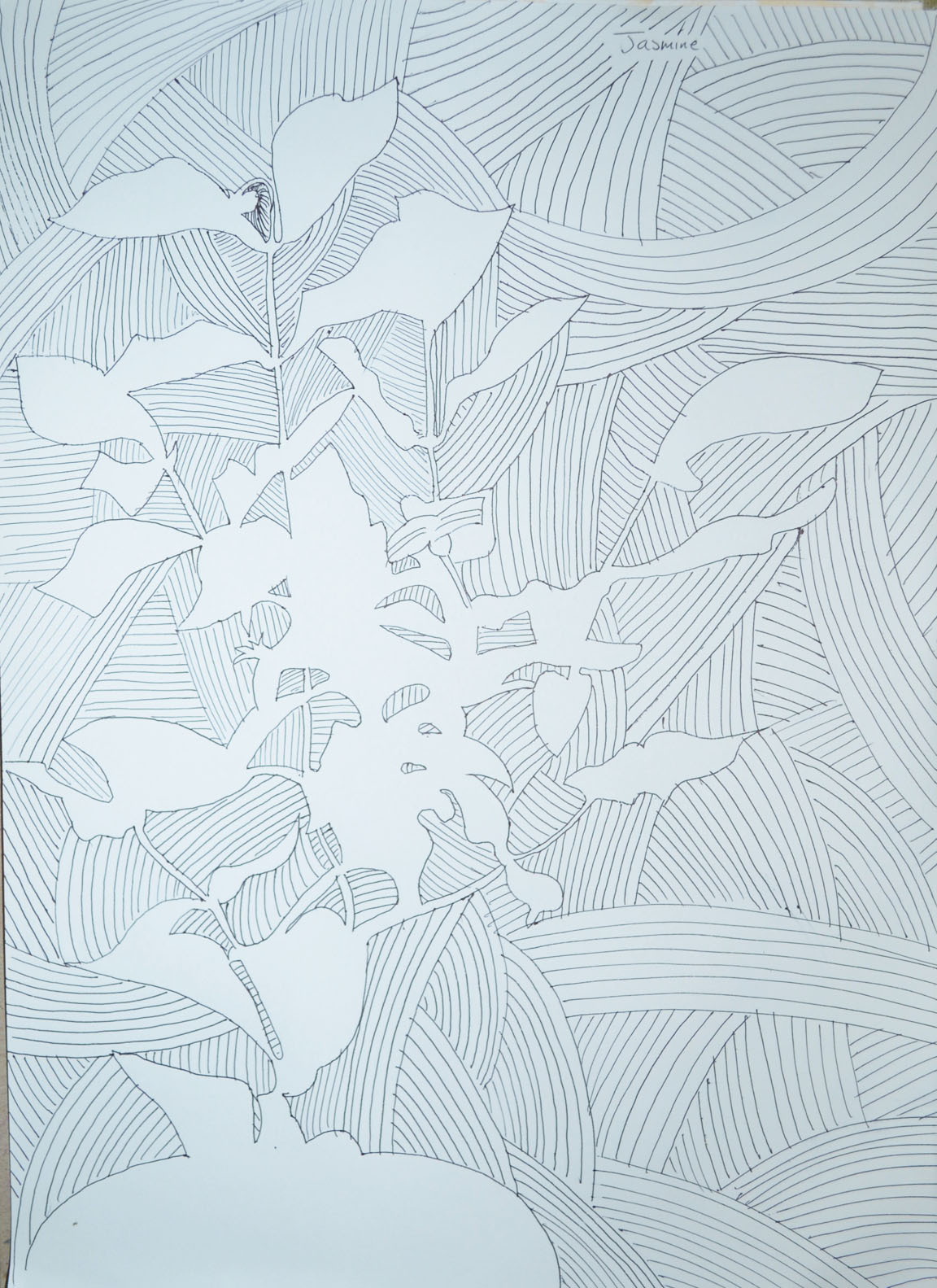
I used my faithful ball point pen and an A3 sheet of paper, placed the plant in front of a large drawing that I am in the progress of doing for a friend in England and began to draw. Concentrating on the negative spaces, I started to draw the space within and around the pot plant beginning at the top and working my way down to the bottom.
Drawing Negative Space in a Plant 1
Drawing Negative Space in a Plant 1st Attempt
My first attempt went really well until I got down to the bottom where the plant came out of the soil and I realised that the right of the plant would be well out, so to make the plant readable I drew in a few more negative spaces to even it up. I then began to finish it off by filling in the negative space in the drawing with some swirling psychedelic patterns.
Drawing Negative Space in a Plant 2nd Attempt
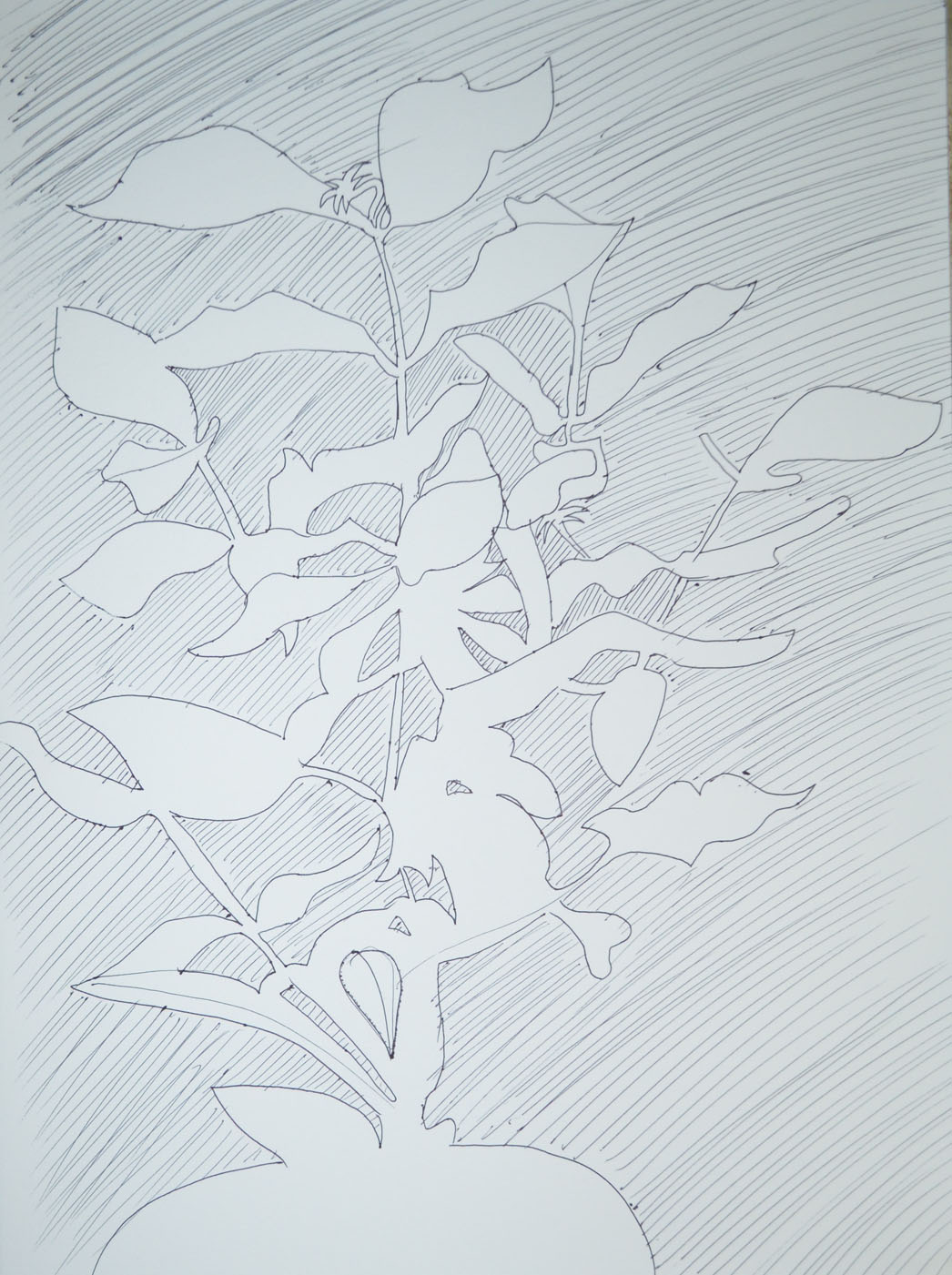
My second attempt was quicker and I think is also an improvement on the first, this time I crossed over a few lines along the way and when I had finished filled in the negative space with more conservative lines.

Monday, 27 October 2014

Drawing 1, Part 2 Observations in Nature, Drawing Fruits and Vegetables in Colour, Check and Log

Your composition should occupy most of the paper’s surface. How much negative space do you have left?
I think I did really well with all the three exercises of this project, ‘Using Hatching to Create Tone‘, ‘Using Markers or Dip Pens‘ and ‘Drawing Using Oil Pastel‘. In all three final drawings I left minimal negative space allowing for shadows and props used.
What have you learnt from drawing the details of fruit and vegetables?
All fruits and vegetables have different surfaces from smooth and shiny to rough, hairy and spiky so every object is a challenge not only this but its very difficult to get familiar with the shape of a certain fruit or vegetable as the surface differs from one to another taking into consideration ‘ripeness’.
What did you find most challenging about this part of the course? 
Firstly, I really had problems using dip pens and creating tone with this medium it is something I really have to work hard at getting as much practise in as possible.
Secondly composition arrangement and that arranging a composition with fruit and vegetables takes more time than arranging other objects; not only for fear of repeating a similar composition you drew in a previous exercise  but for fear of arranging a composition that will not allow you to capture the full details of the objects.

Drawing 1, Part 2 Observations in Nature, Still Life, Check and Log

What aspects of each drawing have been successful, and what did you have problems with?
Still Life Group Using Line
I drew this drawing from scratch without sketching in pencil first in this aspect I think I did really well. However I found it very difficult not to start hatching to depict tone and so I probably went overboard on the pumpkin but I feel that it was better to but too much effort in than two little.
I was also dissatisfied with the pumpkin because the actual surface wasn’t as rough or bumpy as what I made it out to be in my drawing. In both drawings.
Still Life Group in Tone
The only problem I had with this is I should have chose a composition that used up more of the paper. I also could have been more adventurous with the subjects that I chose. Apart from that I think I did really well with depicting tone and none of the objects look out of place.
Did you manage to get a sense of depth in your Drawings? What elements of the drawings and still life groupings helped create that sense?
This is one thing I did not have a problem with with the Still Life Group Using Line exercise I did this by placing the tallest objects at the back. With the Still Life Group in Tone I looked down at the group from an angle.
What difficulties were created by being restricted to line or tone? 
Like I said earlier sometimes it was very difficult not to cross the fine-line between drawing with line and hatching.
See more on my Still Life exercises on my Drawing 1 Blog

Tuesday, 7 October 2014

Drawing 1, Part 2 Observations in Nature, Detailed Observation - Stipples and Dots

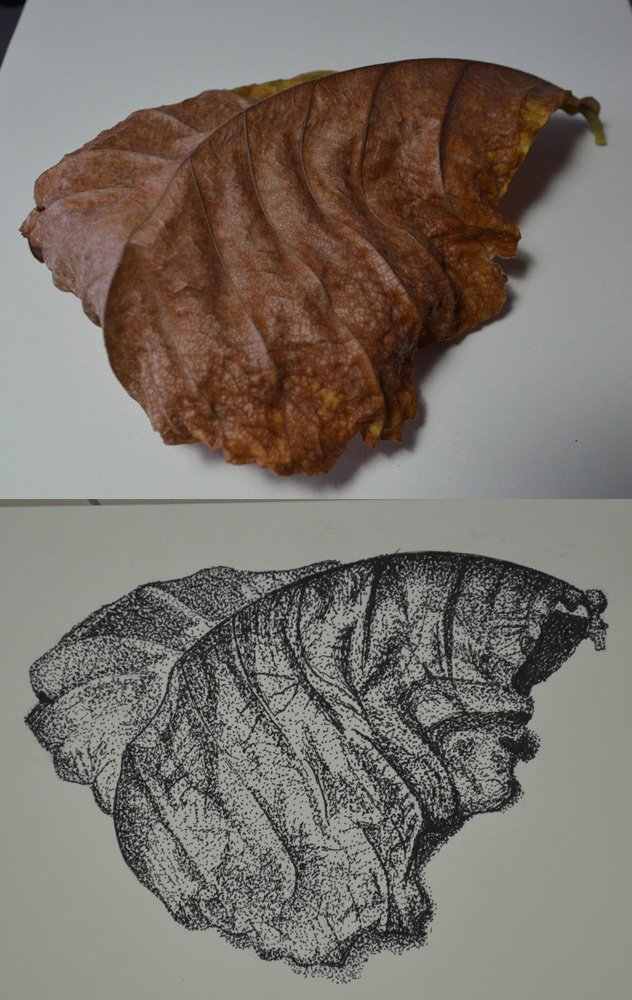
For this exercise I was to pick another interesting object and use A4 cartridge paper and a ballpoint or drawing pen. Then use a stippling effect, dots and and a variety of marks to create a drawing of depth and interest.
Exercise - Stipples and Dots, Finished Drawing
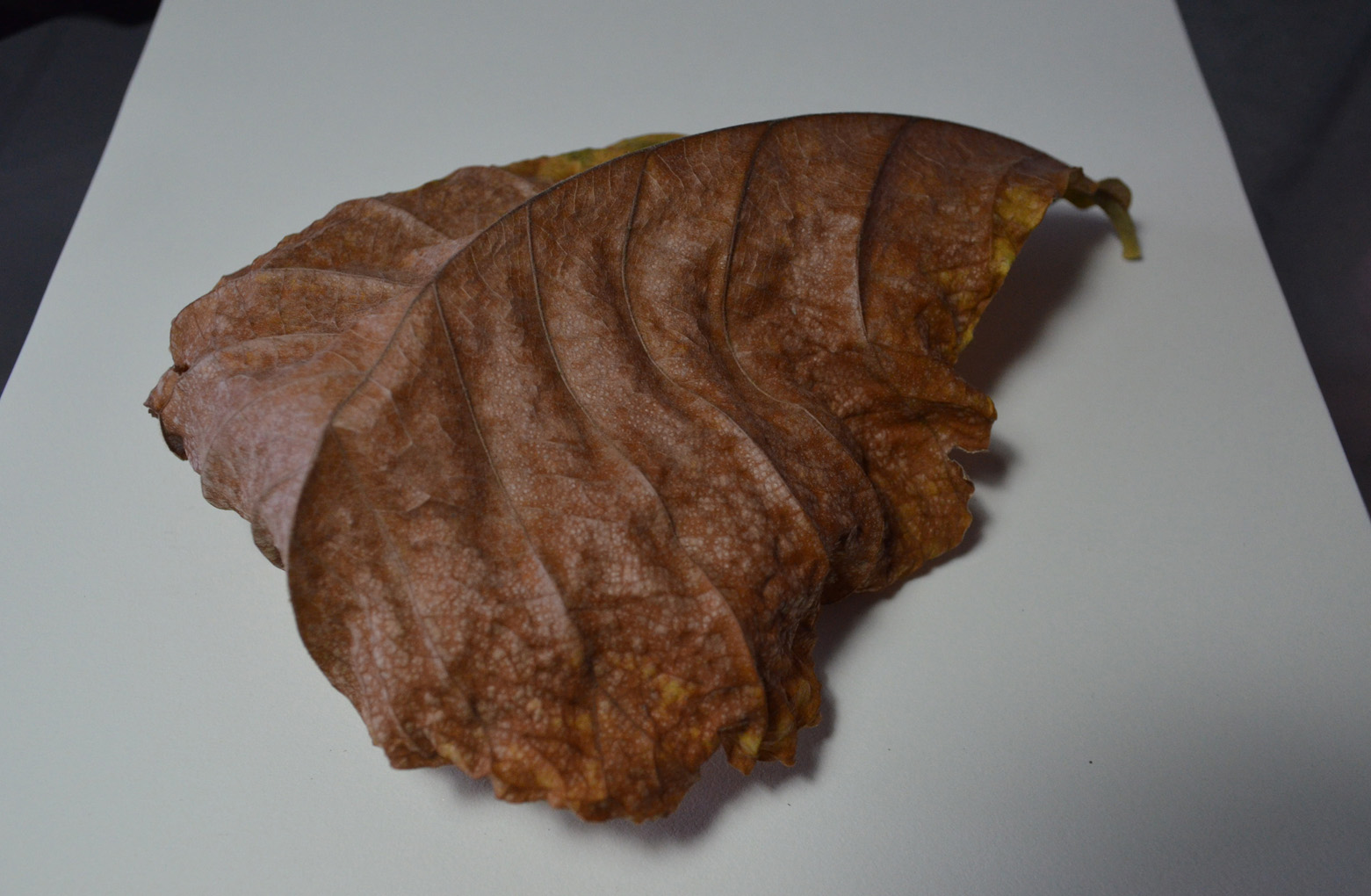
After my research on Eliot Hodgkin I took a walk through the very small park area opposite my school and took some photos of leaves with my mobile phone so I might use them later. When this exercise came up I went back into the park to grab some dying leaves to take home.
Exercise - Stipples and Dots, Leaf Subject
One particular leaf caught my eye as it had some great lines and at the time was half green half brown, so took many photos during the change from green and brown to completely brown and also tried the leaf at different angles, for my drawing I picked out the one above.
I can't say that I love stippling as it is a very slow process and this exercise took me about three hours over two days to complete and since my first assignment was handed in quite slow I'm trying to keep up momentum.
I used a Rotring 0.3 drawing pen and began as I did with other exercises, drawing the light tones by spacing out the dots  and then going back over for the darker tones with more dots. I used a variety of mark making techniques which included stippling, dots, really short hatching and lines and for the creased patterns of the dying leaf I drew the dots in tracks close together and then went back over with more dots.
Exercise: Stipples and Dots Finished
View my learning log for Drawing 1

Drawing 1, Part 2 Observations in nature, Detailed Observation, Research Point B - 2 Contrasting Artists, Gustave Courbet

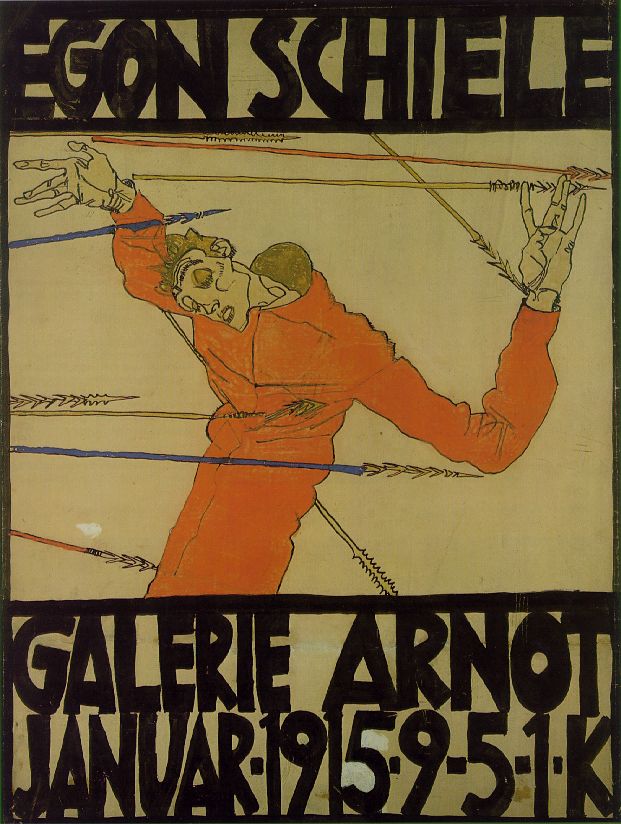
For this research point I was to find two artists who work in contrasting ways: from tight, rigorous work to a more sketchy style. For the artist who worked in a sketchy style I had already researched Egon Scheile in Part A so now it was time to find an artist who did more tight, rigorous work.
I was all ready to research a modern artist for this part of this research point and discovered Grant Wood while looking at Egon Schiele’s work, but then on a last minute search I found another artist that was just as new to me.
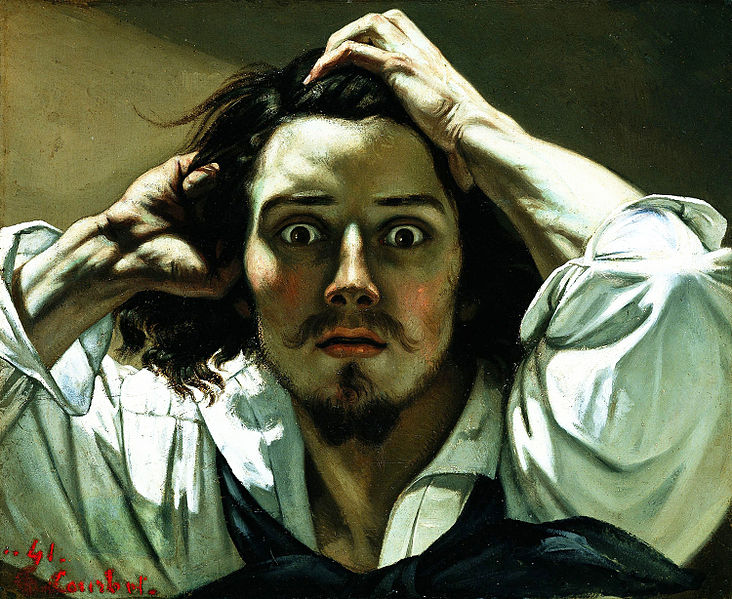
While searching for images  I came across a picture that I had seen many times and for some obvious reason I thought was a picture of Johnny Depp in one of his movie rolls. I was surprised to find out that it was a self-portrait called ‘A Desperate Man’ by an artist called Gustave Courbet, the father of realism and even more interesting the artist that first coined the phrase.
Born in Ornans, France to a wealthy family, Gustave Courbet went to Paris in 1841 with the intention of studying law but soon decided that he would study painting and did so by copying the paintings of the French, Flemish and Spanish masters in the Louvre.
His style was shaped near the start of his career when he chose direct his paintings to observed reality, among his early paintings were self portraits portraying himself in various roles he also painted seascapes, still-lifes and figurative compositions.
Courbet's figurative work was somewhat controversial because he addressed social issues in his paintings portraying subjects that were considered vulgar at the time such as rural hierarchy, peasants and the poor working conditions of the underprivileged.
Courbet's style became known as realism however instead of using perfect line and form in his paintings he dealt with realism with spontaneous brush strokes and a rough handling of paint achieving a sense of direct observation by the artist while depicting the inconsistency in nature.
Although Gustave Courbet and Egon Schiele are artists of two different movements living at two different times their lives are very similar in that they seem to demonstrate freedom of expression in their art by painting subjects that were pornographic or controversial at that time. The poses by Courbet's nudes such as La Femme Aux Bas Blancs, (Woman with White Stockings), 1861 and The Origin of the World (L'Origine du monde) (1866) remind me very much of Schiele's paintings; as though Schiele could have been influenced by the artist. Both artist's also served time in prison.
I'm not particularly turned on by the works of the old masters and so there are a lot of Gustave's paintings that I don't find appealing, but there are two or three that I think are brilliant simply because I can imagine how sensational they were at that time being so 'real' when photography was still in it's infancy.
http://en.wikipedia.org/wiki/File:Origin-of-the-World.jpg - The Origin of the World (L'Origine du monde) (1866)
Gustave Courbet auto retrato
Self-portrait (The Desperate Man), c. 1843–1845 (Private collection)
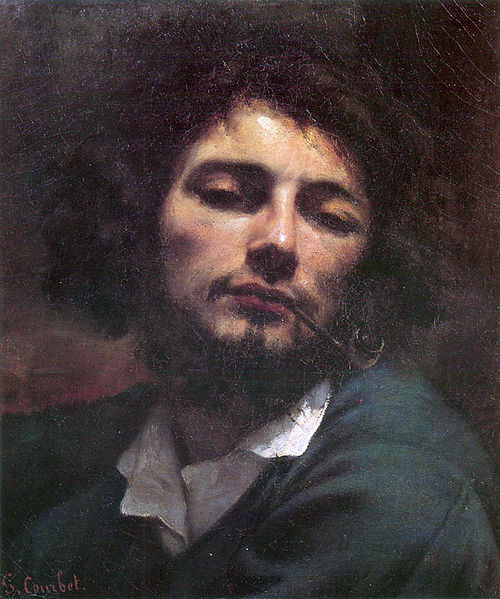
Gustave Courbet Autoportrait
The man with a pipe Self-portrait, 1848-49
Bibliography:

Drawing 1, Part 2 Observations in Nature, Detailed Obsevations, Research Point 2 Contrasting Artists A - Egon Schiele

For this research point I was to find drawings by two artists who work in contrasting ways: from tight, rigorous work to a more sketchy style.
I decided to research the artist who works in a sketchy style first.  While I have tried to find new artist so far in this module for this part of this research point I decided to research an artist I was already familiar with as when I saw the words 'sketchy style' he was the first artist that popped into my head and rightly so.
Austrian Expressionist painter Egon Schiele  was born in Tulin in 1890. His father Adolph Schiele was the station master at Tulin Railway station and as a child Egon was fascinated by trains and would spend many hours drawing them. It is said that his passion for drawing started at the early age of 1 and a half years old and this led his father to believe is son would become an engineer and so at eleven years old was sent off to attend a Realgymnasium 25 miles away from his home town. Due to lack of friends and lack of interest in his studies he was a poor student and was kept back two years. When his father died of syphilis in 1905 family problems made his situation worse and eventually was politely asked to leave school by his teachers
In 1906 he asked his mother and uncle to allow him to apply at the Vienna Academy of Fine Arts and in the summer of that year, passed the tough entrance exam to became the youngest student ever to attend his class. Although he was passionate about art he showed a resistance to the strict regimen at the academy. As a brilliant draughtsman he would get through projects in minutes that would take other students in his class hours to complete but his early works were heavy handed and his soulless depictions of professional models did not amuse his tutors who simply gave him grades of ‘satisfactory.’
Schiele’s early work showed traits of Gustav Klimt and then in 1908 after a visit to a the large art show known as the ‘Kunstschau’ where a room full of the artists’ paintings were on show the influence of Klimt emerged full blown in Schiele’s paintings. He saw himself as the new Klimt and paraded round Vienna calling himself the ‘Silver’ Klimt and against the Academy’s authority accepted invitations to exhibit at the ‘Kunstschau’. In 1909 Schiele and a few of his like-minded class mates handed over a formal letter of protest to the academy expressing their disapproval at the academy’s rigid rules and withdrew themselves from the school.
By 1910 Egon Schiele’s unique expressionist style had gotten him many admirers including Gustav Klimt himself who bought several of his paintings and also offered to exchange some for his own. Klimt also introduced him to patrons and collectors and he thought that leaving the academy had turned out to be a wise career move but that wasn’t to be the case. Klimt was very vain and expected his works to be snapped up by the patrons who he had hoped would show him devotion but the truth was they didn't find him the least bit cooperative and found his commissioned works, far too sexually explicit. Feeling let down he left Vienna for the countryside.
Egon Schiele led a short life dying at the early age of 28 of the Spanish flue in the epidemic that swept Europe in 1918 but his short life was somewhat controversial. At 21 years old he was imprisoned for seducing an underage girl and during his arrest the officials destroyed many of his drawings that were regarded at the time as pornographic due to the nature of his subjects. He spent a total of only 24 days in custody but during that time he a created a 'series of 12 paintings depicting the difficulties and discomfort of being locked in a jail cell' - Wikipedia.
His work was shaped by World War I during which he was drafted up and stationed in a Russian prisoner of war camp; however he still continued to paint and was even given a disused store room to be used as a studio where he painted captured Russian officers.
His style changed over the years  he was influenced by Klimt and Oskar Kokoschka and his early works from 1907 to 1909 resembled those of Klimt but in 1010 began experimenting with nudes and began developing his own unique style that we know today, pasty soulless doll like figures with strong overtones. Many view his works as pornographic, twisted or erotic depicting death, sex and discovery and yet I see his works as simply brilliant and way ahead of their time; paintings that have influenced so many artists since.
I first came across Schiele's work in the music room at my secondary school, a poster of his 'Self Portrait of Saint Sebastian' but it wouldn't be til many years later that i would find out the name of the artist or what the painting was called.
Egon Schiele - Self Portrait as Saint Sebastian
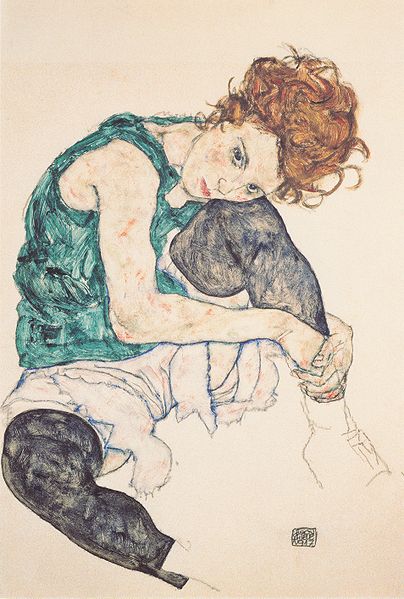
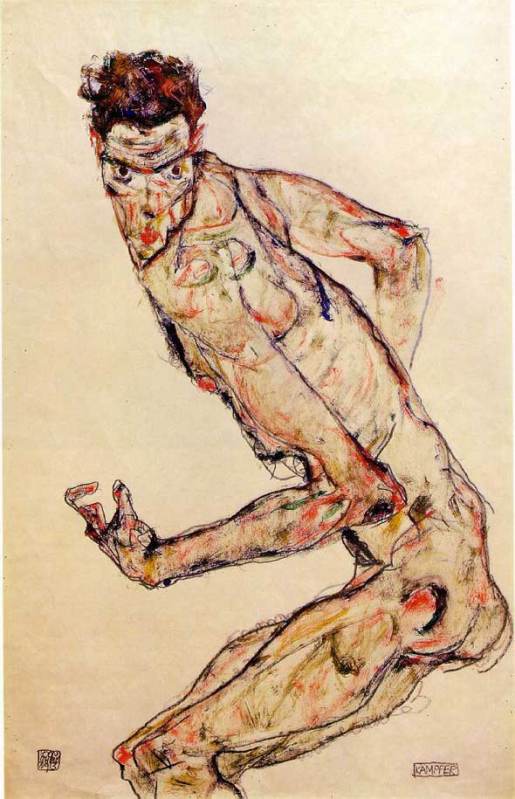
My favourite paintings by Schiele have got to be the Fighter 1913 and Seated Woman with Bent Knee 1917, although I have to admit I do love a nude or two of his which are simple, crude but very erotic.
Egon Schiele - Seated Woman with Bent Kneee 1917
Egon Schiele - Fighter, 1913
I love the way he has clearly thought hard about the subjects (maybe a bit too hard from what we know of Schiele) and yet his paintings are no more than coloured sketches on a plain background, allowing him to show movement and even though some regard his subjects as being 'soulless' I don't think they can be accused of being lifeless. I can see how it is easy to be influenced by an artist such as Schiele and I know that his paintings will come to mind in the 'Drawing Figures' part of this course.
Bibliography:

Wednesday, 14 May 2014

Drawing 1, Part 2: Observations in Nature, Exploring Coloured Media - Exploring Coloured Media

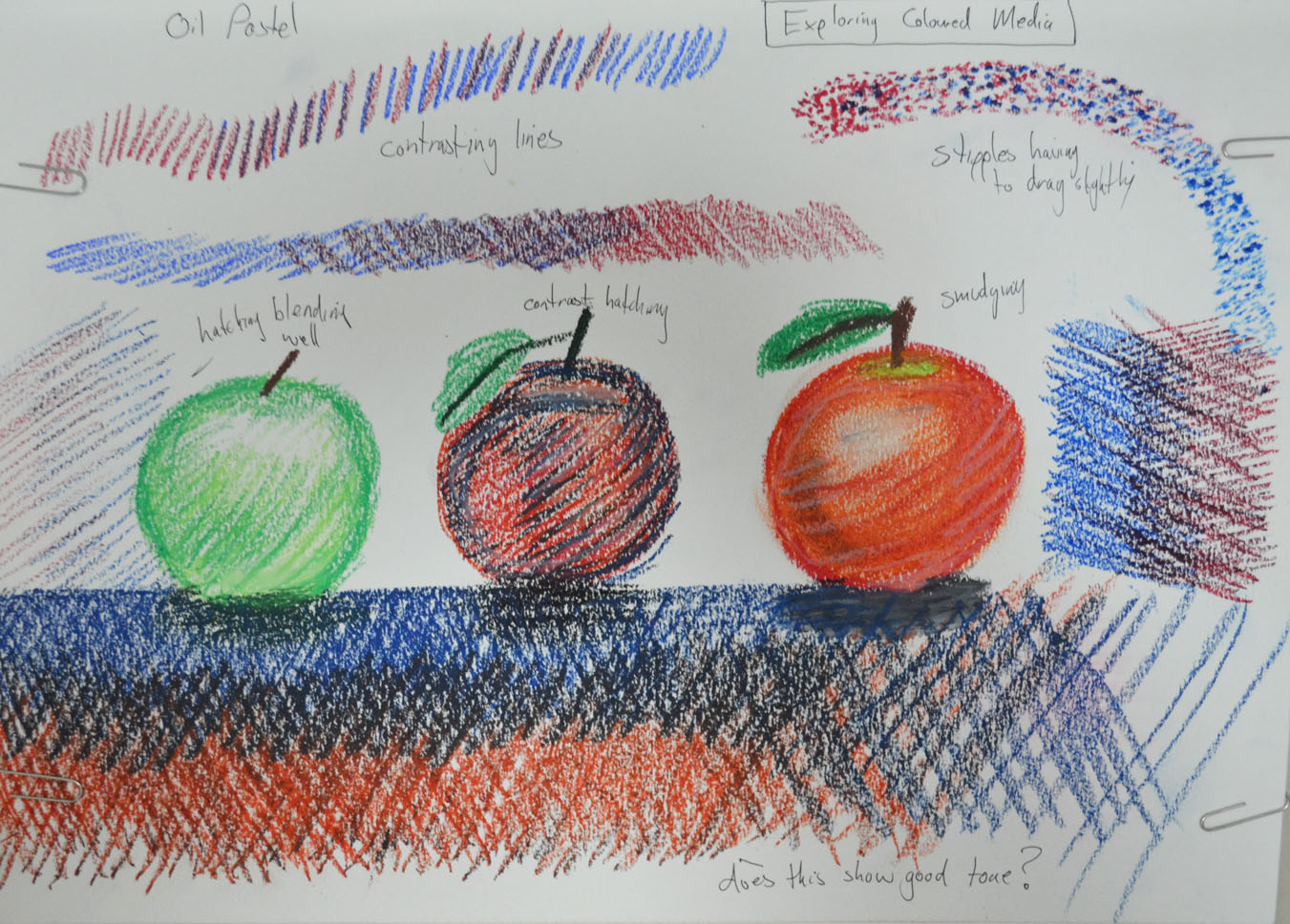
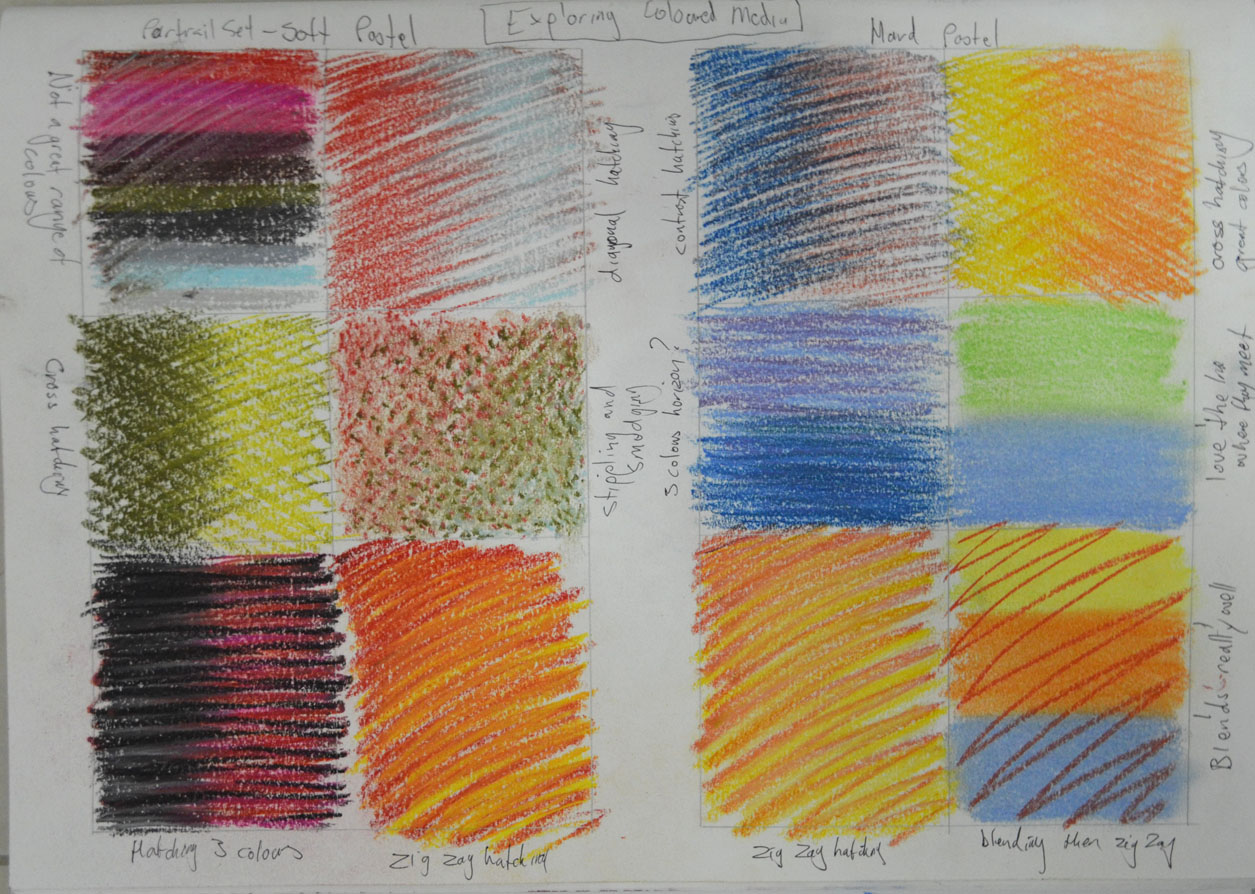
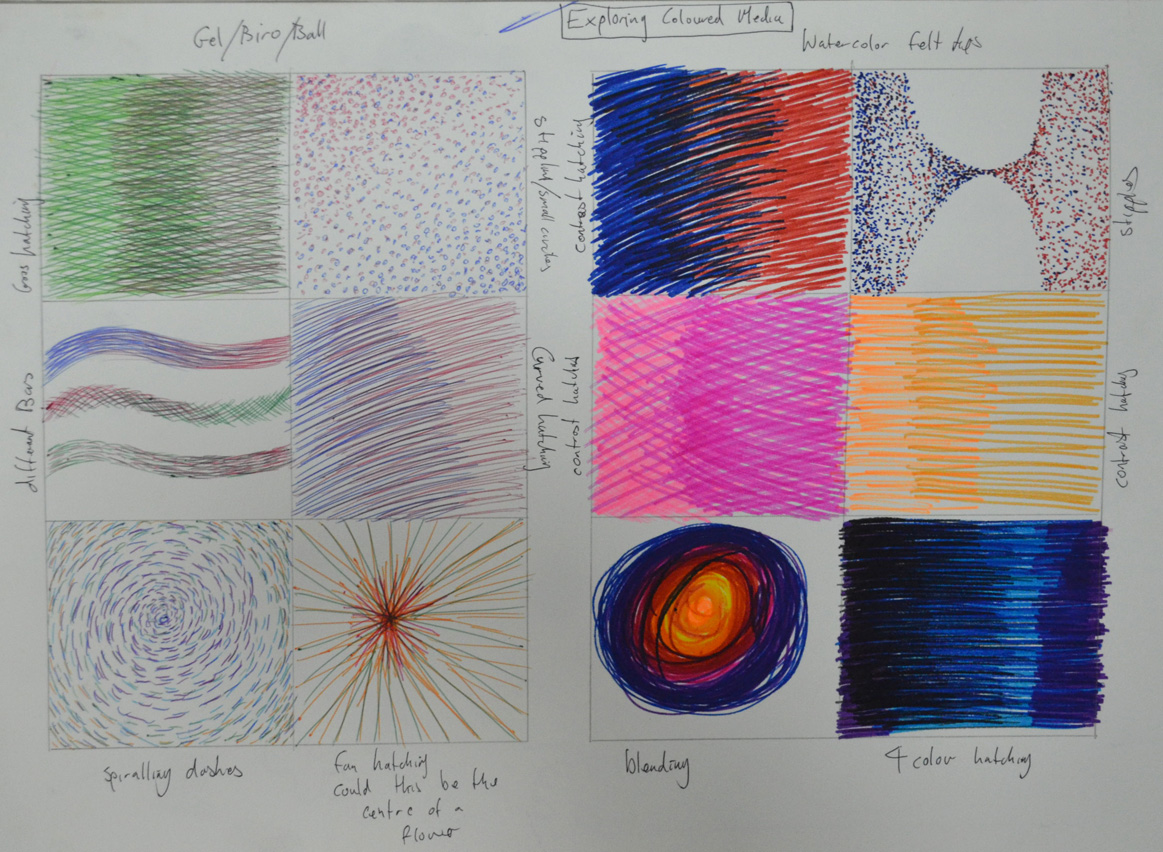
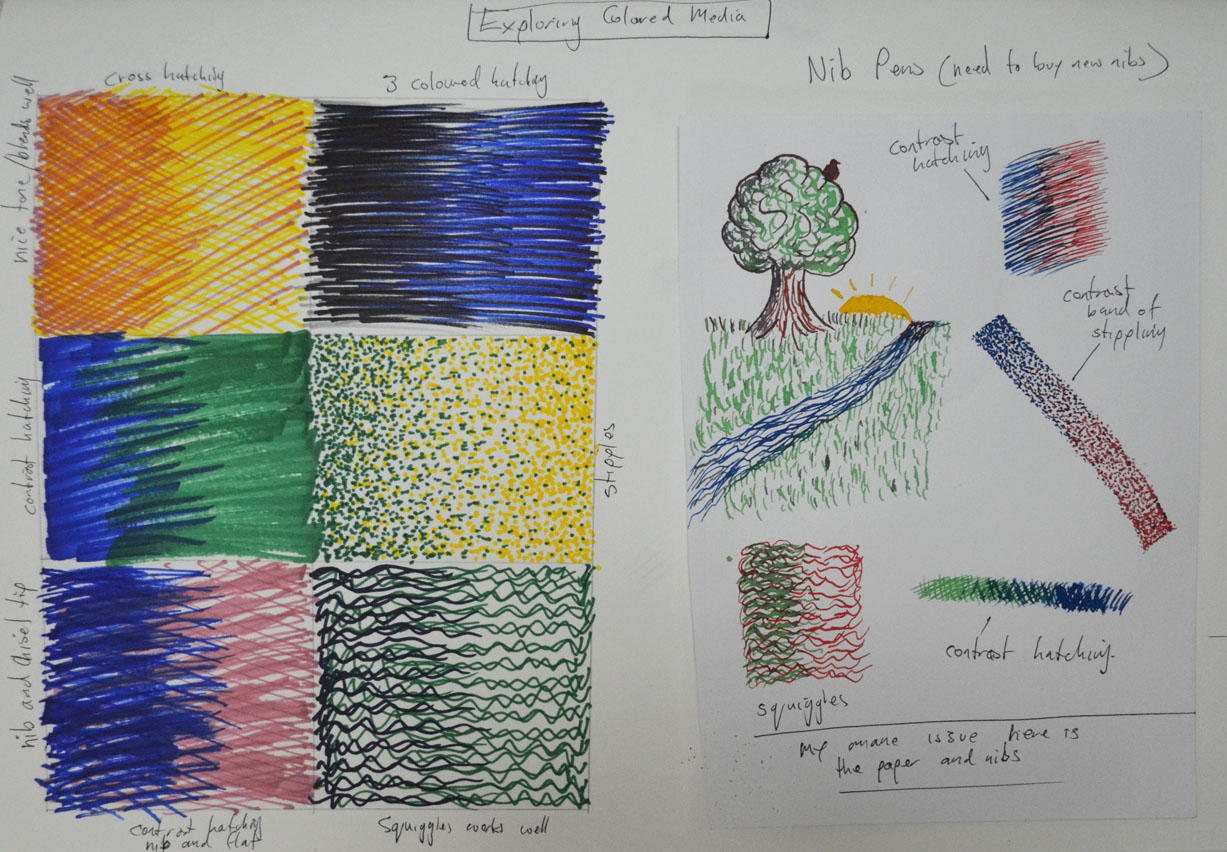
In this exercise I set out to explore the different coloured mediums I had available which included oil pastels, soft pastels, felt tips, markers, different coloured inks and dip pens as well as coloured pencils and a pack of coloured ball point pens. Just like I did in the Making Marks Project in Part 1 I decided to go at this project using a mixture of doodling and filling in squares with different techniques.
Coloured Pencils
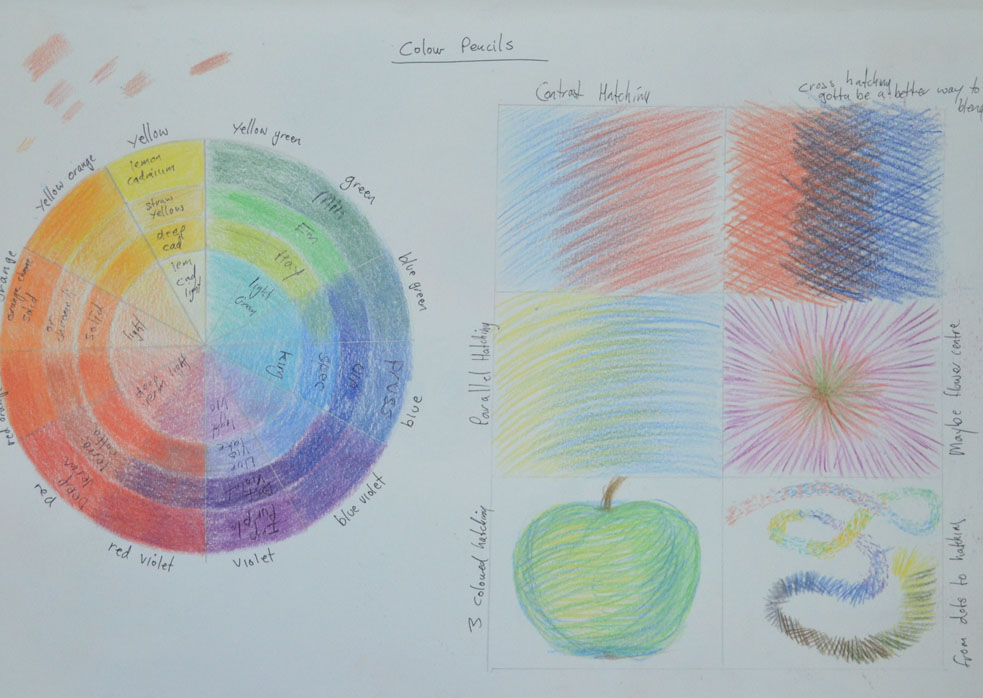
I started out with coloured pencils I had recently bought some Derwent coloured pencils for the composition development of assignment 1 but have yet to discover their full potential. I began by putting together a rough colour wheel based on one that I found online to see how the colours would blend together, there are much more possible colour variations  to be had from blending this medium but it gives me some idea and will help me in the future.
exploring coloured media - Coloured Pencil
In the squares i tried different hatching techniques such as cross hatching and horizontal hatching. some techniques work better with this medium but I think all can be utilized in a drawing and this gives me some idea of what each technique can be used for,
exploring coloured media - Oil Pastel
Oil Pastels
With the oil pastels I decided to do some experimenting by doodling just to get a better feel for this medium as I know I will be using them a lot later. I found that they were quite good forstippling and leave a lot more colour on the page when stippling than coloured pencils which weren't great and found myself drawing circles with them. They were also really good for hatching but can also be smudged quite well, so all in all a very versatile medium.
exploring coloured media - Soft and Hard Pastel
Soft Pastels
At the start of the course I bought some soft pastels but haven't really used them until now. I hadn't noticed that they were a portrait set so I didn't have much choice of colours, however I did enjoy working with them. They were very good for stippling and hatching and depicted tone very well, in one box I did some stippling and then smudged over the top and was rather pleased with the result.
Hard Pastels
I've used these a couple of times now in both the Study of Light Reflected from one Object to Another exercise in part 1 of this course as well as in my finished piece for the Natural Forms part of Assignment 1 but yet still have to discover their full potential. Hard pastels are great for hatching and smudging as well as layering. They are also quite expressive when using certain techniques and they blend very well.
exploring coloured media - Ball Point and Felt Tip
Ball Point Pens
I bought a cheap pack of Staedtler coloured ball points that were in a sale in a local art/book store and tried out different techniques, now I know from the work I have seen of other artists in ball point that they are a great medium to use, however techniques have to be improved, when hatching they seem to work better when you lift the pen off the paper towards the end. I get a feeling they are probably better for small pieces rather than large drawings.
Felt Tip Pens
The felt tip pens that I have here are not a normal felt tip but a watercolour pen, I didn't know they existed, the colours are very vivid and seem to better when used for darker images. Stippling is great with this medium but when hatching they tend to clot on the paper towards the end of the stroke so like the ball points I found that they work better if you lift your pen off the paper towards the end of the stroke. These watercolour pens also blended quite well, I have yet to try out normal felt tip pens but shall be doing so quite soon.
exploring coloured media - Markers and Dip Pens/ Coloured Inks
Markers
I used markers for the Patrick Caulfield Research point but only used them in blocks of colour, I really enjoyed using them just as I did in this exercise. They were brilliant for stipling and hatching and depicted tone very well, I also filled a square with hatching using both the pointed nib and the chisel nip and found it to be very expresive. Again they tend to clot but not as much as the felt tip and I found that that they are probably better for darker drawings.
Nib Pens and Coloured Inks
This is a medium that I am still struggling with I have a good few Ecoline colours to play around with and have been experimenting with different papers but I think my nibs are letting me down, I shall be investing in some quality nibs very shortly. However, i did get some decent results this time. Starting off with a bit of doodling I got used to the feel of the pen on the smooth paper in my A5 drawing book then did some stippling and hatching. I get the feeling that it is best to let the inks dry before using other colours. I found that they were great for stippling on the smooth paper but then on water colour paper not great at all the same went for hatching. This is a medium that I want to see myself using more of as I love pen and ink drawings so it is going to be worthwhile exploring this medium more deeply.

Sunday, 16 February 2014

Drawing 1, Part 1 Mark Making and Tone, Assignment 1 – Check and Log


Did you do enough preliminary work before starting on your final pieces?


Yes definitely, the preliminary work not only helped me decide on the best composition for the final piece but helped me to decide which mediums I should use. In both parts of this assignment it changed my mind about what mediums I would use and also the layout of the composition for the final piece. I probably could have done more with regards to colour blending and make more notes on which colours to use for the Natural Objects.
Do your large drawings give an accurate interpretation of the still life groups? If not, what went wrong?
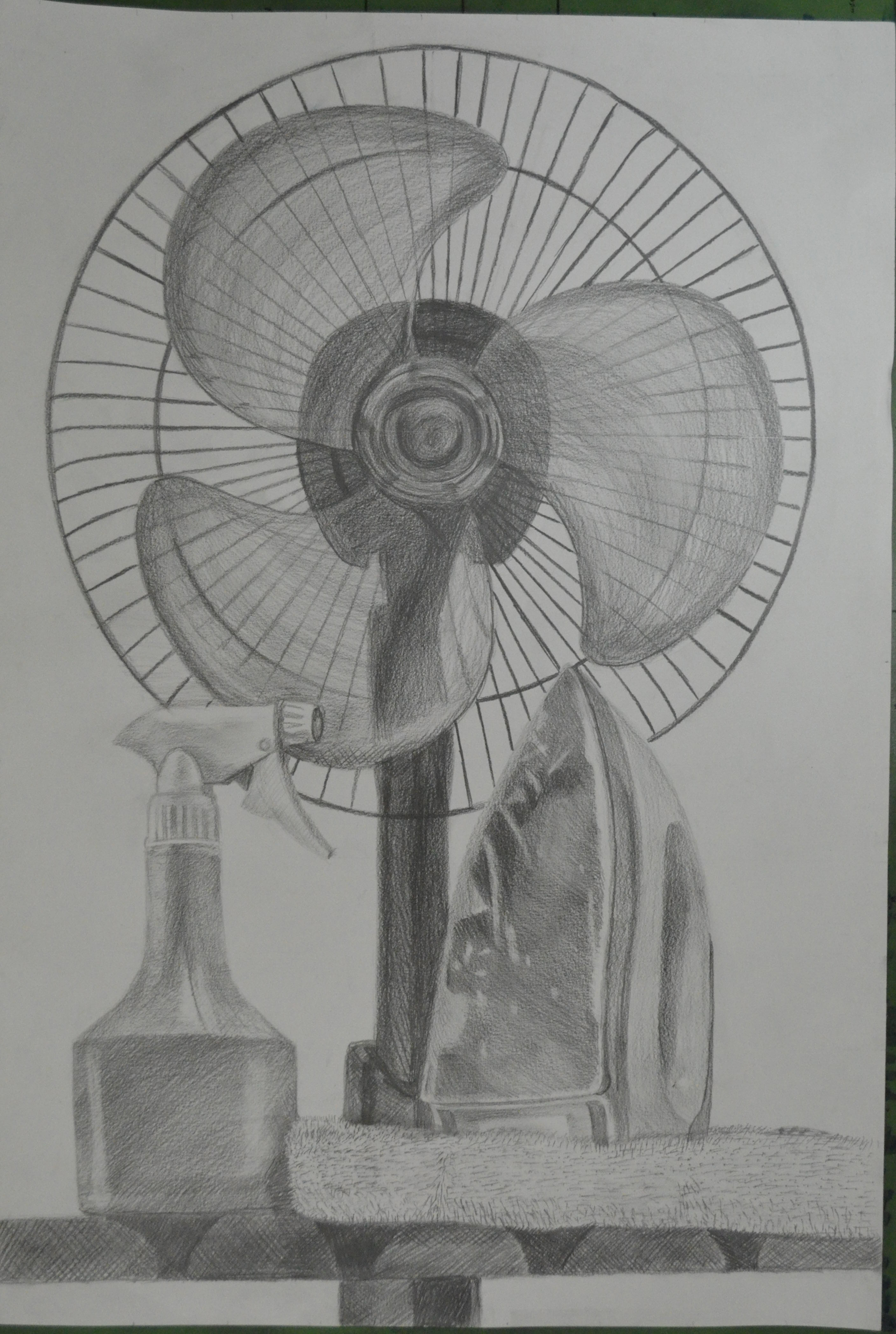
The large drawing for Made Objects I believe was a very accurate interpretation of the still life group even after playing down certain details such as the amount of bars on the electric fan cage. However I I’m not too happy with the interpretation of the still life group in the large drawing for the Natural forms. There are certain shapes on the edge of the drawing that I know are not the same as the actual objects this was due to moving the objects about trying to find the composition that I chose to develop, then having to work from the drawings I had already done and photos that I had taken.
Did you make a good selection of objects or did you try to include too much?
I believe I made a good selection of objects for both parts of this assignment with a minimum amount of objects in mind as I set out on each project.
Do your drawings fit well on the paper, or could they be improved by working on a larger sheet of paper?
The drawings do fit well on the paper but I do feel that both compositions may have been improved on a larger A1 sheet of paper because of the objects that I chose for the Made Objects and for the medium that I chose for the Natural Forms.
Did you have problems with drawing, or find hatching too difficult?
I don’t feel that I have any problems with drawing, any problems that do have are probably from the lack of experience with certain mediums. In the Natural forms part of the assignment I thought I did quite well in developing my hatching skills with hard pastel.
View My Drawing 1 learning log here www.mydrawingcourse.com

Drawing 1, Part 1 Mark Making and Tone, Assignment 1 – Made Objects


I originally had the idea to to use traditional Buddhist items for this part of the assignment such as yellow cloth, a candlestick, temple type money box and did go out and purchase them. The medium I chose for the original composition was coloured pencil, but as I laid down watching the girlfriend iron in front of the electric fan with the white wall of my apartment I had a better idea.


Assignment 1 - Made Objects - finished A2
Assignment 1 – Made Objects – finished A2
I wanted to show something about my life in Thailand and I felt that the new objects set out in the right composition would describe my life perfectly, a normal working-class life in a tropical country. With 13 years in the country and the last few years living alone I knew these objects intimately but the fan would prove to be something of a challenge..
Assignment 1 - Made Objects - composition studies
Assignment 1 – Made Objects – composition studies
I began with composition studies in my A3 sketchbook, I found it difficult to come up with more than two variations as I was locked into how i felt the objects should be presented from the start. How every I did vary the composition slightly with the iron laying down in the first composition which I think was actually my first idea and then the iron stood up proudly in the second. The ironing board was lifted up on the table and I was almost laid down drawing the second composition sketch which I liked so much that I decided this would be the one to develop and decided that I would be there for a while so raised the ironing board higher with the ironing board on top of a table on top of another table. We had to do without a place to eat for the next few days.
Assignment 1 - Made Objects - Photo of Original Composition
Assignment 1 – Made Objects – Photo of Original Composition
At this stage I did things a little bit in reverse with the composition studies just finished I decided to develop the composition in pencil to get a feel of how it would look in that medium before looking at others. One of the main reasons for doing so was being insecure about whether or not I would be able to demonstrate the techniques especially pencil holding techniques that I had practiced in the first part of this course. I then concentrated on enlarging the image by drawing a grid over the top of the composition ready for enlarging for the finished drawing.
Assignment 1 - Composition Development and Enlargement grid
Assignment 1 – Composition Development and Enlargement grid
At this stage I was still not so sure about what medium I would use for the finished drawing, so as instructed on an A2 sheet I practiced with colour pencils and charcoal.
Assignment 1 - Charcoal and Colour Pencil Studies
Assignment 1 – Charcoal and Colour Pencil Studies
Charcoal would have been great for the towel and even the water bottle and possibly the iron but on an A2 sheet which I was planning to use this medium proved itself too messy for the electric fan. I did love the way the water bottle looked in charcoal though, rather like stencil street art. Colour pencil wasn’t too bad but didn’t look solid enough for me, I was still trying to get practice with this medium and didn’t feel like I could carry it off in any other medium than graphite pencil and so that was my final decision.
assignment 1 made objects
Fan Almost Complete
At this stage i decided the composition still needed more work and moved the squirty bottle further in to create less negative space to fill the rectangle shape of the paper. The layout of the fan was very technical it helped that there was no front on it but still took well over an hour and a compass and ruler for the cage. After everything was sketched out my insecurity about not being able to show the various techniques that I practiced in the first part of the course disappeared as I got into it, swapping between 3B and 4B pencils using different pencil holding techniques and several different forms of hatching.
The squirty bottle was pretty straight forward and quite easy to show tone and form on…eventually after I managed to get the shoulders of the bottle right after several goes, as I had moved the bottle in since the composition development work. This was completed mainly by hatching and cross hatching.
The iron allowed me to use several different drawing techniques including hatching, smudging and drawing the patterns on the blade with a putty rubber. However the shape of the iron varies slightly from the photo above I was having double vision when it came to the iron as my left eye is quite bad but refused to work from the photo.
The towel and the ironing board itself allowed me to draw with texture using short, lines dots and a putty rubber on the towel to dry and fluff it up and cross hatching for cloth ironing board cover.
I’m satisfied that I have managed to make reference to most of the aspects of drawing that have been covered in the first part of the course in this part of my assignment from holding pens and pencils to enlarging an image. Drawing the fan allowed me to demonstrate different pencil holding techniques, the bottle allowed me to demonstrate tone and form while the iron allowed me to show both tonal variation as well as reflected light on the blade. The towel was also a great idea which I originally added to raise the iron and didn’t realise it would help me to demonstrate techniques for drawing with texture.


Drawing 1, Part 1 Mark making and Tone, Scaling Tools for Enlarging an Image – Acetate Grids


For this project of ‘Enlarging an Image‘ I was instructed in the course materials that I needed two acetate grids, one with small squares across it and the other with large squares printed on it.


As instructed I went out and bought a roll of acetate and card and made myself two acetate grids, one small and one big and glued them to card so I could use them as view finders. I managed to slice my finger open with a Stanley knife while making the big one so you can see the dodgy line where the CD marker hit the big chunky bandage.
Acetate Grids for Enlarging an Image - My new scaling tools
Acetate Grids for Enlarging an Image – My new scaling tools
Unfortunately I didn’t get to use them as I didn’t really need to because I was also instructed to draw a grid with an HB pencil over the small image, where as I could have placed the small grid over the image in my A5 sketchbook instead; but I can see they will be getting plenty of use in the future. The size of the squares on the small grid are 2cm, the size of the squares on the large grid are 4cm, I think I also need to make those 2cm as well.

View My Drawing 1 learning log here www.mydrawingcourse.com