Showing posts with label Making Marks. Show all posts

Thursday, 4 April 2013

Drawing 1, Part 1, Mark Making and Tone, Making Marks - 5 Line and Other Marks


The object of this exercise was to draw lots of 5 cm squares in my sketchbook and fill them using pencils and pens practise several different marks in each square, thinking about intensity, texture, smoothness, pattern, length and repetition.
Now after reading the words 'practise several different marks in each square' there was a danger of either turning this exercise into another 'Doodling' exercise or making the squares look like swatches for a textile course. I wanted to avoid both so I looked a few different existing OCA Drawing 1 blogs to see how others had tackled this exercise.
The benefits of other students having their blogs online is that you can see how others have gone about completing each exercise, the drawbacks of this is that one can go look at someone's blog and then feel a little bit restricted for risk of going too close to someone else's work; but then it does force uniqueness or at least it did with me.
The materials I used for this exercise were, pencil, coloured pencil, bic, water soluble pencil, solid graphite pencil and graphite sticks as well as charcoal, Chinese ink, nip pens, marker, whiteboard marker, ArtLiner drawing pens and Chinese white pencil.
Line and Other Marks, Pencil, Bic and Colour Pencil
Pencil, Bic and Colour Pencil
I found that I used the HB pencil a lot until I came out of my comfort zone, it's a tool that's easy to rub out if I'm not happy with what I've done but then I realised at this stage I should allow for going overboard or getting sloppy as it is those little mishaps that will help me 'learn'. I also found that I kept going back to shading and the hardest part of this exercise was trying not to repeat anything I had done in earlier exercises.
As I tried to move onto different media I kept realising that there were still other marks that I could do with pencil. Holding the pencil in different ways and at different angles gave me different effects, holding it in a writing position I created smooth, strong lines while holding it at the end gave me uncontrolled, sometimes smooth but then sometimes rough lines, depending on the direction I took.
Creating patterns through repetition was not only great for conveying a feeling of depth but was a good transition point to help me to move on to using other media, otherwise I could have been there all day (just a figure of speech, this actually took me three evenings).
DSC_0276
Pencil, Drawing Pen, Charcoal, Graphite, Nib Pens and Ink
With the size of the squares (just 5 cm) I spent a lot of time practising on large sheets of paper not having the confidence to go straight into my sketchbook with the softer mediums such as charcoal and the messier mediums like ink.
Nib Pens - This time I had a lot more confidence with nib pens knowing exactly how much ink to put on them and how to 'put pen to paper' and what direction is best with each nib to give me different lines. I used two different nibs, 1 Italic which was nice and smooth and 1 very fine nib which was very scratchy and didn't feel that comfortable with but it was great for doing the Khmer style marks in the third photo.
Trying New Media
Too be honest I wasn't that eager to move onto other mediums, but once I did, I really started to enjoy myself. I was limited to what I had, it might take me forever to find a descent quill in Bangkok, but a walk in the communal garden on the 5th floor got me a leaf and a stick.
The new media I used for this were watercolour pens, water soluble coloured pencils, water soluble graphite pencils, coffee, drawing ink, hard pastels, oil pastels as well as wax crayon, solid graphite sticks, UHU glue, liquid paper and a Derwent Chinese white pencil. I also used several different drawing tools including a scrunched up tissue, nib pens, a stick, a leaf, a toothbrush and a straight razor plus a couple of new techniques such as drip drawing and washing over several of the new mediums with water and a fine brush.
DSC_0273
Trying Other Media, Glue, Leaf, Stick and Straight Razor
It took me a good few squares to really get into this but my hunger for new mediums really started when I drew with the stick dipped in Chinese Ink, with just one stroke of the stick I made both thick strong lines and thin whipping lines which were both chaotic and rhythmic.
I had the idea of washing coffee over UHU glue while I was at  the gym for some strange reason but I'm glad I did. I could have created many different patterns by doing this and practised a few times on large sheets of paper but the easiest one given the size of the square was the swirl which created a wonderful blended effect.
123 uhu
Coffee washed over UHU glue with a fine brush
Even after practising on large sheets of paper when it came to repeating it in the squares on my sketchbook I still messed up. The solution to this was either cut the successful practise from my large sheets and glue it into the squares or to try and make something else of it. When I tried brushing sideways with the toothbrush dipped in drawing ink I got nothing but a large dark grey surface, determined to get something out of this I attacked the surface with a straight razor. The result of this was very raw but it is something I can use later.
DSC_0277
Pastels, Coffeee, Watercolour pen, Cotton Bud and Wax Crayon
I got some great results washing ink over wax crayon and in some ways it looked like the negative of a drip drawing which I also successfully pulled off in both ink and coffee.
I also really enjoyed the watercolour pens that I have been using as felt tips which gave me some great oil type patterns when drawn with on a wet surface, and drawing with liquid paper over mixed coloured felt tip lines produced very dramatic white lines.
View my full learning log for Drawing 1 at: http://www.mydrawingcourse.com 

Drawing 1, Part 1, Mark Making and Tone, Making Marks - 4 Using Charcoal


In this exercise 'Using Charcoal' I experiment drawing lines of varying thickness, doing blocks of shading in different grades of darkness, creating patterns as well as using my putty rubber to create highlights.
I hadn't used charcoal before starting this course and so was was eager to get on with this exercise as charcoal has some very appealing qualities. However the first lesson I learnt is that the patterns you create with the same stick of charcoal change according to the paper you are using it on. Before filling up the squares in my rough 150 gsm sketchbook I practised on a smooth 125 gsm large sheet of paper and as you can see below the outcome was completely different, especially with the charcoal being able to be smoothed more easily on the large sheets of paper. Another valuable lesson I learnt was that if there are any indentations paper in the caused by pencil on previous pages these will show up in the charcoal so you should start any work with charcoal on a fresh sheet.

125 paper smoothe
Compressed Charcoal on Smooth 125 gsm Paper
I started this exercise with compressed charcoal not actually knowing the difference between the two types of charcoal I purchased or the different qualities they had. On the smooth paper the compressed charcoal produced smooth dark strokes that could be smoothed with the finger quite easy but on the rough paper the texture reminded me more of a wax crayon with less contact and more white space. I also had trouble producing defined highlights with the putty rubber on the rough paper. Using the edge of the tip of the compressed charcoal I could create a nice hatching effect over different shades of darkness as you can see in the bottom left box of the image below.
125 rough
Working with Compressed Charcoal (Rough 150 gsm)
On the next page I filled in the first square again using the compressed charcoal before opening the second packet of charcoal I bought discovering it was what I now know to be willow charcoal. Willow charcoal is a lot lighter and a lot softer and worked well on the rough paper of my 150 gsm paper of my sketchbook, allowing me to use my putty rubber more easily to give me more defined marks.
125 rough2
Compressed Charcoal Compared to Willow Charcoal
Overall I like working with charcoal it can be very expressive and some of the patterns I created with it  were almost 3D. I don't think that it is so great for small detailed images but rather an excellent medium for drawing large scale images, both compressed charcoal and willow charcoal have a wonderful soft texture on all be it a different tooth of paper. I did also used a charcoal pencil for certain detail such as hatching, I have yet to make up my mind whether this would be great for small scale detailed drawings with charcoal.
125 smooth 2
Compressed Charcoal Smooth 125 gsm
View my full learning log for Drawing 1 at: http://www.mydrawingcourse.com 

Drawing 1, Part 1, Mark Making and Tone - Making Marks - 3 Mark Making Techniques


This exercise of trying out various media and various techniques to see which mark making techniques work with best which media, was great for reintroducing me to techniques that I hadn't used for quite some time.
The media I used for this exercise were a variety of graphite pencils, colour pencils, felt tips, Bic biros, Art Liner drawing pens, a 1mm Marker and Charcoal; plus a number of mark making techniques such as hatching, cross hatching, stippling, squirkling and point and side shading. I hadn't used many of these techniques for a number of years so I was a bit rusty and need more practise with each medium.
My favourite medium at this stage has got to be pencil and so I began this exercise using various graphite pencils. However I soon learnt that I have a lot to learn about pencil usage and narrowed my choice of pencils down to 2 to 4B. Varying between 2B, 3B and 4B pencils I managed to use several different mark making techniques to fill up the boxes in my sketch book.
DSC_0209
Mark Making Techniques Using Pencil
I found that graphite pencil was a generally good all rounder but particularly great for hatching, point shading, smoothing and  squirkling, however to carry out stippling effectively it seems to help if you know which pencil to use with the weight and tooth of the paper. I can see how graphite pencils are also great for cross-hatching but unfortunately I need a lot more practise at this, it was a technique that I found difficult especially when applying long strokes to large areas where I had to make another stroke to carry on the line which was far from seamless. Another technique which my art teacher taught me at high school was shading with small circles that gradually get bigger, I found that this technique didn't work well with graphite pencils and seemed to be reserved for pen drawing.
DSC_0208
Mark Making Techniques, Pencil, Coloured Pencil, Bic
Colour pencils are also quite a good all-rounder and you can carry out most of the same techniques as you can with the graphite pencils but using 2 or three colours for hatching rather than applying pressure to the strokes give your drawings a better sense of depth. Stippling was also a pleasure especially when using two colours but the points had to be kept sharp or your pencil had to stay longer on the paper drawing the dots to create the stippled effect. I've always stayed away from colour pencils lacking the confidence to use them but this exercise inspired me to do my first colour sketches.
DSC_0207
Mark Making Techniques, Bic, Drawing Pen and Marker
I moved onto pen starting off with Bic biros which I found were great for squirkling creating a very lively effect with good depth but again this is a medium that I need a lot more practise with and should have done so before filling in the squares I attempted two spheres with squirkling and hatching and failed on both, simply because the with the squirkling creating obvious rows between each row. Hatching with biro just shows how much I need to work at this technique not being able to cheat by smoothing the lines in. Biro was great however for shading with the gradual circles technique I learnt at school as were the Artliner drawing pens.
DSC_0211
Mark Making Techniques, Drawing Pen and Felt Tip
The Artliner drawing pens were superb for stippling and I can see how they can be good for other techniques such as hatching and cross-hatching but again like the biro they showed me the bare truth, that I really need to work on my hatching technique. This was also true for the felt tips.
Felt tips were cool for stippling especially with two colours but with the hatching there is a risk of the two colours blotching where they strokes meet and creating a messy darker coloured dot,
Charcoal is a medium that I had never worked with until 'Holding Pens and Pencils' exercise but I do love the texture that each technique gives you, it's a just a shame that when working on this exercise I only had large sticks of hard compressed charcoal so was limited by this. Since then I have found a great art supplies shop at Silpakorn University so I am really looking forward to the next exercise.

View my official learning log for Drawing 1 at: http://www.mydrawingcourse.com 

Drawing 1, Part 1, Mark making and Tone, Making Marks - 2 Doodling


'Free your mind and make as many possible marks as your hand will let you; let you let it trail across the paper slowly or use fast movements to give strong bold marks such as dashes, long wavy lines, dots and circles. Be inventive. Don't attempt to draw anything in particular. Just try to become involved in the lines, dots and different kinds of shading which each medium will produce.'
I didn't expect this exercise to be as difficult as it was, as a teenager I would spend most of my nights doodling to bring out ideas and still do to this day; but when asked to clear my mind and think of 'water, flowers, buildings...' I found myself locked into my surroundings and the tall concrete buildings of Bangkok.
DSC_0163
Dipping Pens, Charcoal, Markers, Felt Tip Pens and Graphite Pencil
I decided that the best way to approach the exercise was to limit the different drawing tools I used in each doodle as the position of my hand while holding a pen or pencil would smudge other soft mediums. And so I had to decide what I would use to create each image beforehand.
DSC_0155
Felt Tips, Marker, Graphite Sticks and Hard Pastels
After the first two or three I was still struggling to break free and every time I thought I succeeded in the task at hand the Bangkok skyline would make another appearance so I decided to take time-out for a couple of days.
DSC_0161
Charcoal, Biro, Markers, Felt Tip Pens, Graphite Pencil
Round two was a lot easier, I chose to start off with charcoal which was something that I had never used until exercise 1 'Holding Pens and Pencils'. The charcoal was great for creating swooping lines and swirls which helped me to get away from the squares and rectangles I'd been creating in previous doodles while still thinking about buildings and water. I thoroughly enjoyed creating the next few doodles and it was great to try out new mediums such as graphite sticks and hard pastels.
DSC_0165
Charcoal, Graphite Sticks, Hard Pastels, Conté Crayon
DSC_0167
Biro, Graphite Pencil, Felt Tips, Markers, Colour Pencil
View my official learning log for Drawing 1 at: http://www.mydrawingcourse.com 

Drawing 1, Part 1, Mark Making and Tone - Making Marks - 1 Holding Pens and Pencils


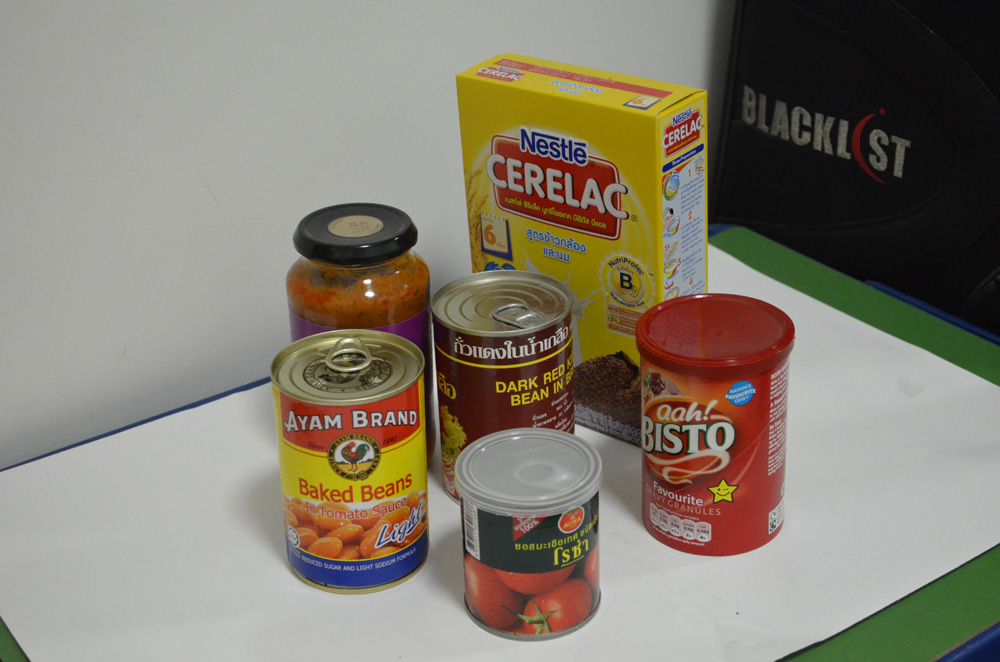
I originally wanted to do this exercise as quickly and as simply as possible, but then turned into something that I needed, a practise for using different medium.
DSC_0359
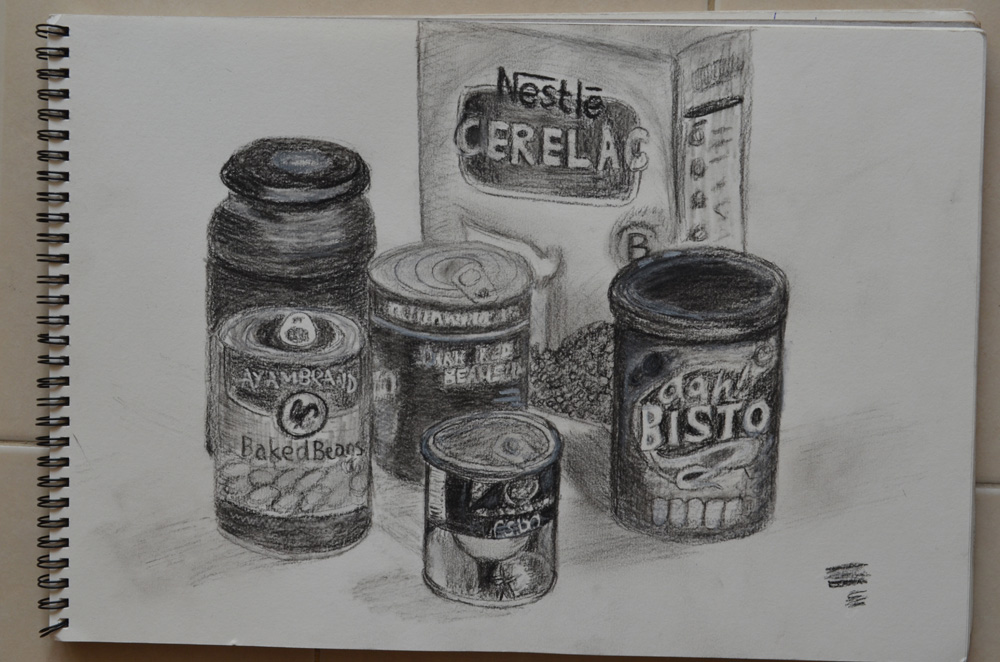
I did a practise drawing in charcoal pencil rather than graphite, I probably should have sketched it out in pencil first to see if it fit on the paper as I lost the top of the box of baby food but it felt good to do something completely in charcoal.
1st rawing with charcoal and Pencil
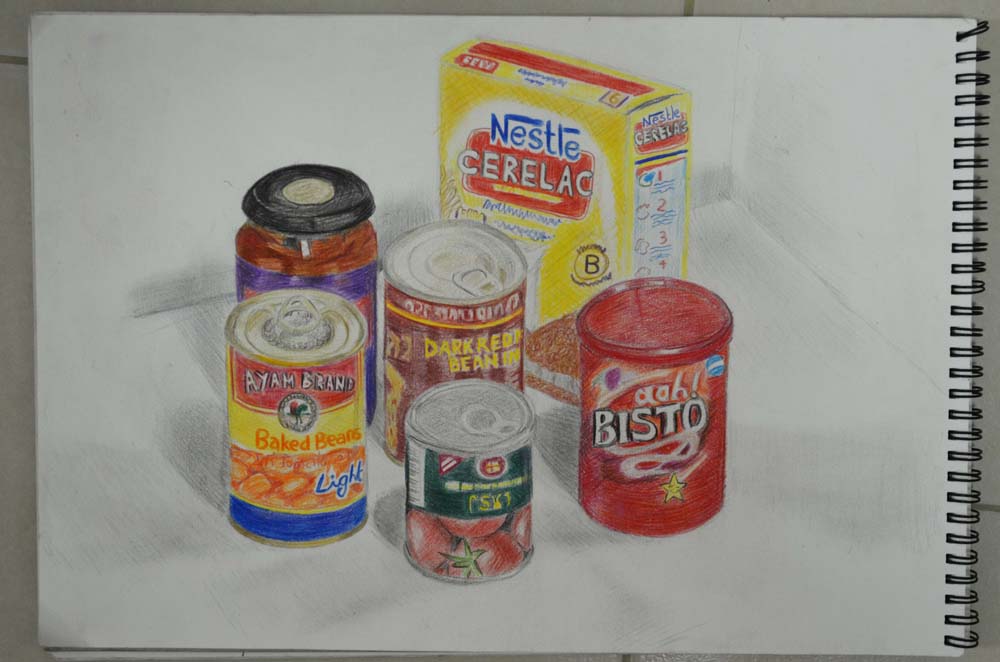
I wanted to produce the finish drawing in watercolour pencil, but I needed to get work up some confidence as I had never used watercolour pencils before so did an initial drawing in ordinary colour pencils, and I'm glad I did as it taught me a few crucial lessons.
1. I would never buy any drawing tools made in Thailand again, the leads kept breaking.
2. Next time I produce a colour pencil drawing to use paper with less tooth, rough paper is hard for blending.
3. Place objects at the best angles so I don't have to spend hours producing every bit of detail.
4. Read the exercises in the course materials properly. Most of these objects were cylinders with only 1 box and no packets.
2nd Drawing Colour Pencil
After completing the colour pencil drawing which wasn't great as I left a lot of text out off the objects plus the tin in the the middle was too light (the rough paper making it hard to blend) I went to do a bit of shopping. This time I purchased Faber Castell watercolour pencils not trusting the Masterart ones I had in the drawer and some A3 watercolour paper.
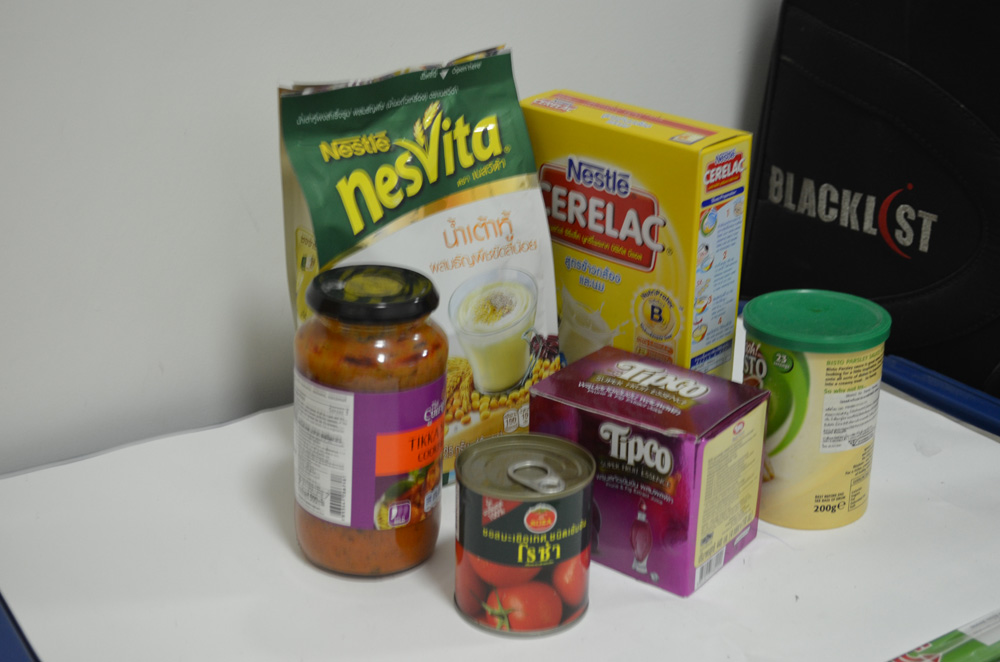
DSC_0384
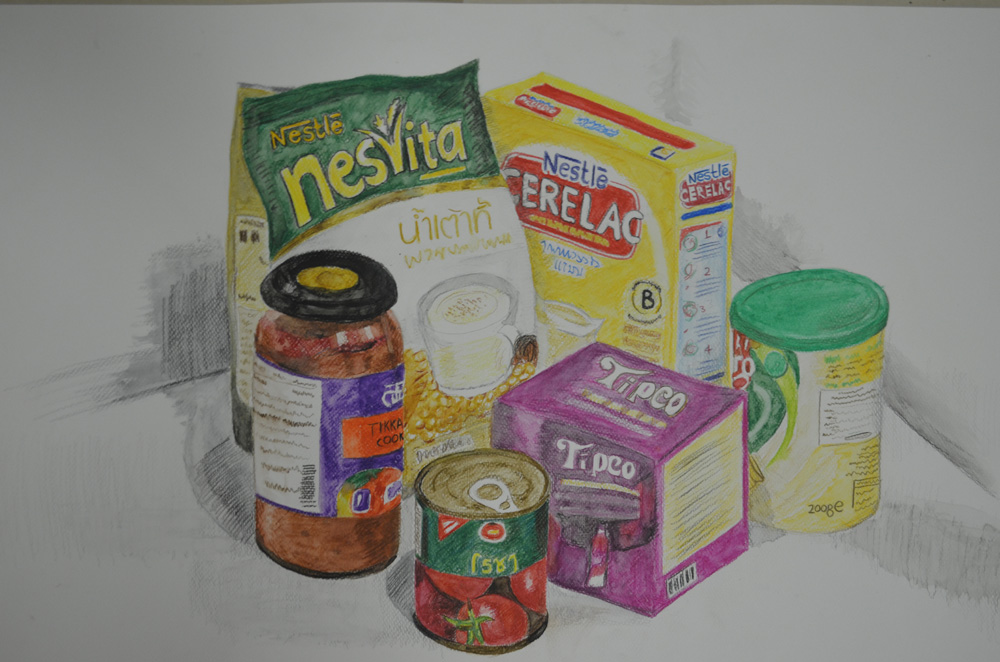
I changed a few objects, I had to use the gravy for Sunday dinner so swapped that for parsley sauce, swapped the tin for a big bag of Nesvita cereal drinks, took the plastic lid off the Rosa tin and swapped the baked beans for a bag of Tipco something or other that the school director gave me for Christmas.
3rd drawing watercolour pencil on watercolour paper
I've never used watercolour pencils or watercolour paper before so instead of spending hours trying to learn how to use them through trial and error I jumped onto YouTube to have a look at a couple of videos.
However once I started the exercise I learnt some more valuable lessons:
1. This probably want the best medium for this exercise with all the writing on the boxes.
2. I probably should have used a heavier paper, the 190 I was using begun to warp like mad.
3. The video was not enough I should have practised before doing this exercise.
Even though I did not rush through this exercise (it took a good few hours split up over a couple of days) the final drawing in my eyes looks a complete mess due to the very reflective purple box in the middle that made me lose my rag. However I am happy that I allowed myself the chance to start using watercolour pencils and to be honest for the first drawing ever with this medium, I don't think I did too bad even though it does looks better without my glasses and my eyes squinted.
Overall the shapes were fine, the shapes between the objects were pretty much perfect and there is depth there so in that respect I was successful.

View my official learning log for Drawing 1 at: http://www.mydrawingcourse.com