Showing posts with label Part 1. Show all posts

Sunday, 16 February 2014

Drawing 1, Part 1, Mark making and Tone, Enlarging an Image - Enlarging an Existing Image


For this exercise I drew a thumbnail drawing of my favourite coffee cup roughly 10 cm square in my small A5 sketchbook, which I’ve barely put to use so was good to fill a page or 2. Once I had finished the thumbnail drawing I drew a grid of 2 cm squares with an HB pencil over my thumbnail sketch.


Enlarging an existing image 1
Enlarging an existing image – A5 sketchbook
In my A4 sketchbook I drew 3 cm squares, deciding they were a perfect size for this object on this size paper, with a larger more detailed composition I would have probably needed smaller squares in both sketchbooks.
Enlarging an existing image - A4 Sketchbook
Enlarging an existing image – A4 Sketchbook
To make it easier for myself to identify which squares I would be drawing in I labelled the squares with letters down the left hand side and numbers across the top. However the drawing was quite low in my A5 sketchbook so in my A4 sketchbook I started at B instead of A lifting the drawing up 1 square.
Enlarging an existing image using grids
Enlarging an existing image – side by side
I loved this ‘Enlarging an Existing Image’ exercise, it was like piecing together a jigsaw puzzle but a hell of a lot easier and as the squares weren’t that big quite easy to judge where  a line curves or which point of the grid they would meet. Admittedly I did do a little bit of rubbing out with an eraser but not that much.

View My Drawing 1 learning log here www.mydrawingcourse.com

Drawing 1, Part 1, Mark making and Tone, Using Texture - A Drawing with Textures


For this exercise I was determined to get outside and draw so I took a few objects with different surfaces  onto the balcony and tried them in different compositions. Originally I planned to use objects that I used in the ‘Experimenting with Texture‘ exercise and what I had in mind was a reel of red and white string, a Siamese football, a mesh dishcloth, mop mitten and a teddy bear so moved them around in different composition to see how they looked. After much thought I headed down to the shop to buy some money type bags and cotton wool and came up with the following composition.


A Drawing with Textures - Composition
A Drawing with Textures – Composition
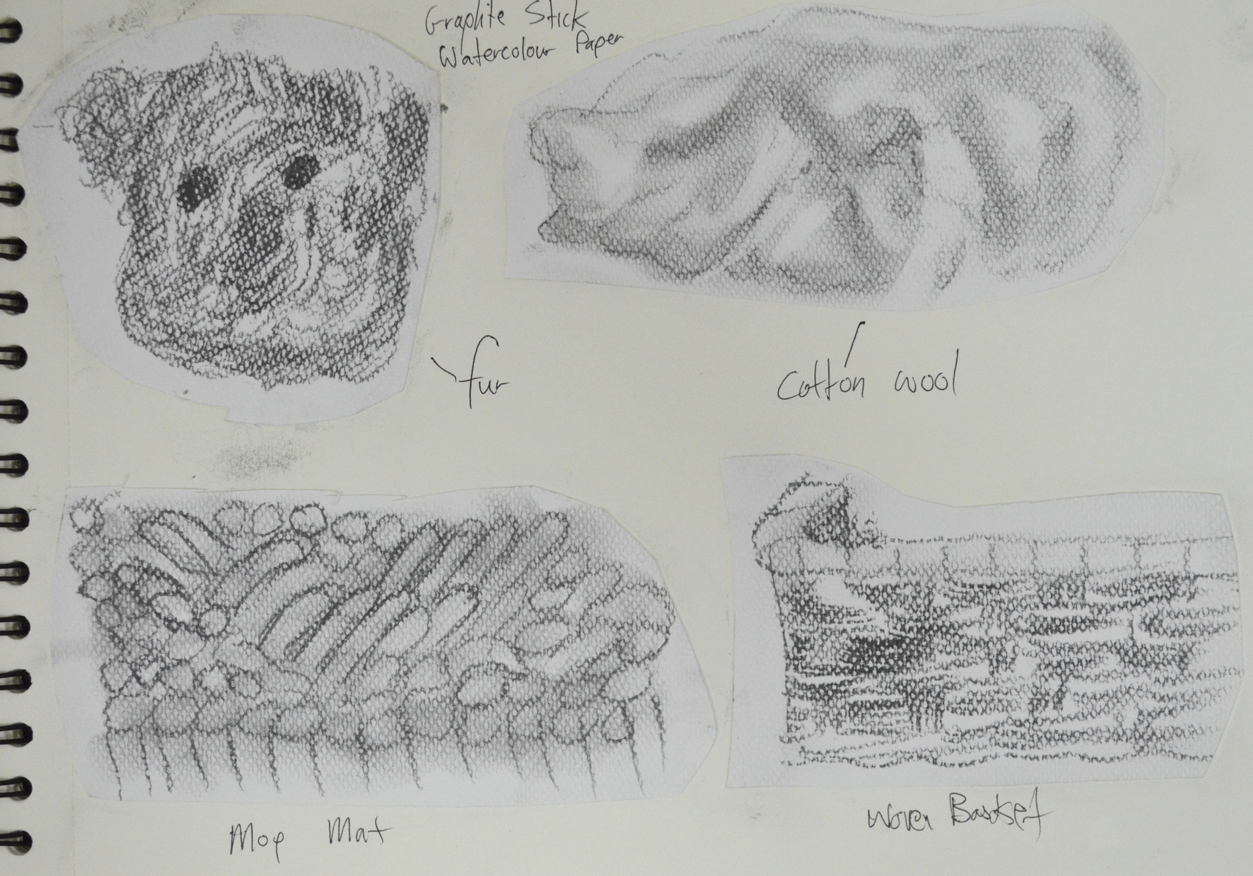
Because of the texture of the mop mat I chose graphite stick on watercolour paper to complete this exercise and started out with some more experimenting to see how each object would look.
More experimenting with textures
I must have not been myself that day because I did a quick sketch of each objects texture with a soft graphite stick and thought everything looked great so grabbed my drawing board and went ahead with the drawing.
Drawing with Textures - first drawing
Drawing with Textures – first drawing
I wasn’t too worried about perspective as it was about depicting the texture rather than anything else. The drawing took me no time at all and when I had finished I packed up, confident that I had done great. I must have been in some kind of trance because when I woke up the next day I looked at again and realised not only did the drawing look awful but was too smudged and I had done a bad job in depicting any texture that was in the composition apart from the woven basket. So I made the decision to change the medium and the paper and  start again.
a Drawing with Textures - Second Drawing
a Drawing with Textures – Second Drawing
This time I did something I had never done before, instead of drawing everything first and then going over it again with texture and detail the only thing I drew in advance was the shape of the bears head and completed the rest of the picture stroke by stroke, The drawing took me quite a few hours and due to not drawing the outlines of the objects first the perspective was off but again I wasn’t too worried about the perspective.
Medium used: graphite pencil - b, hb, 2b, 4b, 7b and white hard pastel
Paper: A3 Canson drawing paper
Technique used:
  • Teddy Bear – Small flowing hatching
  • Bears clothes – cross hatching
  • Woven Basket – hatching, smudging
  • Mop Mat – loops, circles, smudging, putty rubber (twisting)
  • Cotton wool balls – hatching, smudging
  • Cotton wool in plastic bag – putty rubber (twisting and erasing lines) and hatching
I changed the length of the mat as it did get a bit tedious but I am happy I got to show the depth of the mat, my only regrets are 1, that I didn’t get to do the drawing in a different medium such as pen and 2, I didn’t leave the cotton wool in the plastic bag the colour of the paper instead of trying to use a white medium which got a bit messy as I tried a few on the actual drawing before using fixative and going over in white pastel which still looks cream.
to see mnore of my work visit markasmithoca.wordpress.com

Drawing 1, Part 1, Mark Making and Tone, Using Texture, Experimenting with Texture part B – Frottage


The technique of Frottage was invented by Max Ernst in 1925 and involves placing paper over a rough surface such as grained wood and rubbing with a crayon or pencil. In this exercise I experimented with the technique of Frottage (which I always thought was just called rubbing) to see what kind of patterns and textures rubbing over certain surfaces gave me.


Up until this exercise I had done all of the coursework in my apartment and most of it at night, due to early evenings and work finishing times, this was a great opportunity to get outside and do something in the daylight.
Armed with charcoal and pencils I headed out to the swimming pool to experiment on tree bark, stone-chip floors and wooden sun chairs only to find that the paper in my new sketchbook was too thick or too rough and it wasn’t giving me any patterns/texture whatsoever.
It was another day before I finally got going on this exercise or should I say the next evening (fated to working at night) I took some pages out of my small sketch book, a white paper with less tooth and started with charcoal.
Experimenting with Frottage - Charcoal
Experimenting with Frottage – Charcoal
I tried the technique on stone chip floor, my apartment door, floor and even the draining board and then again with different colour crayons before heading downstairs to the lobby,
Experimenting with Frottage - Crayon
Experimenting with Frottage – Crayon
Unfortunately the bark of the trees outside did not give me good results which was both surprising and disappointing and down to the bark being very smooth (difficult to find great trees in Thailand). I did get some nice rubbings off other surfaces though including the joint of a breeze block wall, which looking at it now resembles a crucifix in the sunshine but the best results using both charcoal and coloured crayon were got from the grain of the wooden door of my apartment with different panels giving me different patterns.
View My Drawing 1 learning log here www.mydrawingcourse.com

Drawing 1, Part 1, Mark making and Tone, Using Texture, Experimenting with Texture – Part A


In this exercise I gathered together a a range of objects with different surfaces, some I bought and some I already had. The objects that I used were a takraw (Siamese football), shaggy teddy bear, a towel, mop mitten and  Scotch-Brite brillow sponge as well as a woven basket, PVC chair, wire wool, toilet roll and leather Lay-Z-Boy (not the whole thing) plus a couple of other different surfaces.


Experimenting with Texture 1
In my sketchbook I made a series of approximately 5 cm squares and used both pens and pencils to depict the textures in the squares. To depict the surfaces I used several different techniques such as hatching (takraw ball), irregular hatching squiggles and stippling (Scotch-Brite sponge) and very short hatching (towel) as well as some very irregular marks for my leather look PVC chair and the creases in the arms of my Lay-Z-Boy armchair. I also tried stippling with felt tips for a toilet roll tube but I could not get it to look anything like.
Experimenting with Texture 2
One surface that created something of a challenge was the shaggy teddy bear fur and so I chose this as well as the woven basket for the exercise ‘A Drawing with Textures’.

View My Drawing 1 learning log here www.mydrawingcourse.com

Drawing 1, Part 1, Mark Making and Tone, Still Life - Observing Negative Space and Perspective

This exercise of observing negative space and perspective involved following the silhouette of a group of objects that shared similar elements with a soft drawing tool such as soft pencil without taking it off the paper.
I drew in from the left using the furthest edge of the table as a starting point and followed the upper silhouette of the objects carefully assessing the silhouette and proportions of each object and changing the direction of the line as the silhouette of one object impacted off another.
Then I went back to my original starting point and followed the line until it reached the first object again then followed the bottom silhouette of the objects following the same steps as the top half. When the bottom half of the silhouette was complete I went back and drew in the details of the objects themselves.
Observing Negative Space and Perspective  1
Observing Negative Space and Perspective 1st Attempt
I used a 6B pencil for this exercise as I am still waiting for Derwent to send me replacements for my 7, 8 and 9B. I found the exercise quite difficult and frankly one that I should keep having ago at from time to time.
Observing Negative Space and Perspective 2
Observing Negative Space and Perspective 2nd Attempt
I made a few attempts without taking my pencil off the paper and I was actually very surprised when I drew the bottom silhouette and the objects looked something similar to what they did in my composition. There were a few errors in each of my attempts, vase to wide (starting to draw it too early and the bowl to narrow and the jar on the right hand side was quite wonky in each of my attempts, but the negative space between each object was the correct shape just not always the right size.
observing-negative-space 3
Observing Negative Space and Perspective Attempt 3 and 4
Like I said earlier it is an exercise that I think I will gain a lot from and should practice from time to time, I also like the way that I arranged the objects and would like to do a similar still life using a similar composition, this exercise maybe a great starting point for that still life.

View My Drawing 1 learning log here www.mydrawingcourse.com

Wednesday, 24 April 2013

Drawing 1, Part 1, Mark Making and Tone, Still Life - Composition of Natural Objects


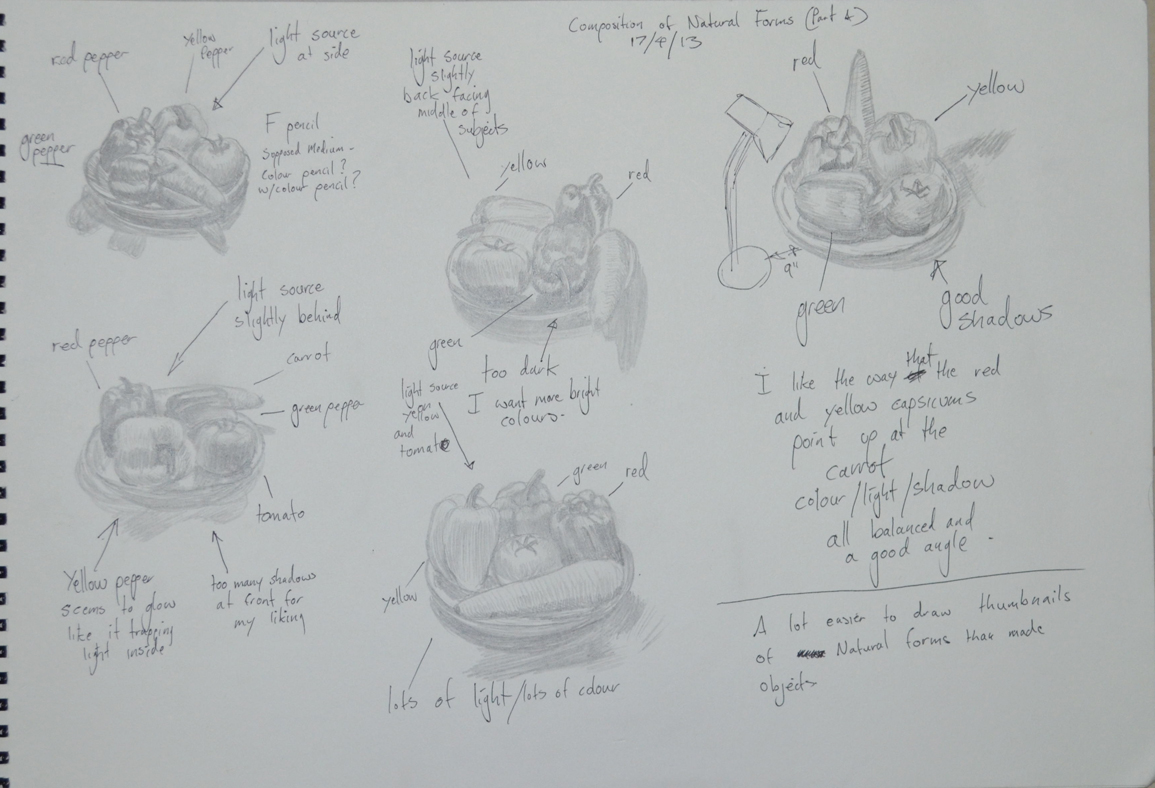
The brief for this exercise was to 'Make a selection of natural objects for my composition, such as fruit or vegetables on a plate, and explore the different viewpoints by moving all the objects around in different arrangements and assessing which set up I like best. In my sketchbook, make quick sketches of each different set-up before moving the objects about again.'
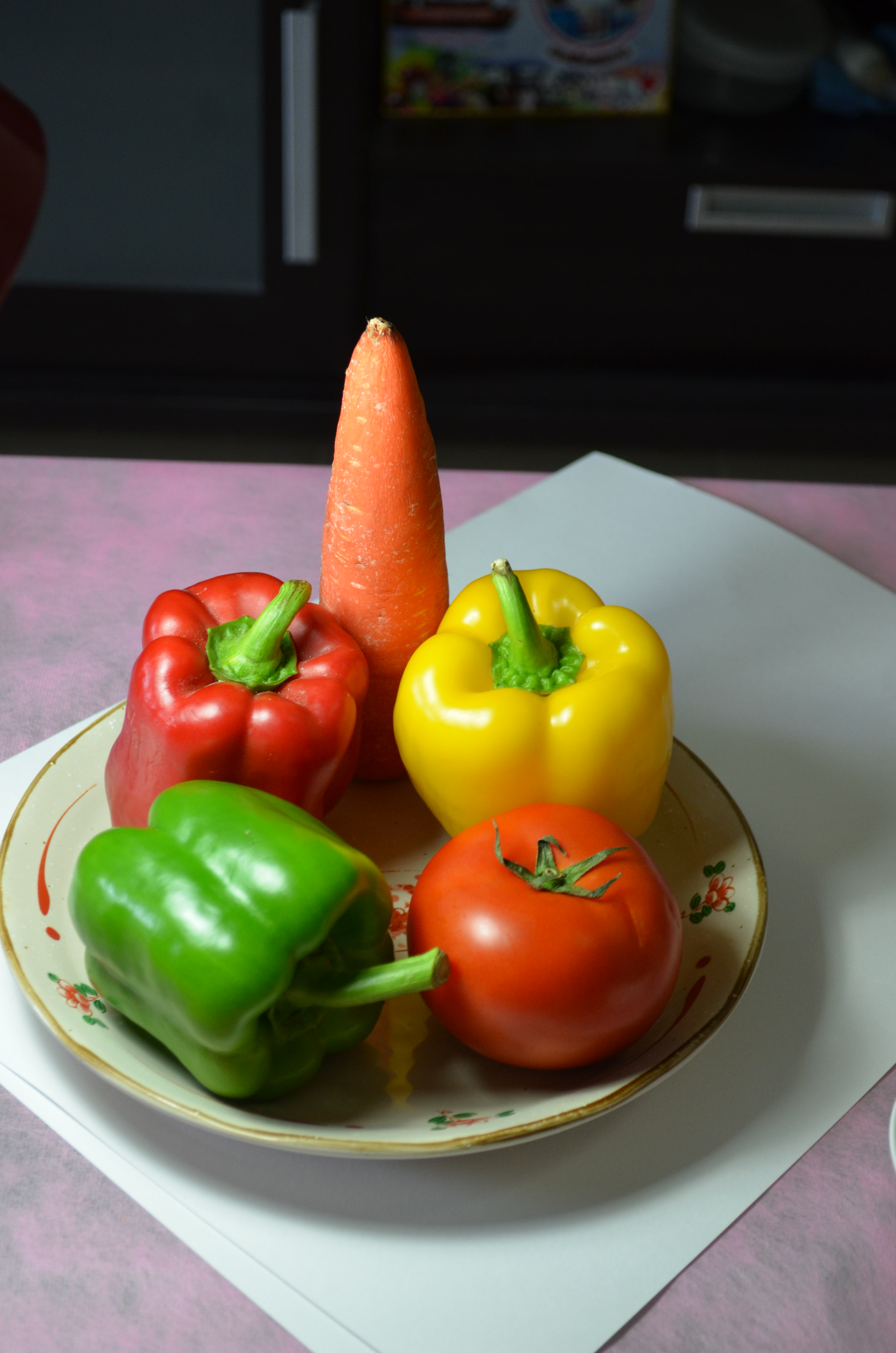
I found making quick sketches of the natural objects a lot easier than making thumbnail sketches of 'made objects' in the previous exercise and started out with a good feeling that the exercise would go well. I chose vegetables for my composition which were a red yellow and green capsicum, a tomato and a carrot.
Still Life Composition of Natural Forms
Thumbnail Sketches of Compositions of Natural Forms
I thought about the best place to position myself in relation to the objects and positioned myself slightly above. This was also more comfortable as I had bruised a rib after a fall during the Thai new year festivities (Songkran) a couple of days before, so I propped myself up with a couple of pillows, I couldn't complain though as it did give me a good view of all the vegetables.
The brief for the second part of the exercise was to 'Use the information collated in my sketchbook along with written notes from previous exercises to make an informed decision about the organisation of my still life drawing. This would help me to clear my mind and give a sense of order to my work.'
As always due to doing most of my work over different times of day and especially in the evening I worked with a bendy light as a light source, making sure it cast adequate light and shade onto the still life.
still life natural forms 2
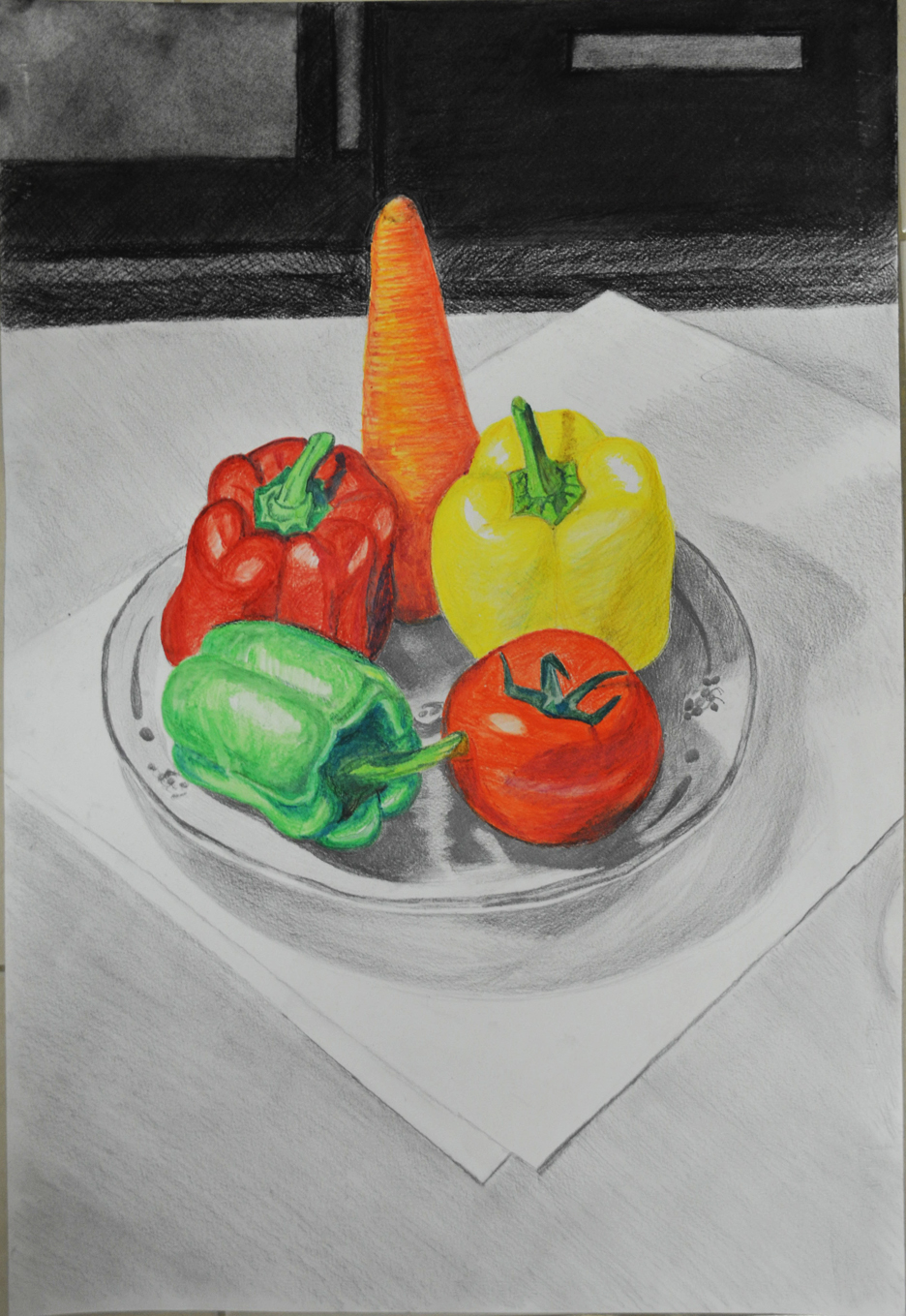
  • Mediums used - Watercolor pencil, 2B, 4B, 8B, EE graphite pencil, charcoal, Conté pencil
  • Paper - A3 Canson Watercolor pencil 190 gsm
  • Time taken - 10+ hours
I wanted to get more practice with watercolor pencils and so I initially chose to do this exercise completely in watercolor pencil and so the only size sheets I had were A3 which I bought for the 'Supermarket Shop' exercise. However the problem was the composition I chose meant that I had to use the paper length ways but I wanted to get the whole of the plate into the finished drawing with the shadow that it cast and so I knew in advance it would leave a lot of negative space on the paper. Placing another folded sheet of paper under the composition helped me fill up the negative space and I decided that I would also use the TV unit in the background as the background.
I made a very poor first attempt at the still life completely in watercolor pencil, it set me back a good few hours and did not put me in the best of moods but did teach me some valuable lessons.
  1. I did not have enough practice with this medium to get it perfect.
  2. Blending colours with this medium was more difficult than I thought.
  3. You can't erase watercolor pencil once it's in paint form and if you try there's a risk of ripping the paper!
I decided that my next attempt at this exercise would be a great chance to produce my first mix medium drawing and if I couldn't perfect the colour, shadow and light of the vegetables I would do my best  and then really make the composition stand out by the drawing everything else in graphite pencil.
On my first attempt at this exercise I started out sketching the dark parts of the vegetables in watercolor pencil first but on the second attempt I started with the lighter colours, although the second attempt was easier and looked better I have yet to perfect my technique.
When it to the lighter shadows in the drawing I took it very slow, using the pencil very lightly and holding it at the end and letting it almost dangle, only occasionally did I have to resort to blending with my finger. For the darker shadows on the plate I used 4B and 8B pencil.
All was going well until it came to the  background objects, my 7B, 8B and 9B pencil kept snapping so after an email to Derwent to complain about the quality of pencils in their 24 graphite pack I continued with an EE pencil. I found the EE pencil no replacement for the 9B pencil and was hard to produce different tones so I finished the background off in Conté pencil and charcoal.
Still Life Composition of Natural Objects
I was a bit disheartened at times after starting off so well, especially having discovered that I drew the composition in my second try on the the wrong side of the paper thinking they were the same. Luckily enough it turned out to my advantage as it was easier to draw in graphite and the paper did not warp as much when wet plus the colours seemed to be a lot brighter when they bled.
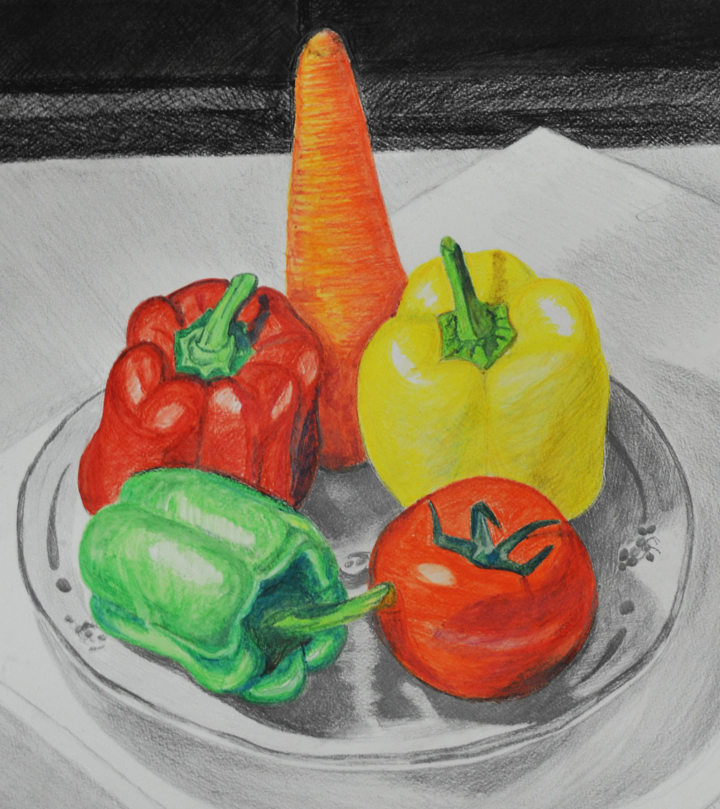
I was also a bit upset that I had to use more than two mediums in this drawing and found it frustrating when things kept breaking. The end result of the watercolor pencils is not what I had in mind but I thought the contrast between the colour and the graphite pencil was excellent.
Composition of Natural Forms - close up
The good news is Derwent did get back to me and admitted there was a problem with the old batch of graphic pencils and are sending me replacement 7B, 8B and 9B pencils.

View My Drawing 1 learning log here www.mydrawingcourse.com

Drawng 1, Part 1, Mark Making and Tone, Still life, Still Life Sketches of Made Objects


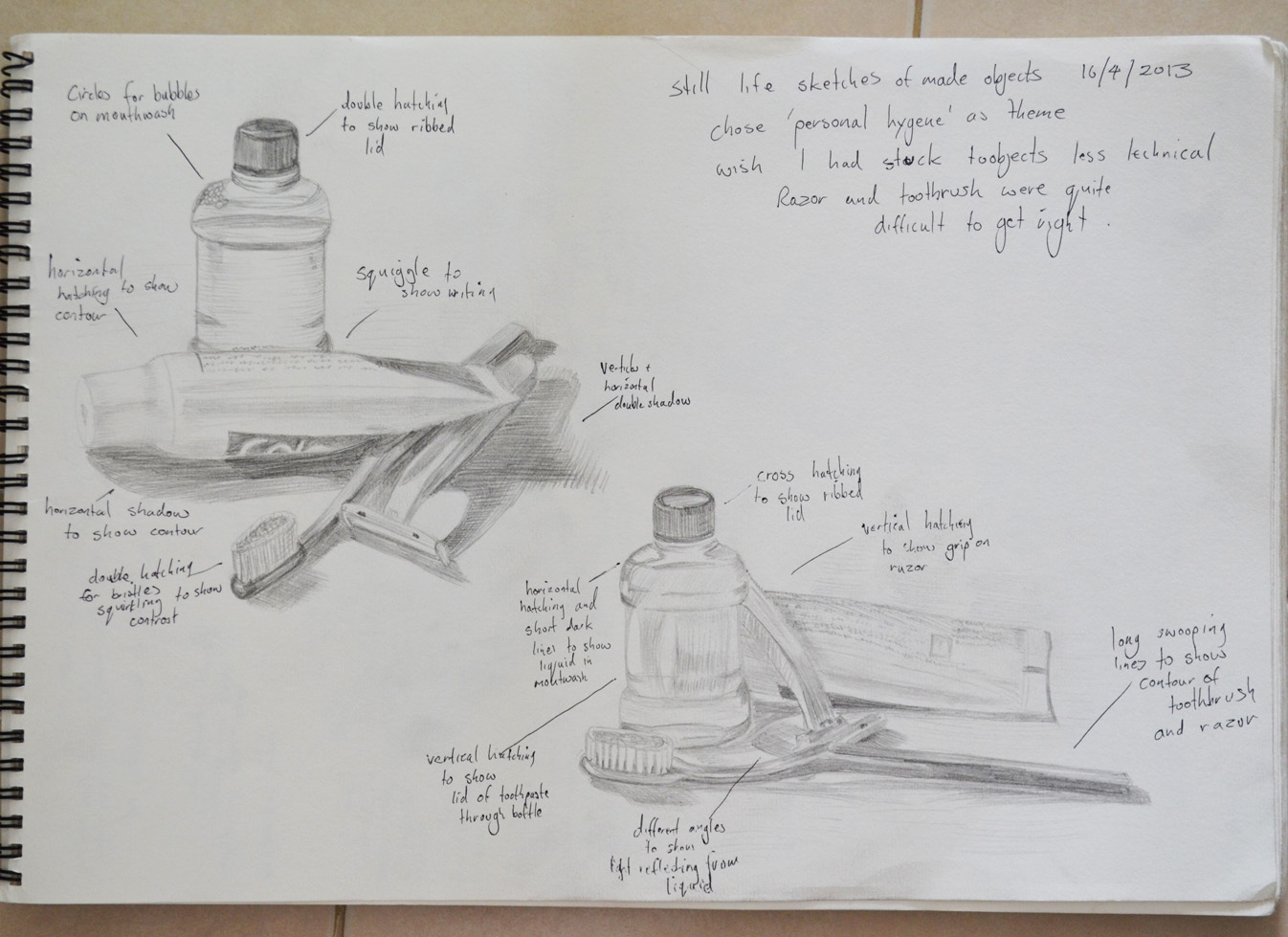
The aim of this exercise was to create a small still life composition from a small themed selection of made objects, of which I chose personal hygiene as my theme and the objects that I chose were, a tube of toothpaste, a toothbrush, a Bic Razor and a bottle of mouthwash.
Then with a pen, pencil, or ballpoint use a technique such as hatching. I used a 3H and a HB pencil (to show the darker shadows).
Then I had to draw two or three thumbnail sketches in my sketchbook of different arrangements from different view points, using my light source to help create strong lights and dark shadows on the surfaces of the objects. I had to include tonal values to indicate form in my sketches as well as shadows seeing as they can also play an important part of a still life composition.
Then I was to make notes on or around my sketches about the technique I used and why I had used it. And make notes on anything else I felt was important.
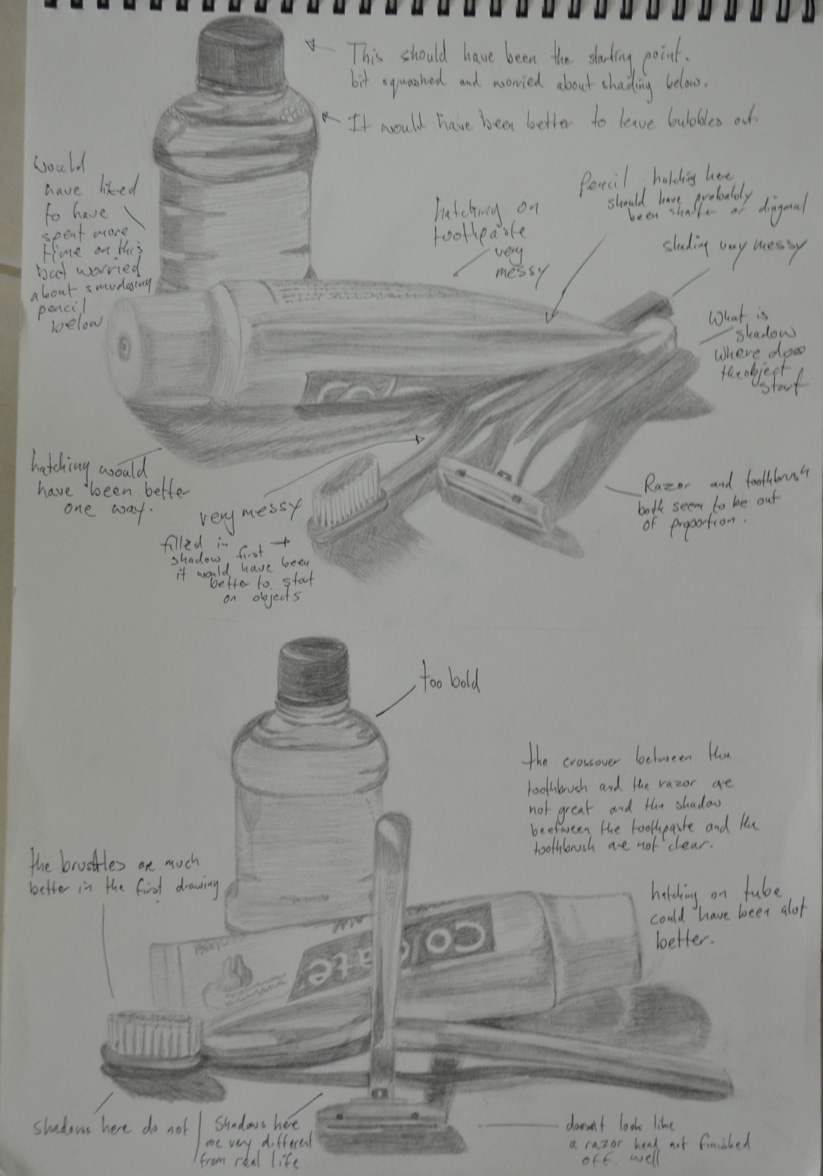
I did two initial drawings that I have to admit were not exactly thumbnail size, I think this was down to miscalculating proportions of the first objects I started on in each composition and then having to keep up proportions,
exercise: still life of man made objects
First attempt at this exercise
In the first drawing I started on the toothpaste tube as I always end up working clockwise, I think this is force of habit. However, because of this I misjudged how much paper I would need for the mouthwash so squashed the lid to fit the rest in; so when I came to the second drawing I worked from  the mouthwash down.
On the first attempt I forgot what I was instructed to do in the exercise. Instead of writing down about the techniques I used I totally ripped the sketches apart fault by fault, only actually remembering what I was supposed to do after I took the photo to upload to my working log. I decided to do the exercise again and this time do it right.
In my second attempt I scaled the drawings down and was less worried about every detail. My hatching technique also seemed to improve a lot in my second attempt, using a variation of cross, vertical and horizontal hatching as well as swooping lines to follow the contours of certain objects.
exercise 2 still life of made objects
Second Attempt at this exercise was much better
This exercise was probably the first time that I made no attempt of smudging in the pencil lines instead I practiced the pencil holding techniques I used earlier in this course, from the tip, from the end etc...
The hardest thing to draw in the composition were the toothbrush and razor and I felt like abandoning the objects and using something easier to draw but stuck at it and did a reasonably good attempt at getting proportions and details right all 4 times

You can visit the learning log that my tutors see right here http://www.mydrawingcourse.com 
Thursday, 4 April 2013

Drawing 1, Part 1, Mark Making and Tone, Reflected Light - 2 Shadows and Reflected Light and Shade


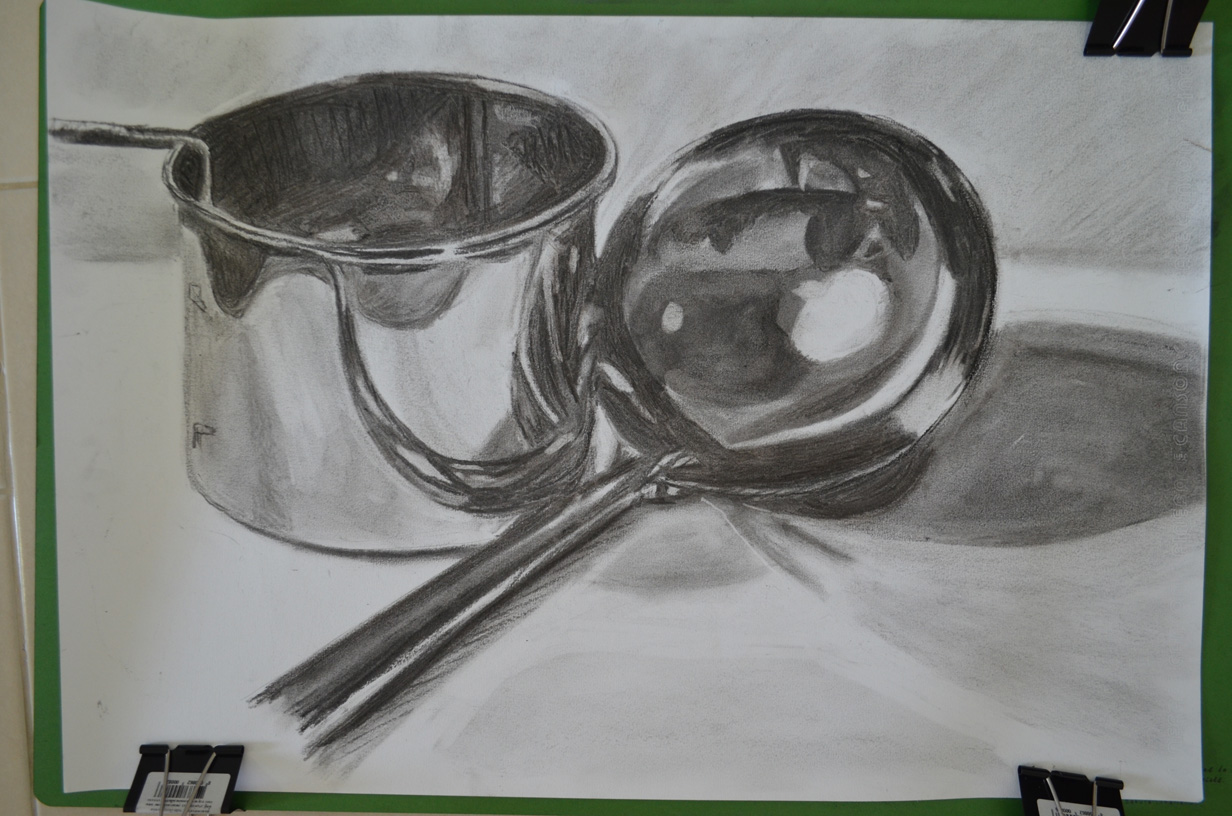
In this exercise I was instructed to 'Use charcoal, a putty rubber and pick two objects with shiny reflective surfaces. Decide on the size of the composition, use A1 or A2 paper so that you can do bold strokes. Try to fill the paper with your objects showing the reflected light and shade of one object falling on another and try to leave very little background space.'
Shadows and Reflective LIght and Shade
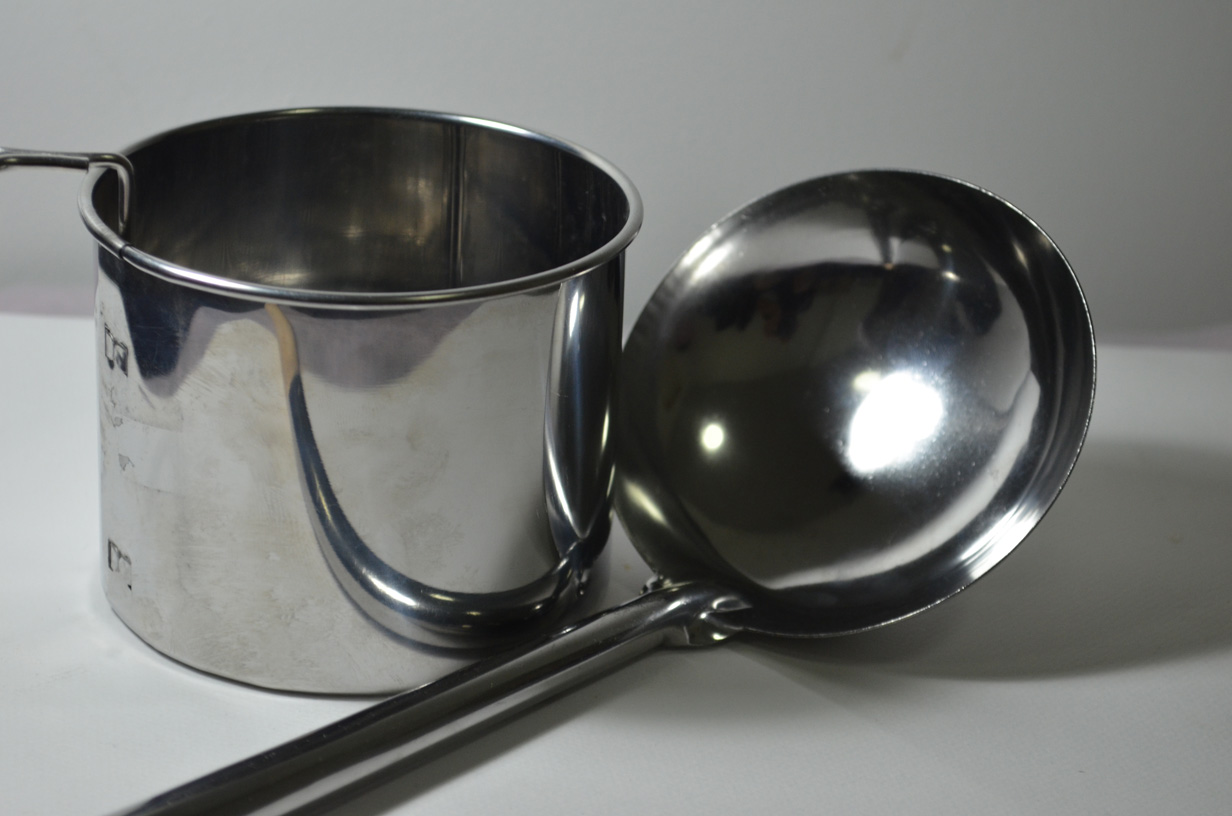
Photo of Chosen Objects, Sieve and Ladle
I went out and purchased a few objects specifically for this exercise, after putting them together in pairs to see how they reflected off each other I settled for what I think is some kind of sieve and a ladle. I chose A2 for the composition because my drawing board wasn't big so an A1 size drawing board will be my next purchase. The brief said to leave very little background but I wanted to show some of the handle of the ladle and the shadow that it cast but to be honest I could have shown a lot less and made the objects bigger.
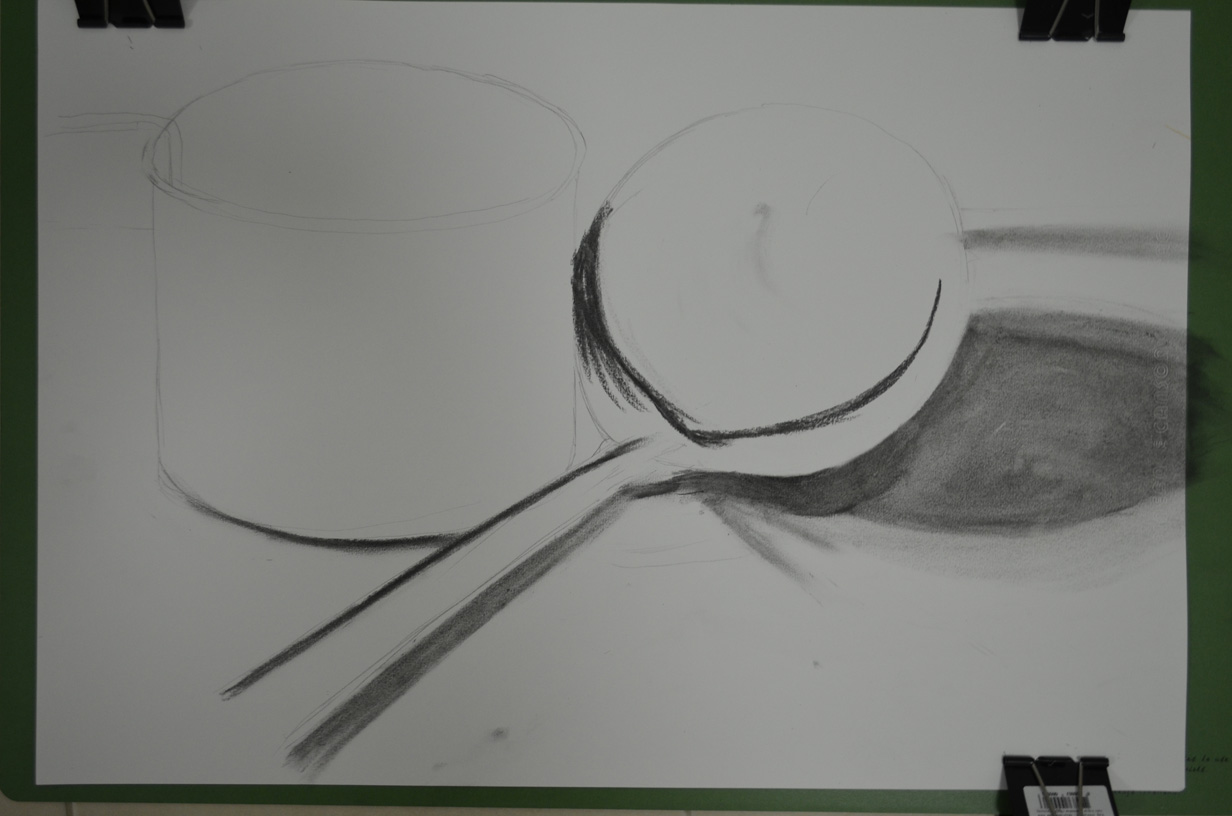
Drawing Pattern of Shadow with Charcoal
Drawing Pattern of Shadow
I sketched an outline with an H3 pencil then as instructed I drew the basic pattern of shadow first with sweeps of charcoal. I did try hatching but the charcoal seemed to leave too darker marks on the paper even trying the charcoal at different angles, this may have been down to the smoothness of the Carson paper that I used.
I tried to stay away from smudging the charcoal as it said nothing about it in the brief but when I did resort to smudging my finger took too much off so I used a stump that I forgot I had. It was great for smudging the charcoal without taking too much off as well as drawing solid outlines. I think if I had used A1 sized paper I could have probably had a better chance of completing the drawing using hatching.
Finished Drawing, Shadows and Reflective Light and Shade
I did start off with the darker tones on the ladle but just on the inner shadows to make sure I was drawing the correct shape (hopefully in time I'll get more confident with charcoal) and then once everything was fine I switched to the mid tones and then built up to the darker tones.
For the lightest tones and the light reflected from the bendy lamp I used a putty rubber to erase the charcoal. I bought a couple of Conte  knead-able erasers which were much better quality than the ones I bought when starting off the course which stuck to everything in the Bangkok heat and left debris on the paper.
I enjoyed the exercise and proud of the result but I am still lacking the confidence with charcoal. I seem to still have a lot more to know about the different types of charcoal, if time allowed I would have liked to have done this again on an A1 sheet of paper to see if I can do the whole exercise without smudging.
View my learning full drawing 1 learning log at: http://www.mydrawingcourse.com/

Drawing 1,Part 1, Mark Making and Tone, Reflected Light, Study of Light Reflected from one Object to Another


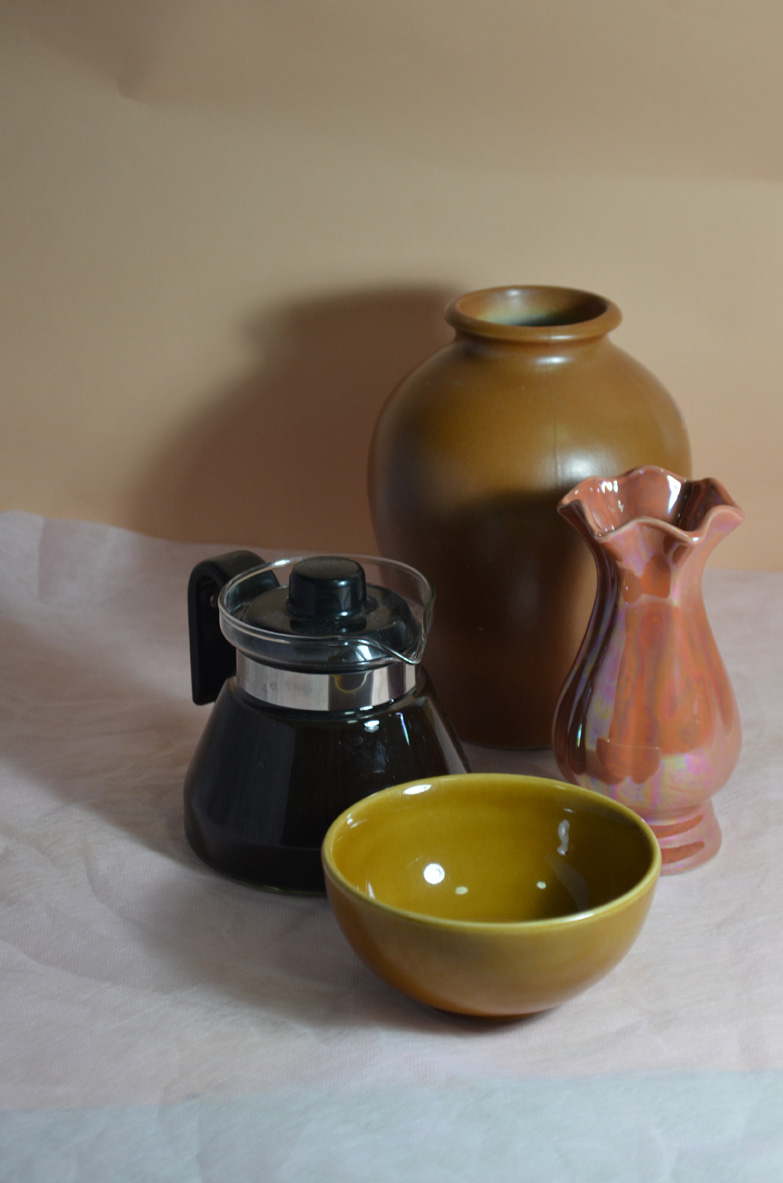
The brief was to 'Arrange two three objects ,  at least one of which has a shiny reflective surface, side by side with a small space in between them. Place a light source so that it is to one side of your (two) objects to cast clear shadows. Sit so that you can easily see the shadow on one side of the objects and the light on the other'.
Objects with Coloured Paper Background
The first sentence said two or three and the second paragraph said two but the example students drawing had quite a few objects so I want for four, which were a ceramic bowl, a pearlescent vase, a Chinese style vase and a glass teapot. The glass teapot had a chrome band around it but it didn't cover a large area so I filled it up with a very strong black coffee in order to make the glass more reflective
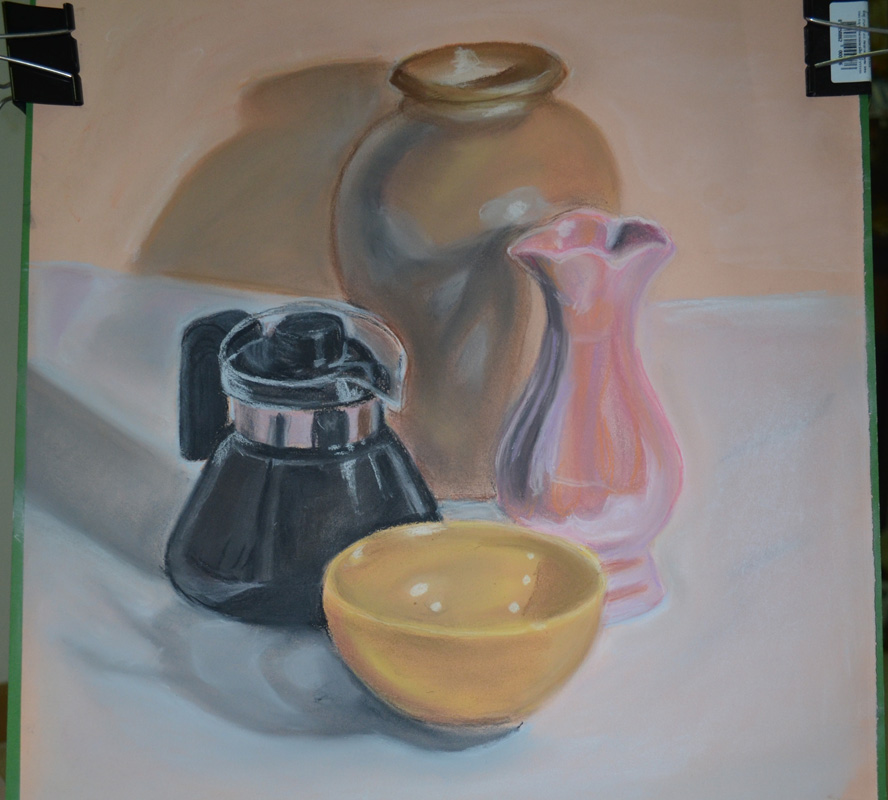
The sample student drawing was on coloured paper which gave me an idea, so I bought some large sheets of orange coloured paper and set one as the background and did the drawing on the other. The medium I chose for this exercise was hard pastel by Cretacolor, I had never drawn with hard pastel before and this was the perfect chance to lose my virginity.
I was instructed to draw the main shadow pattern created by the light source first then add the reflective light and shadow patterns to the drawing. I followed the instructions drawing it in graphite pencil first as I knew that when it came to add the shadow patterns and reflective light with the hard pastel I would have to work on an object at a time due to how much work blending in this medium needed especially on the coloured paper that I chose.
A Close up of my Finished Drawing in Hard Pastel
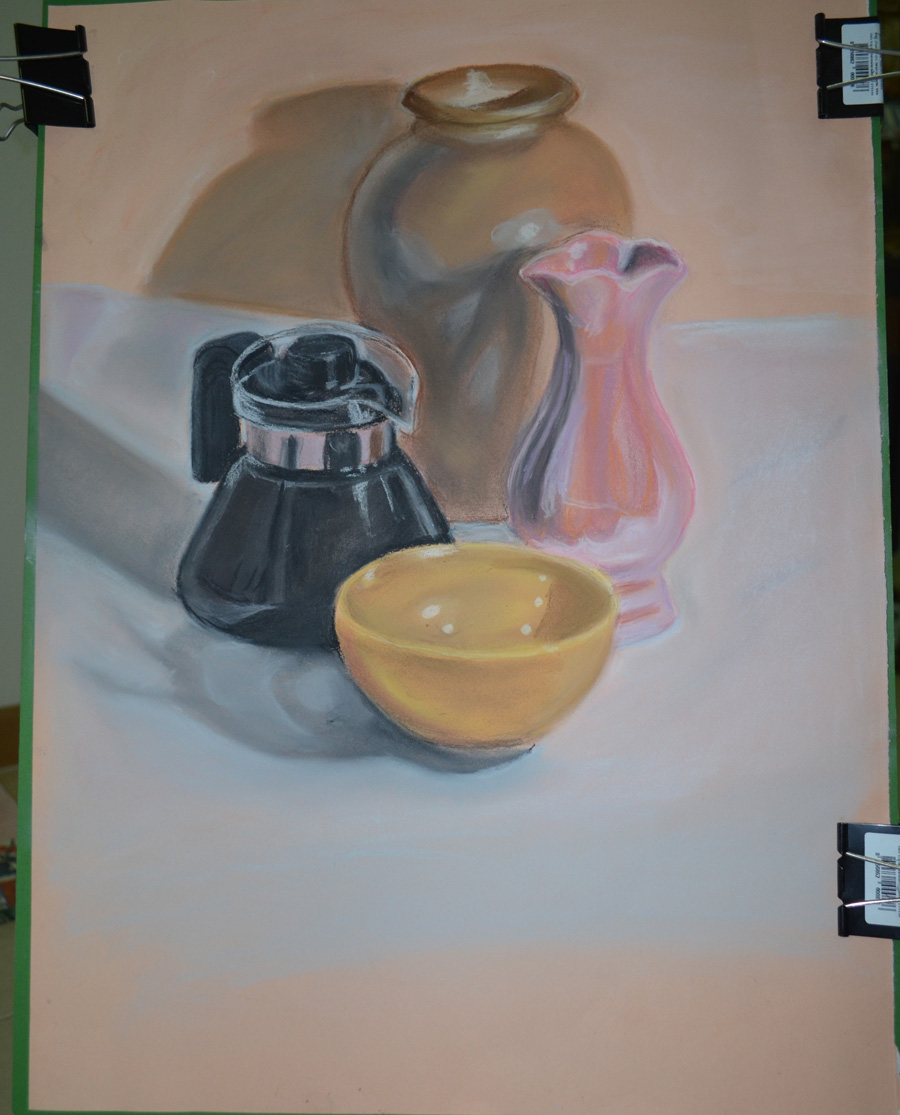
I found that I bit off more than I could chew and it took me about 6 hours to finish the exercise, and the colours on the objects in the drawing were quite different from real life, I find blending most mediums quite difficult and really need to spend more time experimenting before working on a piece.
Although happy with the finished drawing I feel I have let myself down and could have gone out of my way to find better objects that were more reflective, although the teapot reflected the colour of the other objects quite well over the small reflective area, the pearlescent vase also did quite a good job.
I could have also done a better job of positioning the objects on the paper which was approximately A3 with about a third of the paper gone to waste.
The valuable lessons that I have learnt from this are that I should choose my mediums and objects wisely and  to use more of the paper next time.
Bad Example of Paper Wastage
View my learning full drawing 1 learning log at: http://www.mydrawingcourse.com/

Drawing 1, Part 1, Mark making and Tone, basic Shapes and Fundamental Form, Research Point - Odilon Redon


Odilon Redon (April 20, 1840 - July 6, 1916), started drawing as a young boy, and was awarded a prize for drawing at school at the age of 10. At 15 years of age, at his father’s insistence, he took up formal architectural studies, but failed to pass his entrance exams at Paris ‘Ecole des Beaux-Arts (School of Fine Arts). On return to Bordeaux he took up sculpture, and also etching and lithography under the instruction of Rodolphe Bresdin.
Threw his early career he continued to work almost exclusively in black and white, in lithographs and charcoal drawings right into his 50s. These drawings became known as his Blacks ‘Les Noirs’. He developed an extremely unique repertoire of weird subjects such as strange creatures, insects and plants with human heads on; these subjects were often influenced by the writings of Edgar Allen Poe.
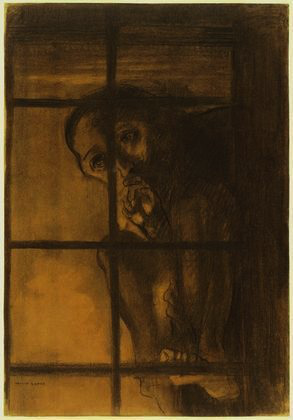
In 1975 he studied trees and the Underwood at Barbizon in North-Central France, the same year saw his Blacks reached the ‘Most distressed period’ with him often depicting the topic of prisoners in his works, appearing behind the bars of windows or isolated in a nightmare or hallucination. Has he said about his Noirs “They were executed in hours of sadness and pain”.
From the 1890s due to illness and a religious crisis which transformed into a happier person he began to use  pastels and oils, expressing himself with use of vibrant colour, creating works that depicted mythical scenes and flower paintings. Odilon abandoned his Noirs completely after 1900.
He always remained a fairly private person but the end of his life he became a rather distinguished figure with various awards and recognitions and was also regarded by the surrealists to be one of the forefathers of the surrealist movement (I was almost certain that it was going to say this in at least one of the online biographies as I began to look at his works.)
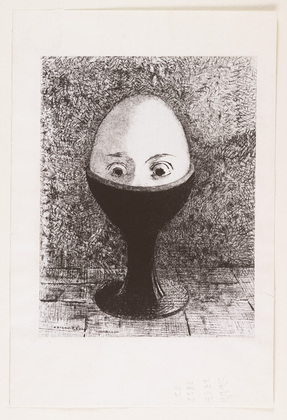
I had never heard of this artist until I was asked to research him but I’m glad I got the chance to do so. It was good to get a chance to see all his paintings side by side and to see how his works changed over the years, rollercoastering in and out of an often dominating dark mood until his change in mediums in the 1890s. I found a lot of his images disturbing and quite a lot of the hybrid characters made me feel uncomfortable like ‘The Egg’. However I was inspired by some of his darker works like ‘The Convict’; since my childhood I have often tried to put something similar down on paper but never got around to it.
The Egg, Odilon Redon 1885
I find a lot of his works interesting and could probably gain inspiration and ideas from them. Although I would find it hard to bare my emotions like he did, for all to see I quite often like to depict some of my innermost feelings and beliefs into my work and will continue to do so.
The Convict, Odilon Redon 1881
View my learning log at: http://mydrawingcourse.com/

,Drawing 1, Part 1, mark Making and Tone, Tone and Form – Check and Log


How difficult was it to distinguish light from the primary light source and secondary reflected light?
I was very aware of where the light was coming from on the first two drawings of the Johnsons baby Powder Bottle and Mug in the first exercise, and even clearer while working on the second sketch. There were other light sources in the room as I worked on them in the evening but still it was quite easy to tell, I think using the ceramic mug helped.
In the second exercise it was not so easy to tell but I did know what to look for so it helped; the easiest reflections to make out was the light reflecting from the ping  pong  ball on to the apple. But even though I knew  which light came from the primary source I wasn't quite sure where certain reflections of light on the mug were coming from. I could only guess.
How as awareness of light and shade affected your depiction of tone and form?
I could have gone my whole life missing certain reflections and shadows out, saying to myself ‘Yeah, that’ll do’, trying to copy as precisely as possible, thinking that’s enough. However, these two exercises have made me more aware of reflected light and I’m starting to piece together where the light in certain places is coming from, this has helped to make these drawings more realistic than anything I’ve done before so it’s something I will continue to observe.
View my learning full drawing 1 learning log at: http://www.mydrawingcourse.com/

Drawing 1, Part 1, Mark Making and Tone, Tone and Form - 2 Tonal Studies


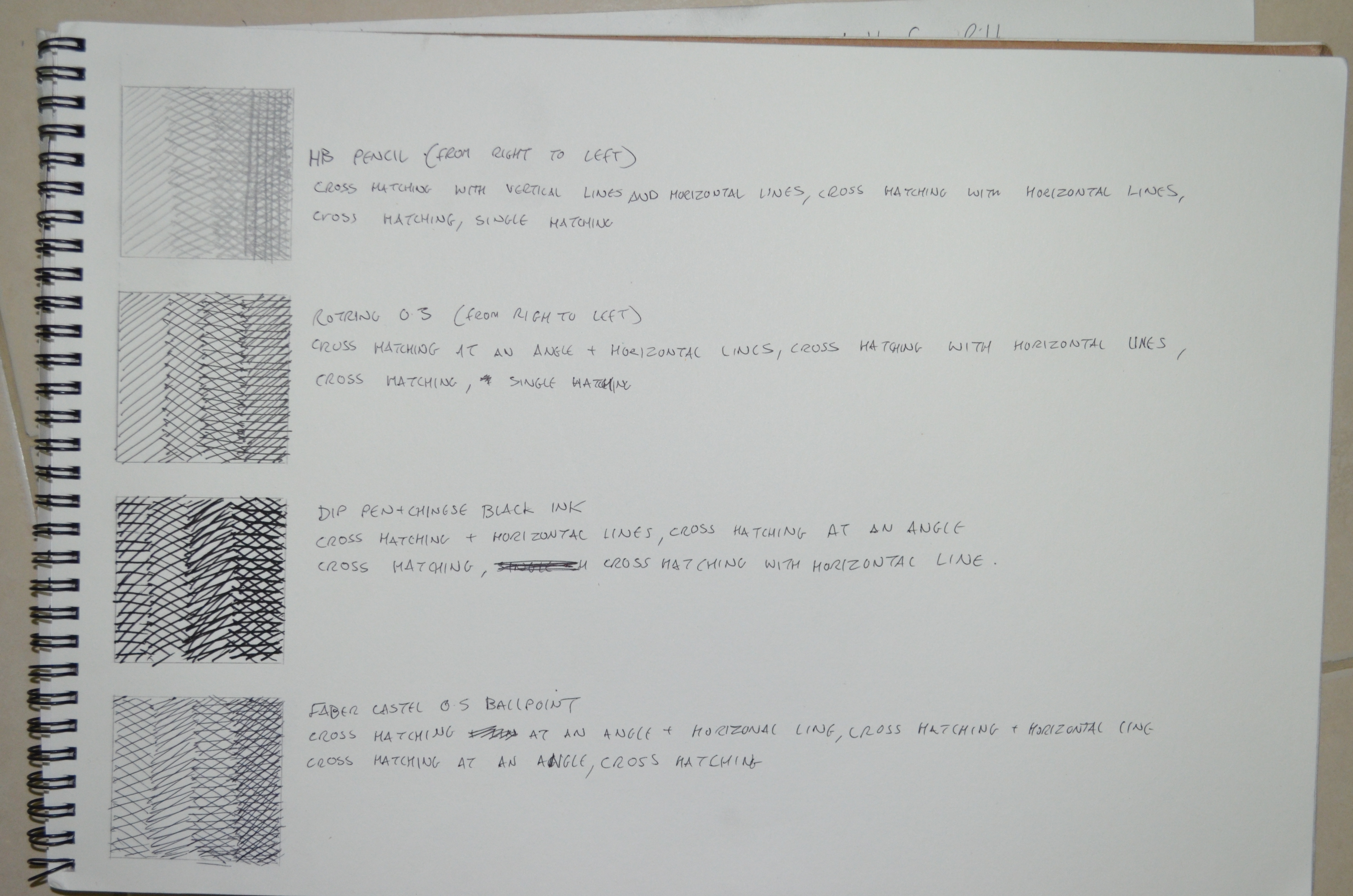
The brief of the first part of this exercise was to draw four 5 cm squares in my sketchbook using 4 different drawing tools such as a pencil, drawing pen, nib pen and black ink and a ballpoint pen. Try to make 4 distinctive grades of hatching with each square without paying too much attention to detail, suggesting that we have close our eyes as this will help eliminate most of the detail.
I totally read this wrong, drawing the squares in pencil and then hatching within the square using the 4 drawing tools that it gave as examples as above. I tried different types of hatching to do this including, cross hatching at an angle as well as using horizontal and vertical lines to give a much denser tone. The nip pen was probably the most difficult for me and couldn't quite graduate the tones.
Tone Using Hatching
Tone Using Hatching
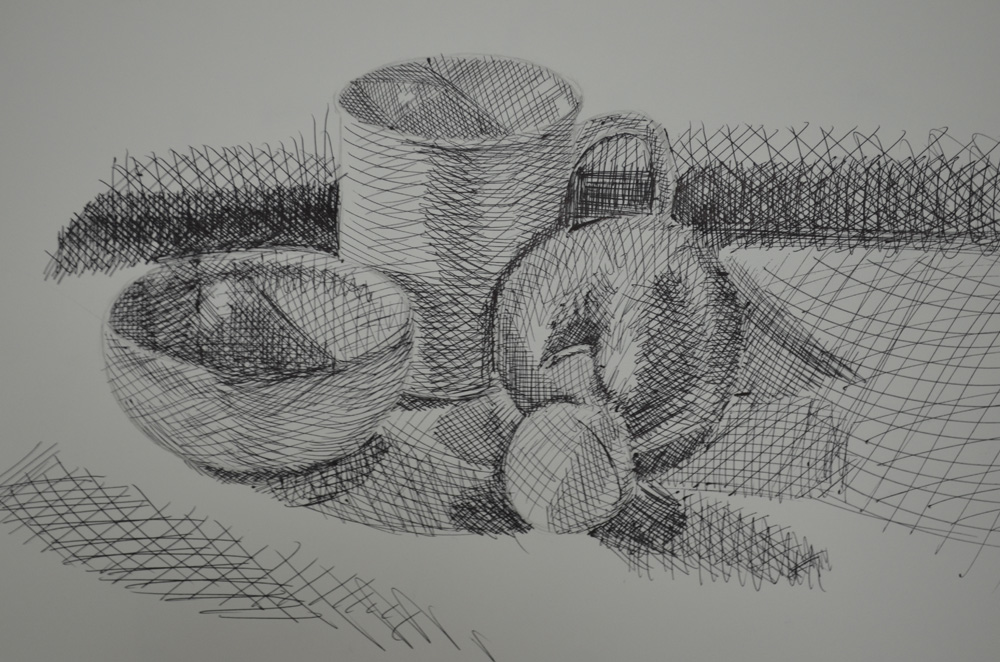
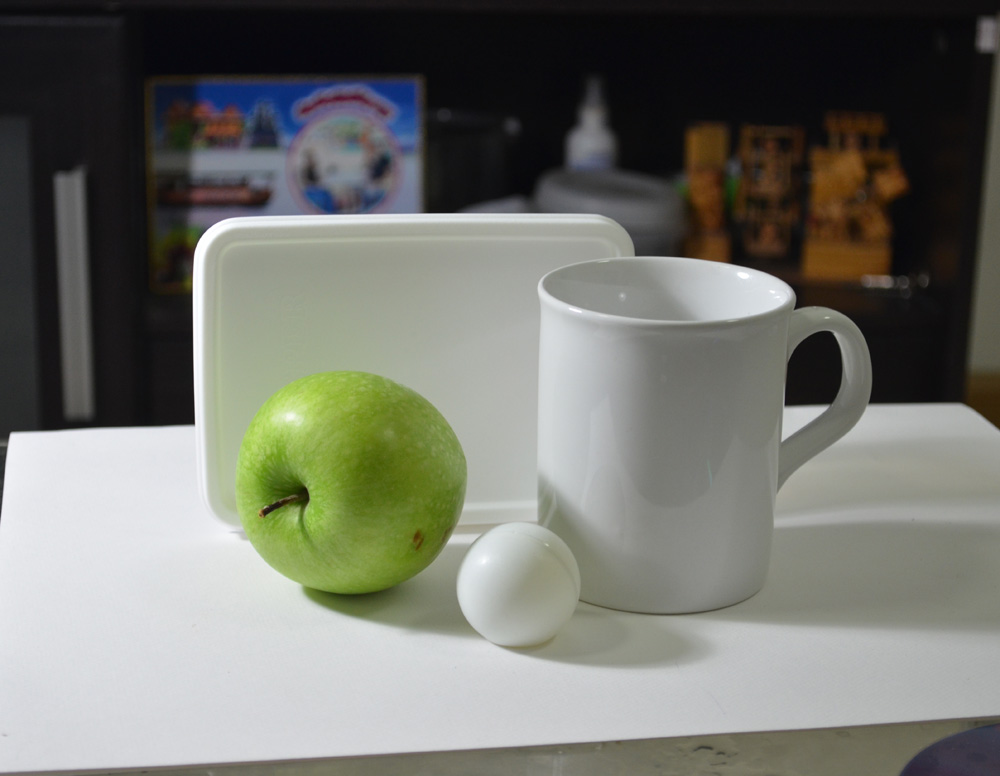
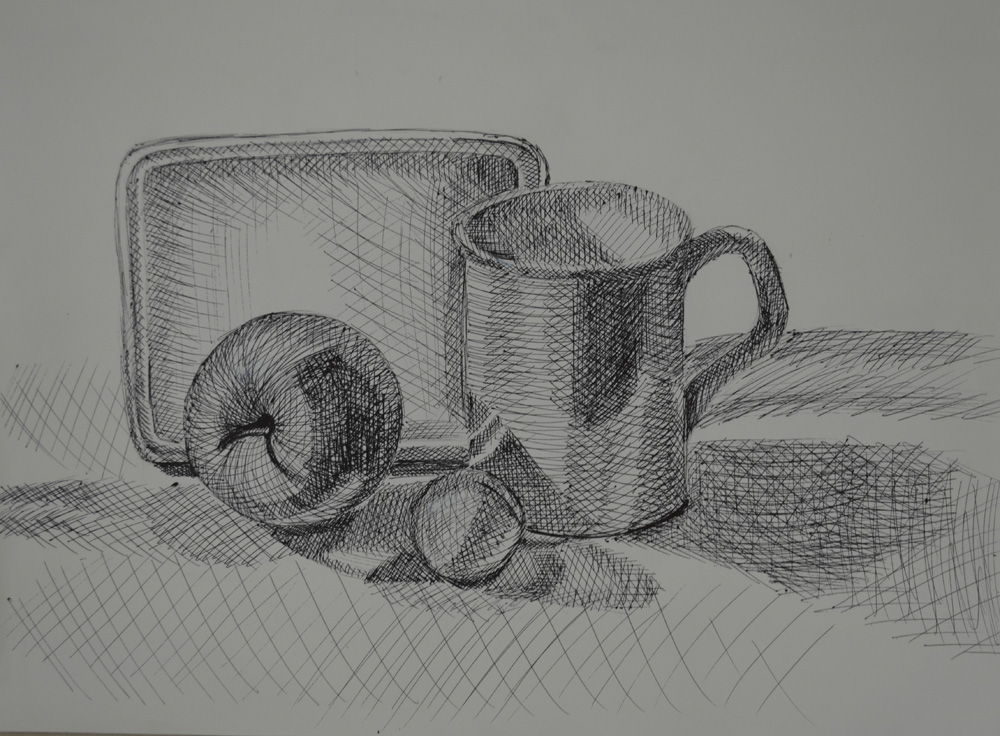
The second part of the exercise was to arrange 4 objects such as an apple, orange, ball, cup or other kitchen utensils, draw the objects then use a hatching technique to technique to add tonal shadow patterns to these objects. The 4 objects I initially chose were a mug, a small bowl an apple and a pong pong ball and chose to have a go at cross hatching with a Faber Castelle Ballpoint pen.
1st Drawing Using Ballpoint
I failed miserably in my first attempt, I even forgot I was hatching with a pen at one stage and went to smooth the pen and smudged the ink across the paper having to fill in the background to cover it up. However it did give me some well needed practise.and confidence towards the end to have another go with the ballpoint pen.
2nd Choice of Objects
2nd Drawing Using Ballpoint
My second attempt was much better, this time I swapped the bowl for a tupperware container turned on its side and I could clearly make out what each of the objects were in my finished drawing, well...apart from the ping pong ball that is.
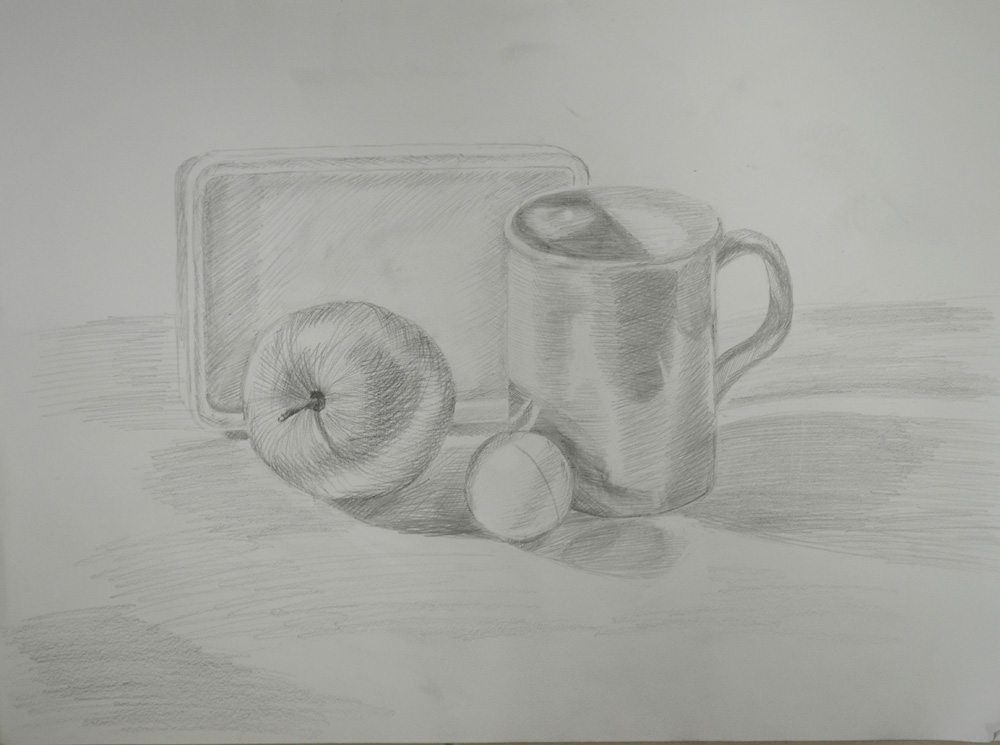
3rd Drawing Using 2B Pencil
For my third attempt I went back to a 2B graphite pencil, the tool I feel most comfortable with and successfully cross hatched the whole drawing without smoothing any lines with my finger and this time even the ping pong ball was clear enough to make out in my finished drawing,. I think deciding to start off the exercise with a ballpoint pen was a very wise idea and may have even helped to improve my cross hatching technique.

View my learning full drawing 1 learning log at: http://www.mydrawingcourse.com/

Drawing 1, Part 1, Mark Making and Tone, Basic Shapes and Fundamental Form - Check and Log


Are the objects in your drawings the correct size and shape in relation to each other? 
In most of the drawings in these three exercises, especially Boxes and Books, the objects were the correct size and shape in relation to each other apart from when I started to use pen for the Jugs and Jars, but with a bit of practise I managed to get them in proportion, a better quality pen helped.
Do the shapes between the objects look correct? 
Yes, one thing I don’t seem to have a problem with at this stage is the space between the objects, it helps to get them right the first time and then make sure you are looking from the same angle as you continue to draw.
Do the objects in your drawing look solid? 
Yes the drawings in the Supermarket shop exercise all look solid, however the objects in the watercolour pencil drawings do not look as sturdy as the others, but with more practise I will get better at drawing with these.
Have you managed to create the feeling of depth? 
I would say that in all three exercises I managed to create a good feeling of depth but more so in the charcoal sketch and the colour pencil drawing of the Supermarket Shop exercise

View my learning log at: http://markasmithoca.wordpress.com/