Showing posts with label Still life. Show all posts

Monday, 27 October 2014

Drawing 1, Part 2 Observations in Nature, Still Life, Check and Log

What aspects of each drawing have been successful, and what did you have problems with?
Still Life Group Using Line
I drew this drawing from scratch without sketching in pencil first in this aspect I think I did really well. However I found it very difficult not to start hatching to depict tone and so I probably went overboard on the pumpkin but I feel that it was better to but too much effort in than two little.
I was also dissatisfied with the pumpkin because the actual surface wasn’t as rough or bumpy as what I made it out to be in my drawing. In both drawings.
Still Life Group in Tone
The only problem I had with this is I should have chose a composition that used up more of the paper. I also could have been more adventurous with the subjects that I chose. Apart from that I think I did really well with depicting tone and none of the objects look out of place.
Did you manage to get a sense of depth in your Drawings? What elements of the drawings and still life groupings helped create that sense?
This is one thing I did not have a problem with with the Still Life Group Using Line exercise I did this by placing the tallest objects at the back. With the Still Life Group in Tone I looked down at the group from an angle.
What difficulties were created by being restricted to line or tone? 
Like I said earlier sometimes it was very difficult not to cross the fine-line between drawing with line and hatching.
See more on my Still Life exercises on my Drawing 1 Blog

Tuesday, 7 October 2014

Drawing 1, Part 2 Observations in Nature, Still Life - Still Life Group in Tone

After the last exercise 'Still Life Group Using Line' this exercise sounded like it was going to be a breath of fresh air and indeed it was...
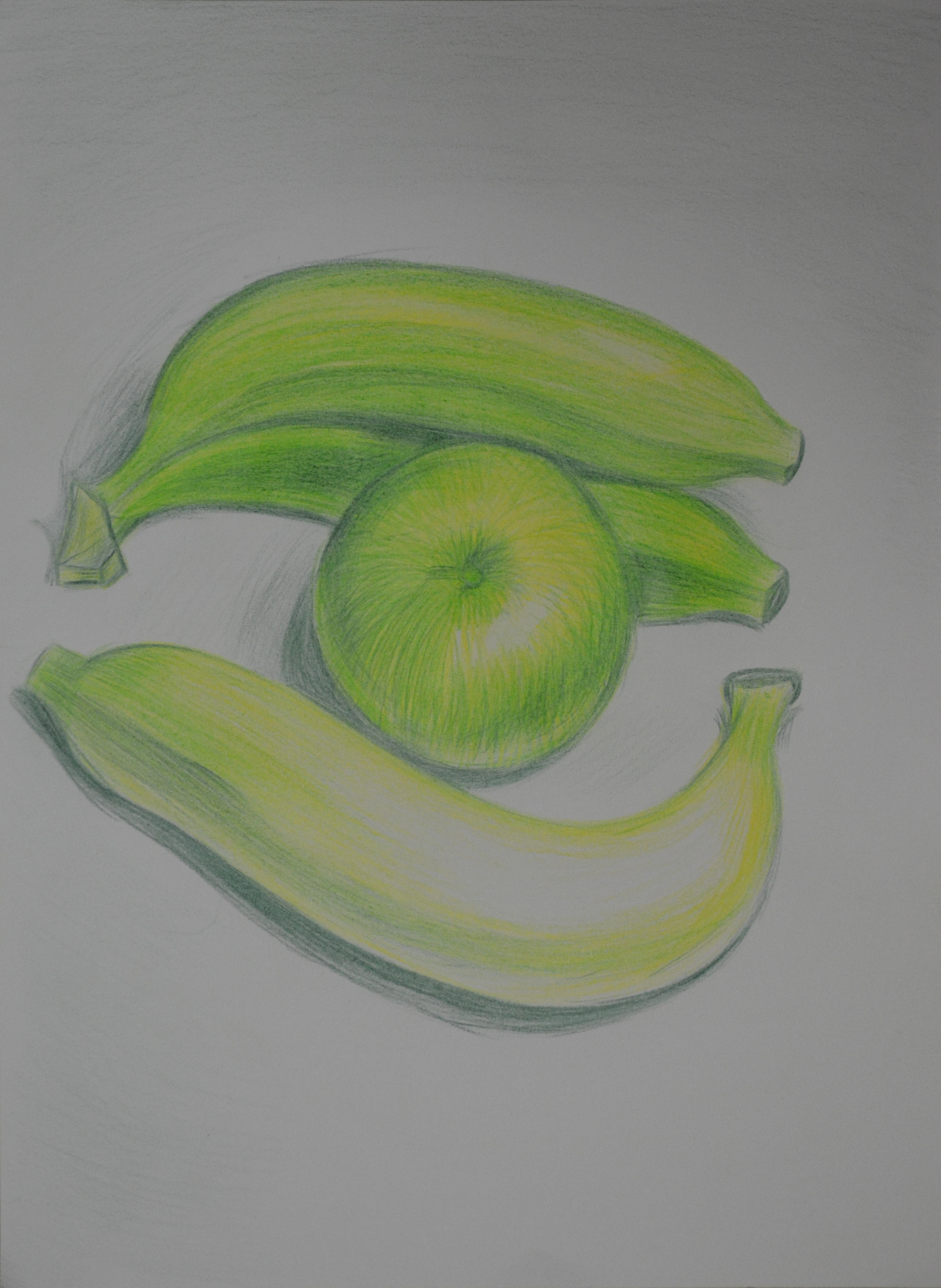
Still Life Group in Tone
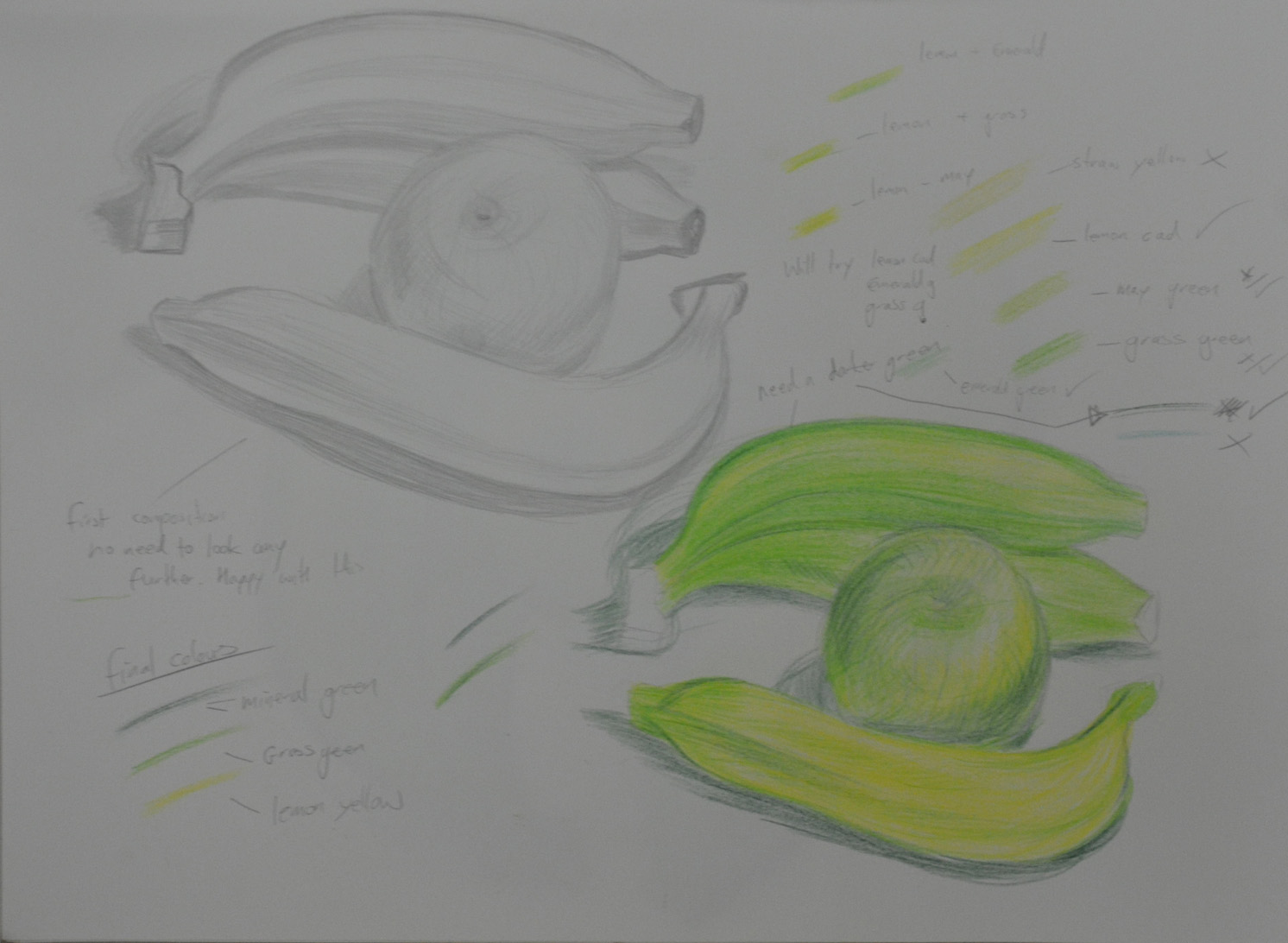
I started with a bit of a study to firstly get the right composition for this exercise and then to try out different colours so I could find three colours that would give me three different tones for this drawing. I feel like I cheated on this exercise as I chose objects that could be drawn easily enough with just three colours, a yellowy green banana, an apple and two green bananas but I just started a high fruit diet the week before and I used objects that were at hand.
Like it instructed me in the brief I screwed up my eyes to take a look at the dark colours only and lightly sketched them in and then chose a different colour to sketch in the mid tones, then another for the light tone. On completion of the initial sketch I decided that my darkest colour was too light and so changed it for my final drawing.
Still life group in tone
I changed the composition of my final drawing slightly so I could depict the full form of the apple and I'm glad I did. The final drawing took me less than two hours going at a really steady pace and I am really satisfied with the completed drawing and my choice of colours, It would have been nice to apply a fourth colour though and also maybe a variation in orange and reds.
The one thing I am not happy with is the amount of blank space I left on the paper but I tried to make up for this by shading with my darkest colour.

Drawing 1, Part 2 Observations in Nature, Still Life, Still Life Group Using Line

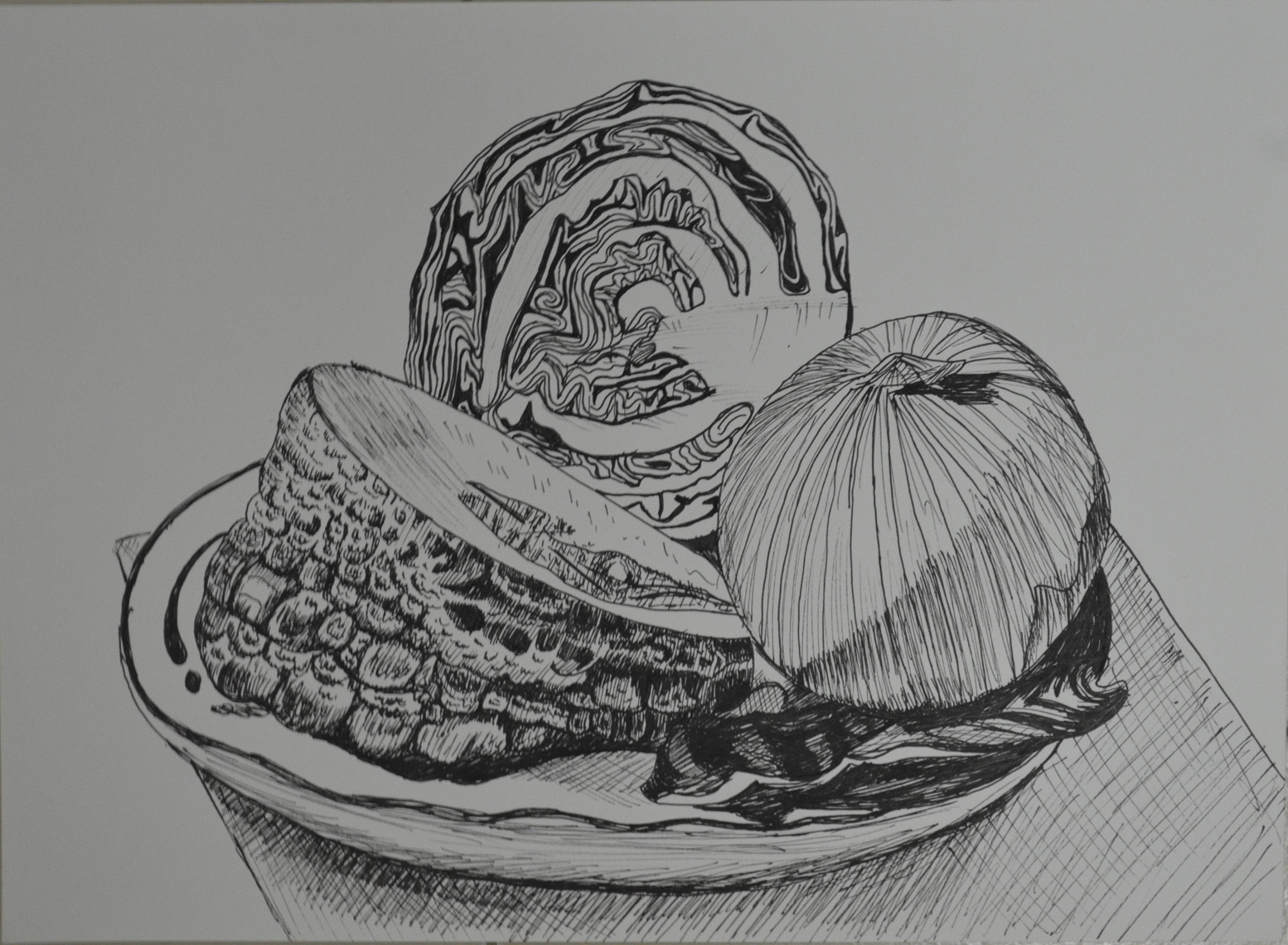
In the brief for this exercise I was to set up a still life group out of objects at my disposal, either objects that naturally connect together or deliberately contrast. For this I did a supermarket shop and purchased onions, a big chunk of knobbly Asian pumpkin and a red cabbage thinking about three objects that gradually went from rough to smooth.
I had to think about the following questions: 'How will I treat the objects?', 'How will their connections be clear?', 'How will I capture the differences between the objects?', 'How do the objects relate to their background? and 'How will I reference the colour in the group in this drawing?.
Then with these questions in mind I had to select a medium such as pen and ink, marker pens or fine black pen and A3 paper and begin to draw; which is exactly what I did. I wanted to use pen and ink for this drawing as I have kept delaying it but when i saw I would be using them in the next project I decided to use a Rotring 0.3 drawing pen.
My objects had already been in the fridge a couple of days so they wouldn't last long once I took them out and my SD card for my camera kept locking due to me removing it too often so I had to work fast as I couldn't get a photo to work from in case I didn't finish before evening came.
 Still Life Group Using Line 1st Drawing
Still Life Group Using Line 1st Drawing
There was no drawing this out in pencil first for me, I wanted to do start as I meant to go on and and put my Rotring drawing pen to paper. I started on the outline of the three objects together rather than drawing them individually then when the outline was complete I finished the shape of each object individually.
From there I started on the lines of the onion which were fairly simple and while I worked my way around the onion with a variation of light and dark lines (applying different pressures) I thought about how I was going to approach the different objects. Working from right to left I tackled the red cabbage next and it was extremely difficult; trying to view the patterns as a whole and then working on the lines individually was enough to drive me crazy.
The pumpkin was the next obstacle and because this was a still life group using line I had to exaggerate the texture of the pumpkin at certain parts where there was no real pattern at all. It looks like I have tried my hardest to depict tone here but actually I wasn't thinking about tone at all. I was just trying to complete the surface of the pumpkin with as many different line as possible, squiggly lines, short strokes, anything that came to mind.
The cabbage leaf on the right of the drawing was probably the most difficult object in this drawing and was very difficult to draw without hatching to depict it's smoothness which I wasn't very successful in doing so.
Then when I finished the composition I ruined the whole picture by doing some stupid speckle background and so I decided to have another go.
Still Life Group Using Line 2
This time I tried a slightly different angle and the finished drawing was cleaner but there are a lot more things that I am unhappy with. For one I don't know how the cutting board got so out of shape the cabbage leaf didn't turn out that great and the pumpkin surface was a little too exaggerated but certain parts of the pumpkin surface turned out a lot better.

Sunday, 16 February 2014

Drawing 1, Part 1, Mark Making and Tone, Still Life - Observing Negative Space and Perspective

This exercise of observing negative space and perspective involved following the silhouette of a group of objects that shared similar elements with a soft drawing tool such as soft pencil without taking it off the paper.
I drew in from the left using the furthest edge of the table as a starting point and followed the upper silhouette of the objects carefully assessing the silhouette and proportions of each object and changing the direction of the line as the silhouette of one object impacted off another.
Then I went back to my original starting point and followed the line until it reached the first object again then followed the bottom silhouette of the objects following the same steps as the top half. When the bottom half of the silhouette was complete I went back and drew in the details of the objects themselves.
Observing Negative Space and Perspective  1
Observing Negative Space and Perspective 1st Attempt
I used a 6B pencil for this exercise as I am still waiting for Derwent to send me replacements for my 7, 8 and 9B. I found the exercise quite difficult and frankly one that I should keep having ago at from time to time.
Observing Negative Space and Perspective 2
Observing Negative Space and Perspective 2nd Attempt
I made a few attempts without taking my pencil off the paper and I was actually very surprised when I drew the bottom silhouette and the objects looked something similar to what they did in my composition. There were a few errors in each of my attempts, vase to wide (starting to draw it too early and the bowl to narrow and the jar on the right hand side was quite wonky in each of my attempts, but the negative space between each object was the correct shape just not always the right size.
observing-negative-space 3
Observing Negative Space and Perspective Attempt 3 and 4
Like I said earlier it is an exercise that I think I will gain a lot from and should practice from time to time, I also like the way that I arranged the objects and would like to do a similar still life using a similar composition, this exercise maybe a great starting point for that still life.

View My Drawing 1 learning log here www.mydrawingcourse.com

Wednesday, 24 April 2013

Drawing 1, Part 1, Mark Making and Tone, Still Life - Check and Log


Do you think it is easier to suggest three dimensions on man-made or natural objects?
This project has taught me that it is easier to suggest three dimensions on man-made objects rather than natural objects. Man-made objects are usually made up of geometrical shapes such as cylinders, cones or cubes and so the lines of man-made objects are easier to draw and suggest their 3D form using most mediums. The irregular shapes of natural objects means that their three dimensional features are much more subtle with lines that are more difficult to depict and draw.
How did you create a sense of solidity in your composition?
In the exercise ‘Still Life Sketches of Made Objects’ I created a sense of solidity by using various hatching techniques and swapping between pencils of different hardness mainly B, HB and 2B, shadows and tone also played a big part in making the objects look solid.
exercise still life of made objects
Image 1: Exercise - Still Life of Made Objects
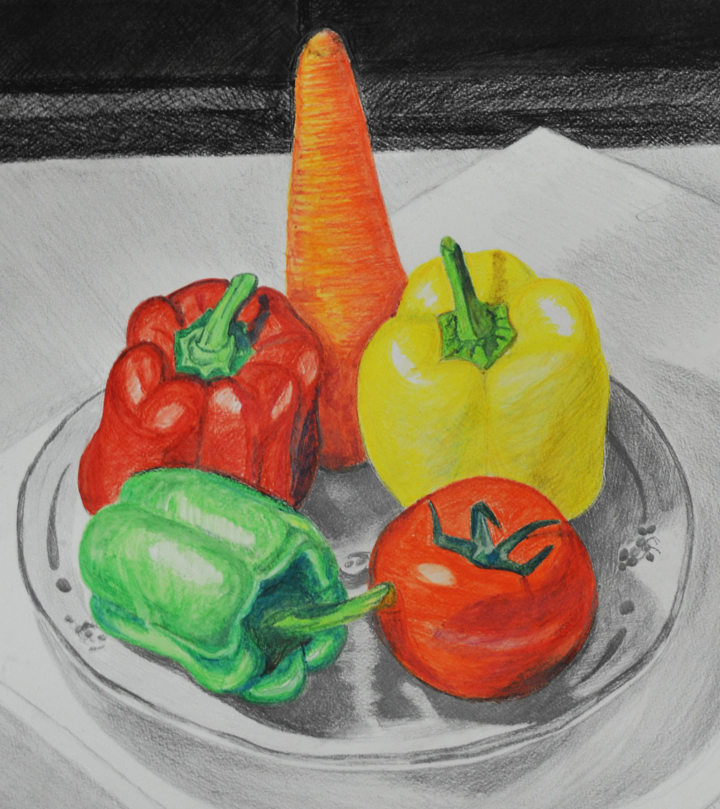
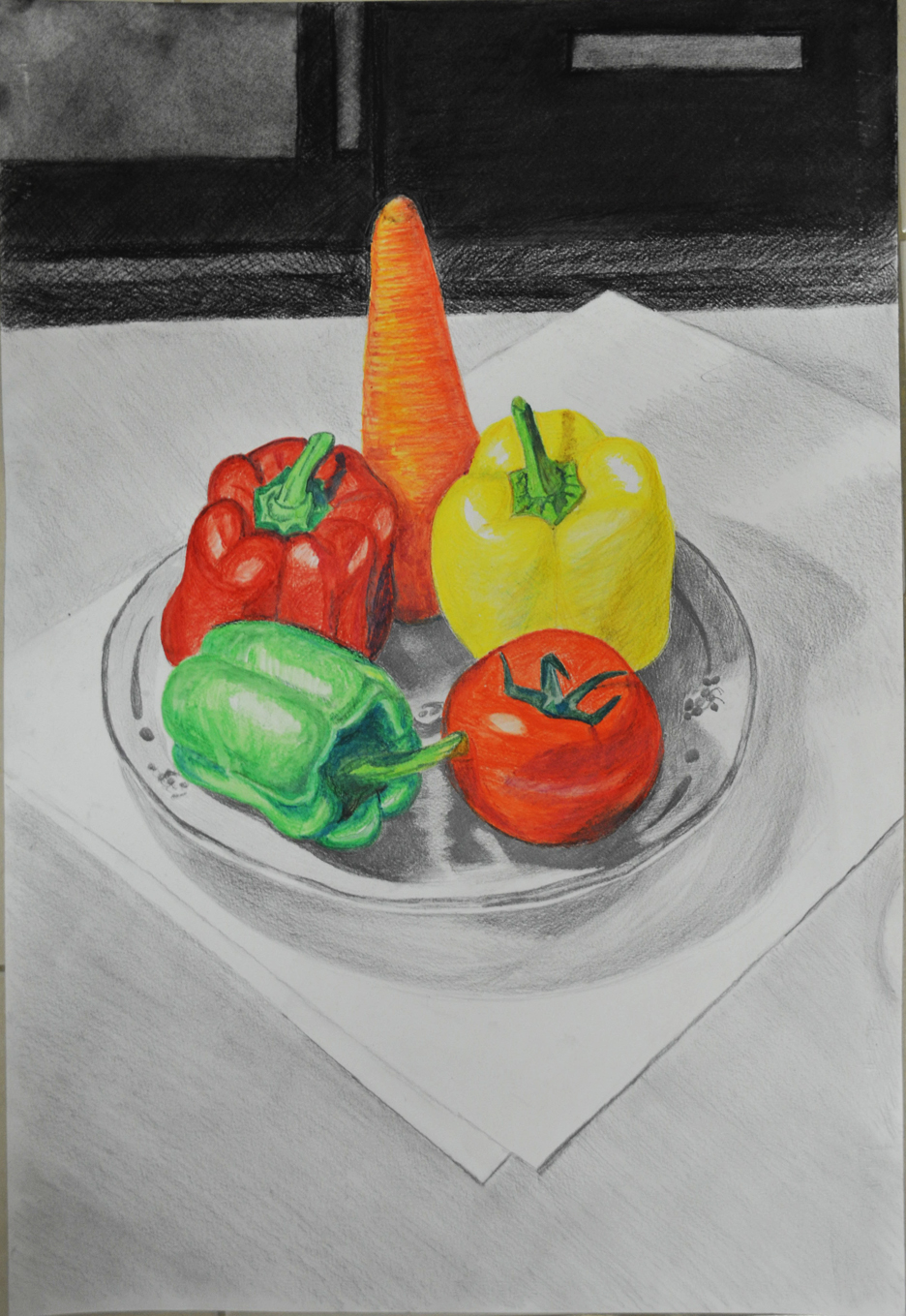
In the exercise 'Composition of Natural Objects' working with watercolor pencil I used hatching and layers of darker colour to show solidity.
Composition of Natural Objects
Image 2: Exercise - Composition of Natural Objects
Do you think changing the arrangement of your composition makes a difference to the way you create a sense of form?
Changing the arrangement of the objects changed the way each objects interacted with each other, shadows and light reflected off one object to another and other objects in the composition (such as the plate in image 2) can play a major role in creating a sense of form.
How did you decide how to position yourself in relation to the objects?
For the second exercise I decided to position myself slightly above looking down at the objects so I could see the full form of the the objects and shadows interacting with each other in the middle of the composition, I thought this would help me to create a sense of form in my drawing. A bruised rib from a an accident the day before helped me to reinforce this decision.

View My Drawing 1 learning log here www.mydrawingcourse.com

Drawing 1, Part 1, Mark Making and Tone, Still Life - Composition of Natural Objects


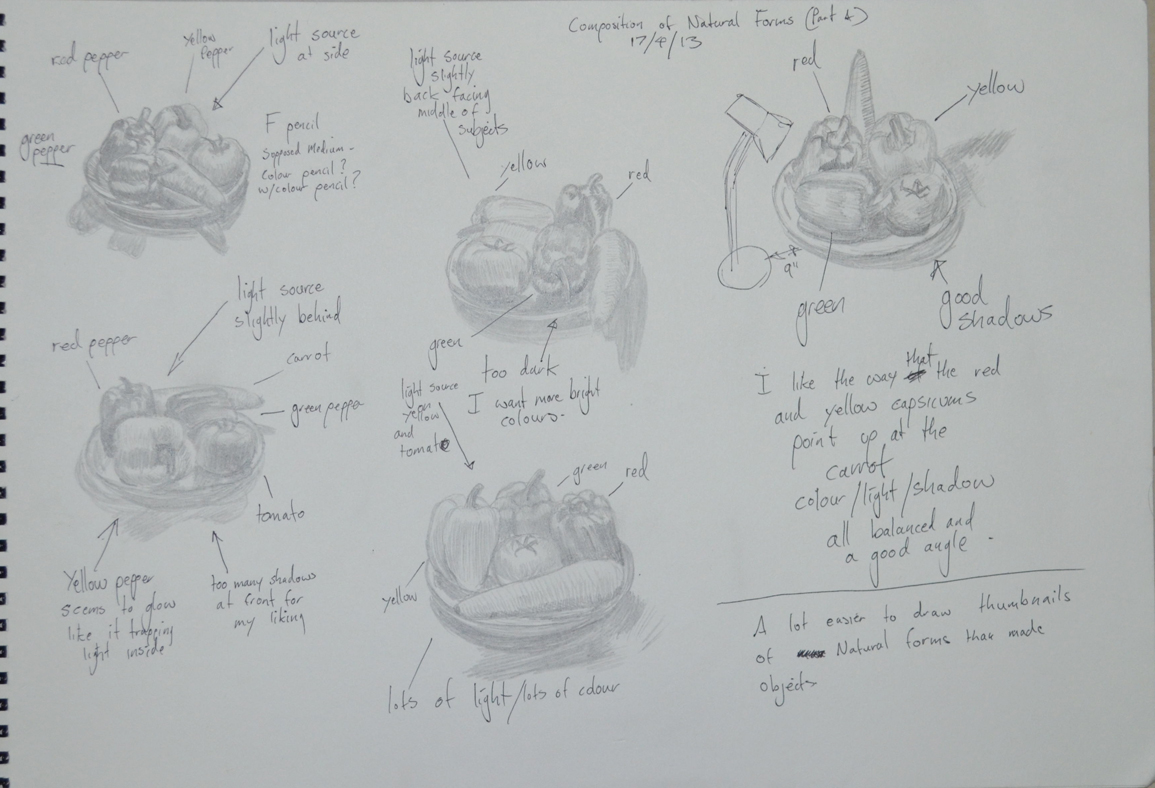
The brief for this exercise was to 'Make a selection of natural objects for my composition, such as fruit or vegetables on a plate, and explore the different viewpoints by moving all the objects around in different arrangements and assessing which set up I like best. In my sketchbook, make quick sketches of each different set-up before moving the objects about again.'
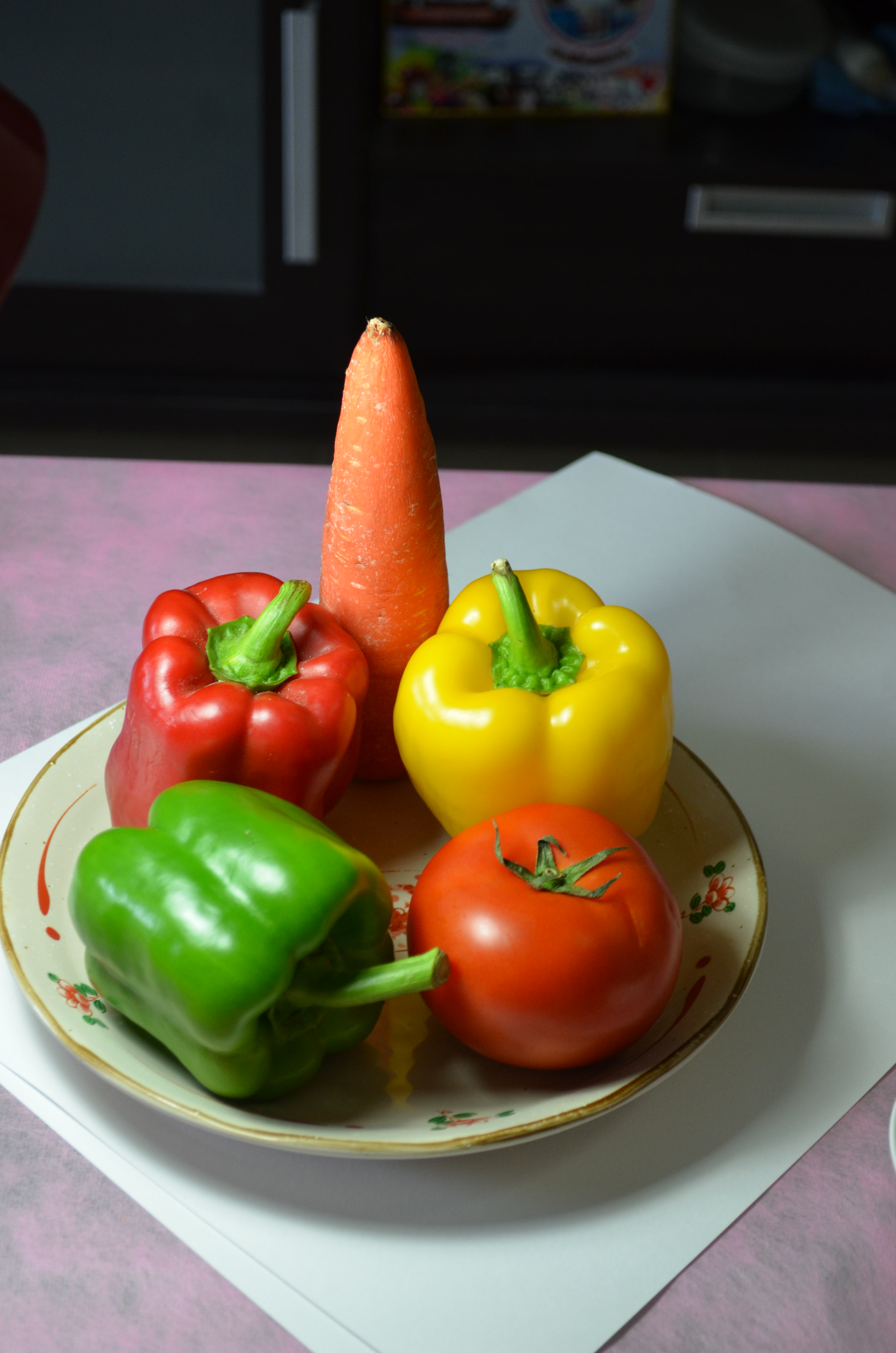
I found making quick sketches of the natural objects a lot easier than making thumbnail sketches of 'made objects' in the previous exercise and started out with a good feeling that the exercise would go well. I chose vegetables for my composition which were a red yellow and green capsicum, a tomato and a carrot.
Still Life Composition of Natural Forms
Thumbnail Sketches of Compositions of Natural Forms
I thought about the best place to position myself in relation to the objects and positioned myself slightly above. This was also more comfortable as I had bruised a rib after a fall during the Thai new year festivities (Songkran) a couple of days before, so I propped myself up with a couple of pillows, I couldn't complain though as it did give me a good view of all the vegetables.
The brief for the second part of the exercise was to 'Use the information collated in my sketchbook along with written notes from previous exercises to make an informed decision about the organisation of my still life drawing. This would help me to clear my mind and give a sense of order to my work.'
As always due to doing most of my work over different times of day and especially in the evening I worked with a bendy light as a light source, making sure it cast adequate light and shade onto the still life.
still life natural forms 2
  • Mediums used - Watercolor pencil, 2B, 4B, 8B, EE graphite pencil, charcoal, Conté pencil
  • Paper - A3 Canson Watercolor pencil 190 gsm
  • Time taken - 10+ hours
I wanted to get more practice with watercolor pencils and so I initially chose to do this exercise completely in watercolor pencil and so the only size sheets I had were A3 which I bought for the 'Supermarket Shop' exercise. However the problem was the composition I chose meant that I had to use the paper length ways but I wanted to get the whole of the plate into the finished drawing with the shadow that it cast and so I knew in advance it would leave a lot of negative space on the paper. Placing another folded sheet of paper under the composition helped me fill up the negative space and I decided that I would also use the TV unit in the background as the background.
I made a very poor first attempt at the still life completely in watercolor pencil, it set me back a good few hours and did not put me in the best of moods but did teach me some valuable lessons.
  1. I did not have enough practice with this medium to get it perfect.
  2. Blending colours with this medium was more difficult than I thought.
  3. You can't erase watercolor pencil once it's in paint form and if you try there's a risk of ripping the paper!
I decided that my next attempt at this exercise would be a great chance to produce my first mix medium drawing and if I couldn't perfect the colour, shadow and light of the vegetables I would do my best  and then really make the composition stand out by the drawing everything else in graphite pencil.
On my first attempt at this exercise I started out sketching the dark parts of the vegetables in watercolor pencil first but on the second attempt I started with the lighter colours, although the second attempt was easier and looked better I have yet to perfect my technique.
When it to the lighter shadows in the drawing I took it very slow, using the pencil very lightly and holding it at the end and letting it almost dangle, only occasionally did I have to resort to blending with my finger. For the darker shadows on the plate I used 4B and 8B pencil.
All was going well until it came to the  background objects, my 7B, 8B and 9B pencil kept snapping so after an email to Derwent to complain about the quality of pencils in their 24 graphite pack I continued with an EE pencil. I found the EE pencil no replacement for the 9B pencil and was hard to produce different tones so I finished the background off in Conté pencil and charcoal.
Still Life Composition of Natural Objects
I was a bit disheartened at times after starting off so well, especially having discovered that I drew the composition in my second try on the the wrong side of the paper thinking they were the same. Luckily enough it turned out to my advantage as it was easier to draw in graphite and the paper did not warp as much when wet plus the colours seemed to be a lot brighter when they bled.
I was also a bit upset that I had to use more than two mediums in this drawing and found it frustrating when things kept breaking. The end result of the watercolor pencils is not what I had in mind but I thought the contrast between the colour and the graphite pencil was excellent.
Composition of Natural Forms - close up
The good news is Derwent did get back to me and admitted there was a problem with the old batch of graphic pencils and are sending me replacement 7B, 8B and 9B pencils.

View My Drawing 1 learning log here www.mydrawingcourse.com

Drawng 1, Part 1, Mark Making and Tone, Still life, Still Life Sketches of Made Objects


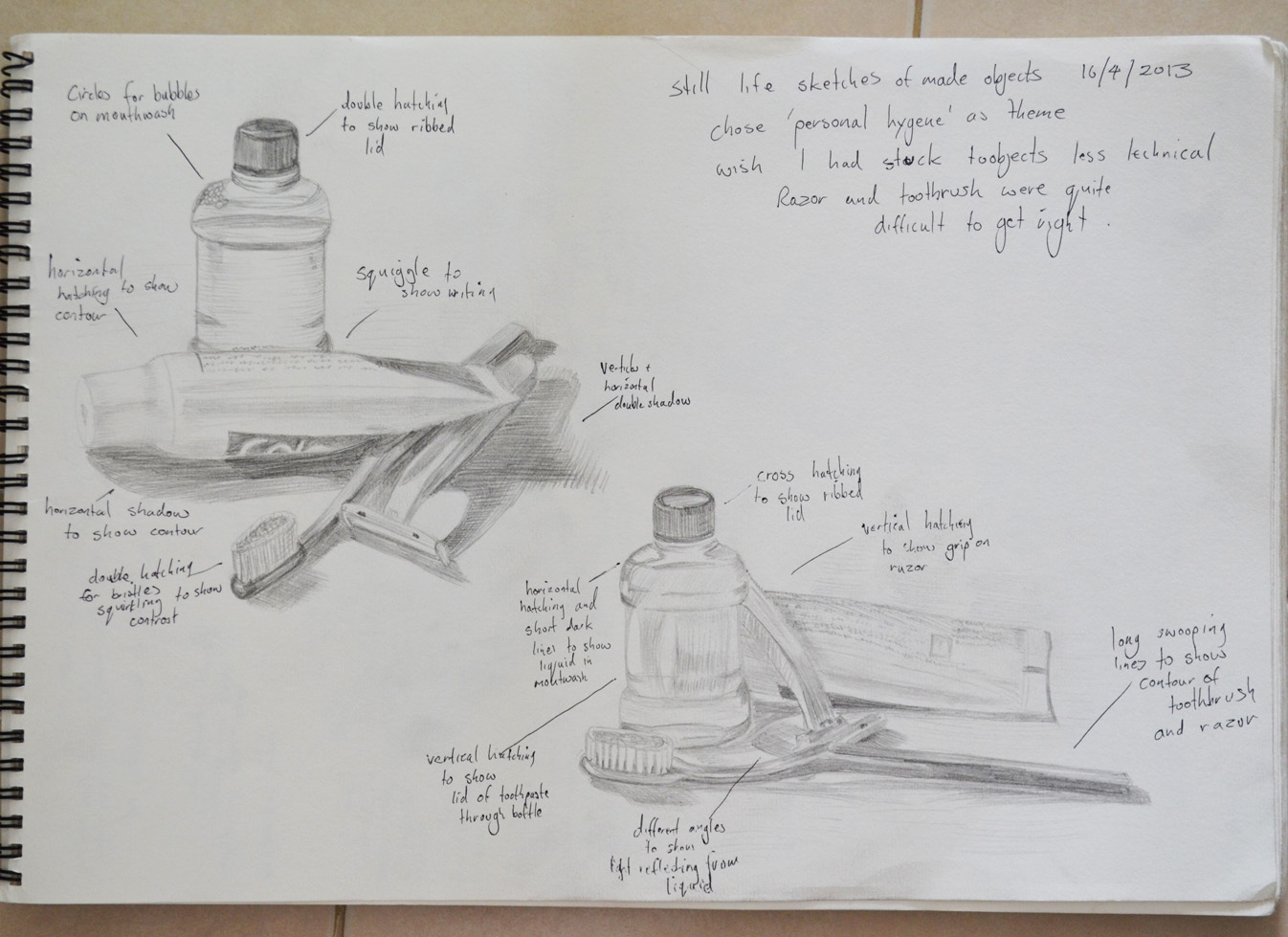
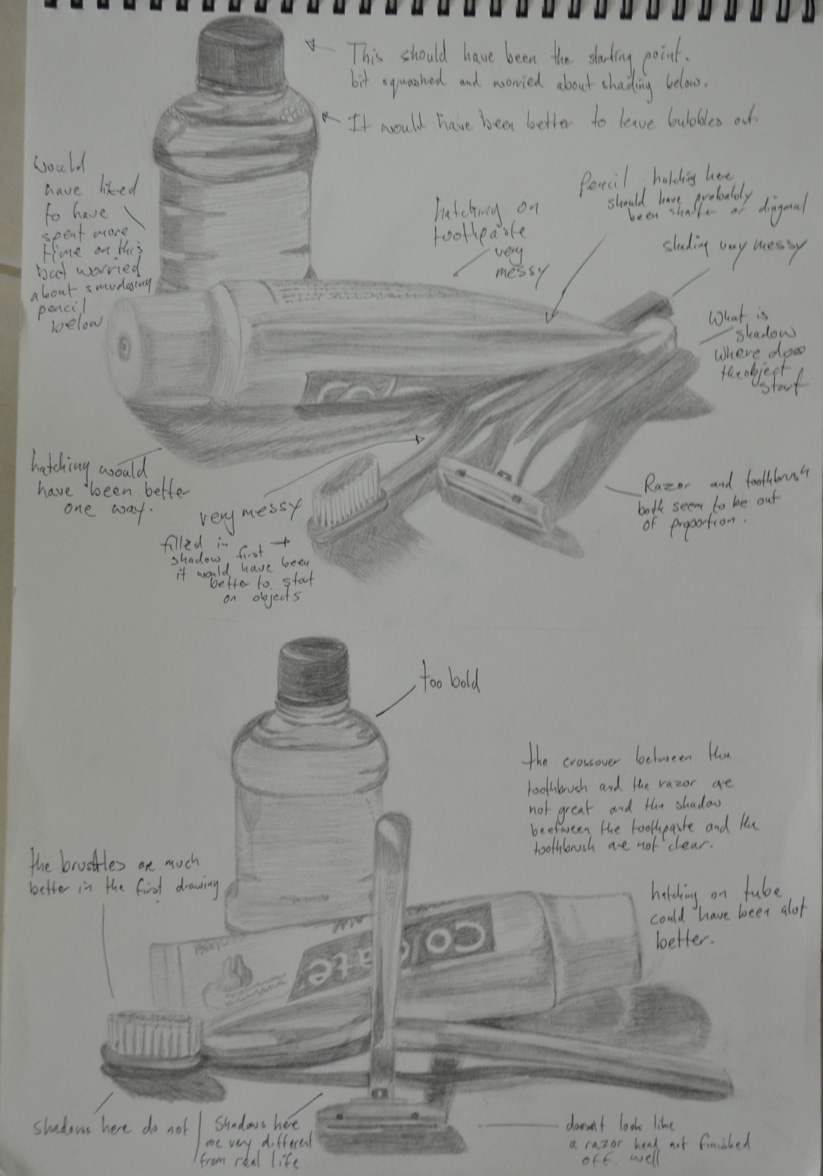
The aim of this exercise was to create a small still life composition from a small themed selection of made objects, of which I chose personal hygiene as my theme and the objects that I chose were, a tube of toothpaste, a toothbrush, a Bic Razor and a bottle of mouthwash.
Then with a pen, pencil, or ballpoint use a technique such as hatching. I used a 3H and a HB pencil (to show the darker shadows).
Then I had to draw two or three thumbnail sketches in my sketchbook of different arrangements from different view points, using my light source to help create strong lights and dark shadows on the surfaces of the objects. I had to include tonal values to indicate form in my sketches as well as shadows seeing as they can also play an important part of a still life composition.
Then I was to make notes on or around my sketches about the technique I used and why I had used it. And make notes on anything else I felt was important.
I did two initial drawings that I have to admit were not exactly thumbnail size, I think this was down to miscalculating proportions of the first objects I started on in each composition and then having to keep up proportions,
exercise: still life of man made objects
First attempt at this exercise
In the first drawing I started on the toothpaste tube as I always end up working clockwise, I think this is force of habit. However, because of this I misjudged how much paper I would need for the mouthwash so squashed the lid to fit the rest in; so when I came to the second drawing I worked from  the mouthwash down.
On the first attempt I forgot what I was instructed to do in the exercise. Instead of writing down about the techniques I used I totally ripped the sketches apart fault by fault, only actually remembering what I was supposed to do after I took the photo to upload to my working log. I decided to do the exercise again and this time do it right.
In my second attempt I scaled the drawings down and was less worried about every detail. My hatching technique also seemed to improve a lot in my second attempt, using a variation of cross, vertical and horizontal hatching as well as swooping lines to follow the contours of certain objects.
exercise 2 still life of made objects
Second Attempt at this exercise was much better
This exercise was probably the first time that I made no attempt of smudging in the pencil lines instead I practiced the pencil holding techniques I used earlier in this course, from the tip, from the end etc...
The hardest thing to draw in the composition were the toothbrush and razor and I felt like abandoning the objects and using something easier to draw but stuck at it and did a reasonably good attempt at getting proportions and details right all 4 times

You can visit the learning log that my tutors see right here http://www.mydrawingcourse.com