Showing posts with label drawing 1 course. Show all posts

Tuesday, 4 November 2014

Drawing 1, Part 2, Observations in Nature, Drawing Plants and Flowers, Negative Space in a plant

I don't have any plants at all in my apartment and was quite worried about where I would get one from without having to travel to the outskirts of Bangkok to find a suitable pot plant for this exercise.
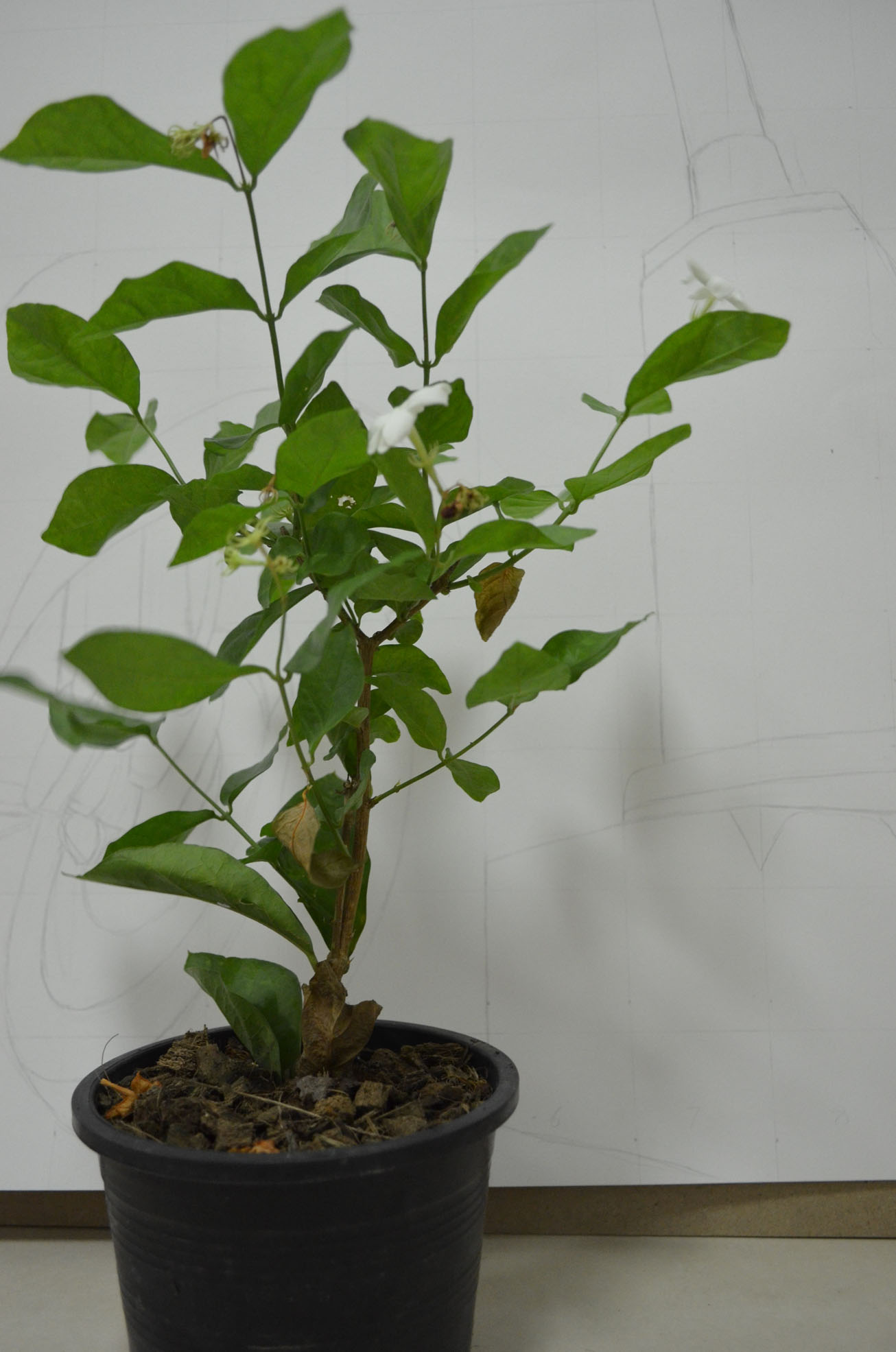
My Subject - Jasmine
Luckily it was mothers day here in Thailand (12th August - the Queen's birthday) and while my girlfriend was shopping in Tesco she came across some Jasmine plants, Jasmine is the Queens flower and at only 49 baht (just over a pound) they were a bargain and I'd definitely picked the nest time of year to do this exerise.
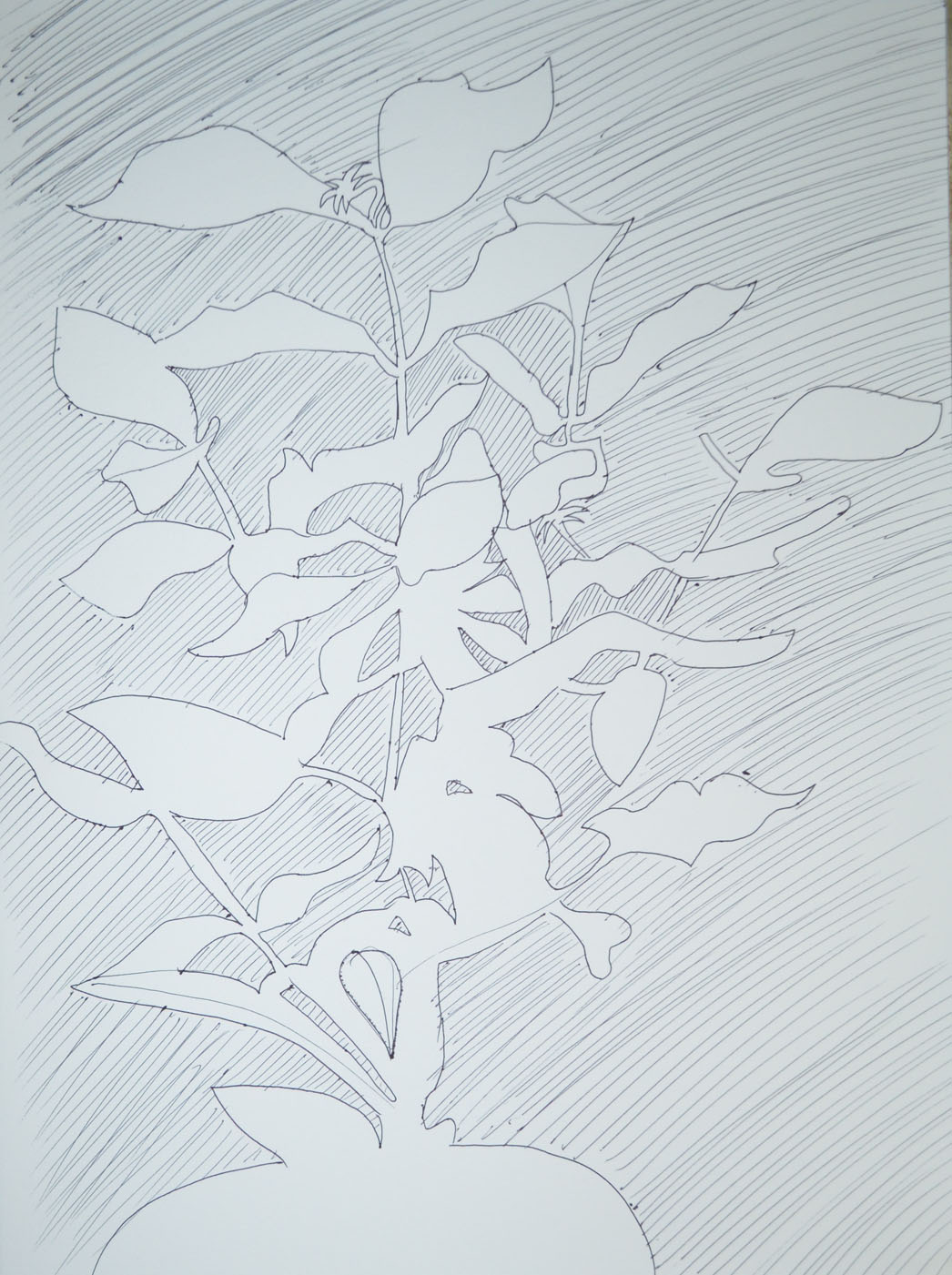
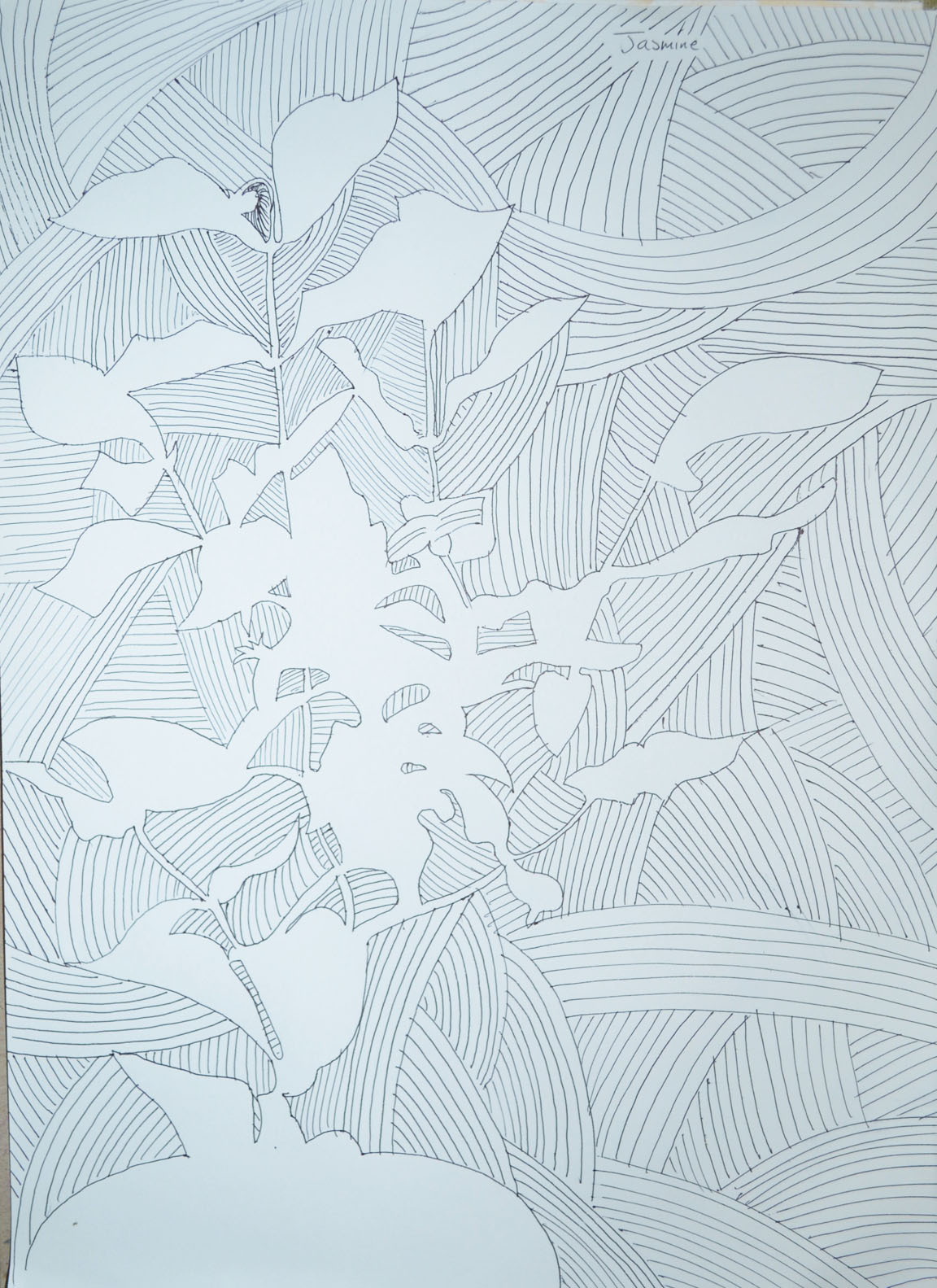
I used my faithful ball point pen and an A3 sheet of paper, placed the plant in front of a large drawing that I am in the progress of doing for a friend in England and began to draw. Concentrating on the negative spaces, I started to draw the space within and around the pot plant beginning at the top and working my way down to the bottom.
Drawing Negative Space in a Plant 1
Drawing Negative Space in a Plant 1st Attempt
My first attempt went really well until I got down to the bottom where the plant came out of the soil and I realised that the right of the plant would be well out, so to make the plant readable I drew in a few more negative spaces to even it up. I then began to finish it off by filling in the negative space in the drawing with some swirling psychedelic patterns.
Drawing Negative Space in a Plant 2nd Attempt
My second attempt was quicker and I think is also an improvement on the first, this time I crossed over a few lines along the way and when I had finished filled in the negative space with more conservative lines.

Monday, 27 October 2014

Drawing 1, Part 2 Observations in Nature, Drawing Fruits and Vegetables in Colour, Research Point: Ben Nicholson

Born in to an artistic family in Denham, Buckinghamshire in 1894 Ben Nicholson was the son of artists William Nicholson and Mabel Pryde.  In 1896 the Nicholson family moved to London where Ben was educated at the Tyttenhangar Lodge Prepatory School in Seaford before becoming a boarder at the Gresham’s School for boys in Holt, Norfolk. Ben Nicholson began his training as an artist in London at the Slade School of art, where he studied from 1910 – 1911, then from 1912 to 1914 he travelled between France, Spain and Italy.
In 1920 Nicholson married is first wife, painter Winifred Roberts to whom he had three children, two sons, Jake and Andrew and a daughter Kate, who also became a painter. From 1923 Ben and Winifred split their time between England and Switzerland spending their winters in the southern Swiss town of Lugano and the rest of the year was divided between Cumberland, where they made their home for that decade and London While In London following an exhibition with his wife Winifred he was invited to join the 7 & 5 Society, he was made chairman of the society in 1926.
Nicholson’s early paintings were still-lifes influenced by the works of his father but then after his first solo show at the Twenty-one gallery he began experimenting with abstract painting influenced by Synthetic Cubism which he implied in all his works thereafter. His works throughout the 1920s were of deceptively simple table top still-life’s and landscapes painted in Switzerland, Cumberland and Cornwall, making his first visit there in 1928.
While visiting France in 1932 and 1933, Nicholson became familiar with the works of artists such as Hans Arp, Joan Miro, Piet Mondrian and Alexander Calder who had settled in Paris in the 1920s. Nicholson was successful in fusing the European trends into a new style that would become identified as his own.
He made these visits to Paris with Barbara Hepworth; Winifred and Ben were divorced in 1938 a break up that was brought on by his growing relationship with Wakefield born sculptor. Hepworth had kids to Nicholson in 1934, three triplets and after his divorce in 1938 she would become his second wife.
Together they moved to Cornwall in 1939 and in 1943 he joined the St. Ives society of artists. Following the Second World War Nicholson lost faith in the ‘utopian promise of geometric abstraction’ and resumed painting landscapes adding colour to his abstract reliefs to emphasize the fundamental unity between nature and abstraction. Hepworth and Nicholson were divorced in 1951.
Throughout the 1950s he achieved international recognition as an artist through a series of awards which included the first Guggenheim International Painting Prize in 1956 and the International Prize for Painting at the São Paulo Biennale in 1957. From 1954 – 1961 retrospective exhibitions of his work were held throughout Europe including shows at the Venice Biennale and Tate Gallery and in several cities in the USA in the 60’s and 70’s.
Nicholson married his third wife, German photographer Felicitas Vogler in 1957 and the two moved to Ticino in Switzerland in 1958 where he again began to concentrate on painted reliefs. In 1968 Queen Elizabeth awarded him the O.M. (Order of Merit) and in 1971 after the end of his third marriage he moved back to England where he died in London in 1982 at the age of 87.
Researching this Artist
I used many different websites researching this artist as the information I found was confusing and contradictory, with information differing from site to site and so I chose to gather information from the websites of establishments that I found out at shown his work, The British Council, Tate Gallery and the Guggenheim comparing the details with the biographywww.oxfordartonline.com.
I have never heard of Ben Nicholson before although his second wife Barbara Hepworth is very familiar to coming from Wakefield I have seen her works in West Bretton (Yorkshire Sculpture Park). Since I have been living in Thailand they have opened the Hepworth Center in her name in my home town so it was interesting to read about their relationships, both personal and professional.
Although I have never heard of the artist by name before, I did recognise a few his works, including 1934 (Still Life – Birdie) 1933 (Study of a Head) and 1932 (Head and Mug in a Greek Landscape).
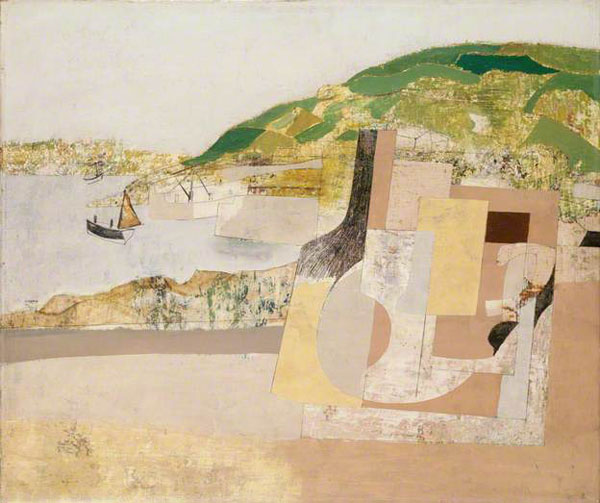
Ben Nicholson Mousehole 1947
Why does he simplify still life forms and negative space and superimpose them on a Cornish Landscape?
I think the answer to this lies in the above text where it says Nicholson ‘resumed painting landscapes and added colour to his abstract reliefs to show the fundamental unity between nature and abstraction’.  Which maybe reflected in what he said in a letter from Nicholson to Patrick Heron (9 February 1954) ‘All the “still lifes” are in fact land-sea-sky scapes to me.’
Bibliography:
Drawing 1, Observations in Nature. Drawing Fruits and Vegetables in Colour, Using Oil Pastel

For this exercise I used approximately 13 different colours of oil pastel and a white textured sheet of A3 watercolour paper and I’m kicking myself now reading the brief where it says usecoloured paper. However further down the page it does say leave gaps to let the white break through so it’s easy to see how I got confused.
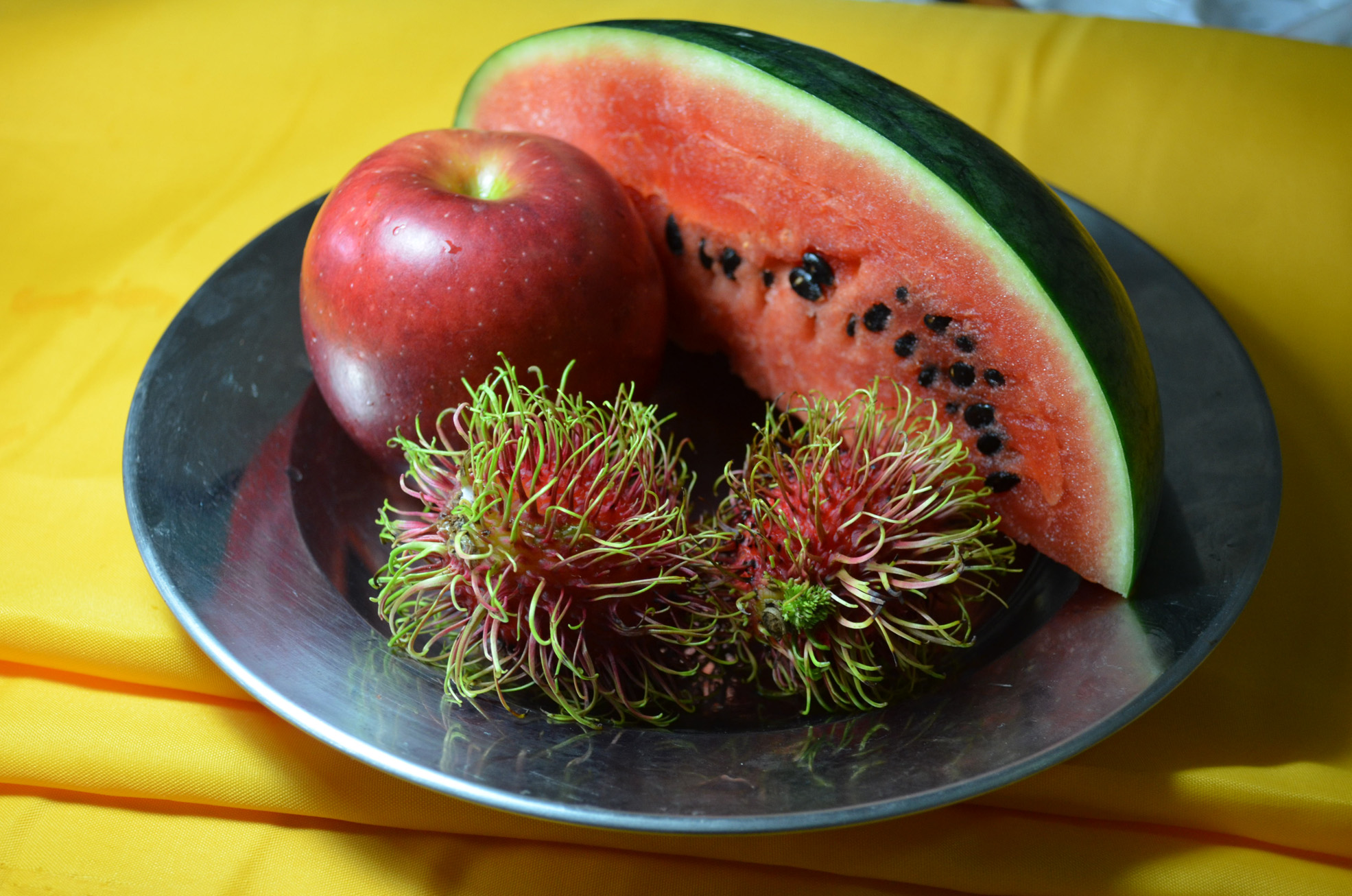
I set up a colourful group of fruit which included a quarter of watermelon, a red apple and two ramhutan or ‘gno’ as they are known in Thai, concentrating on creating a group of contrasting colour and texture I set them on a stainless steel reflective plate which I bought with the intention to use in the earlier exercise ‘Shadows and Reflected Light and Shade‘, and placed the composition on a piece of folded cloth used to make Thai monks robes.
Drawing Using Oil Pastel - Chosen Composition
Drawing Using Oil Pastel – Chosen Composition
First of all I lightly sketched in the main shapes of the group doing my best to fill the paper including the main shapes of the cast shadows on the cloth underneath, I think this was my best attempt at filling the paper so far.
I then started to block in the darkest areas using a sketchy hatching technique, I’m trying to be more fluid in this part of the course and I think I’m doing well so far. From there I went on to sketch the light areas in a different colour, on the watermelon and apple at least.
Once the initial layers of colour were blocked in I worked back over them to strengthen the tone using related colours on each object to strengthen the tone.
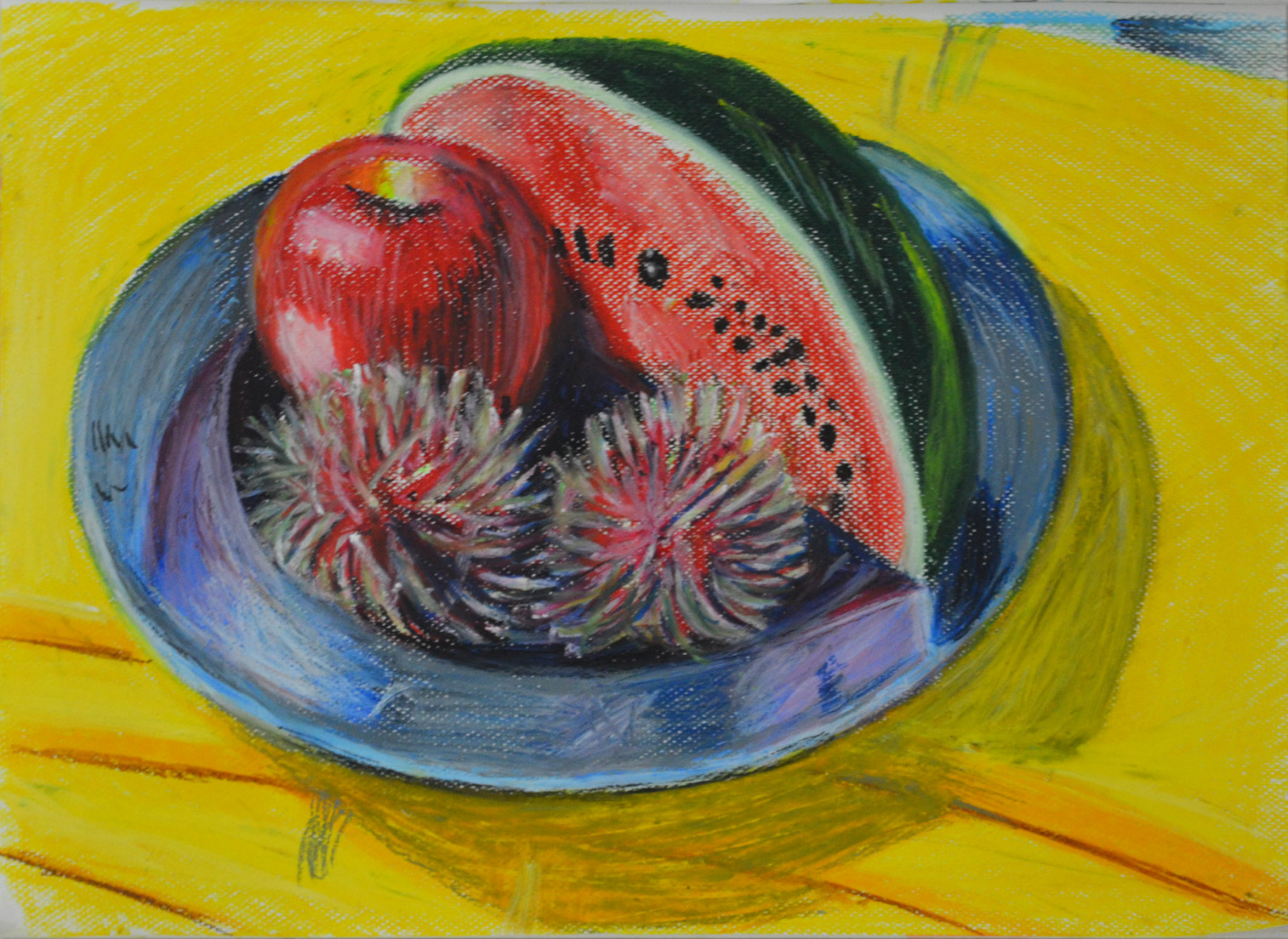
Drawing Using Oil Pastel - Finished drawing
Drawing Using Oil Pastel – Finished drawing
Approximate breakdown of colours used on objects
Watermelon:
On the flesh of the watermelon I used pink, red, a very dark red and a dark blue to create shadow as well as black and white for the seeds. For the skin I used a dark green a light yellow and a grey-blue colour.
Red Apple:
For the red apple I used ultramarine, red, orange and pink for the skin and green, yellow and orange for the core, these colours worked really well together.
Rambutan:
On the rambutan I worked from light to dark then back again and they were probably the hardest thing I’ve drawn so far. For these two objects I used all of the above colours but it took me a very long time to build up the layers and to get them looking anywhere near they did in real life. Although they are not perfect I really love the effect I have created while working on them. They are a very irregular shape and yet I have still managed to make them look round and spiky.
The Plate:
Same again on the plate, because it was so reflective I used a lot of the colours utilized for the fruit plus a light blue, grey and white.
This is the first time I have worked with oil pastels other than experimenting and I found that you have to know when enough is enough for danger of messing up your drawing.
I’m very impressed with the finished picture, but what is worrying me now is how I am going to preserve it, I have sprayed it a few times with an expensive fixative already but I used cheap pastels by Pentel and it doesn’t look like the fixative is not going to do any good…

Drawing 1, Part 2 Observations in Nature, Drawing Fruits and Vegetables in Colour, Using Markers and Dip Pens

For me this was a stressful exercise that took me over two weeks to complete. I initially wanted to focus more on dip pens and ink for this exercise but it was a mediu I would continue to have problems with.
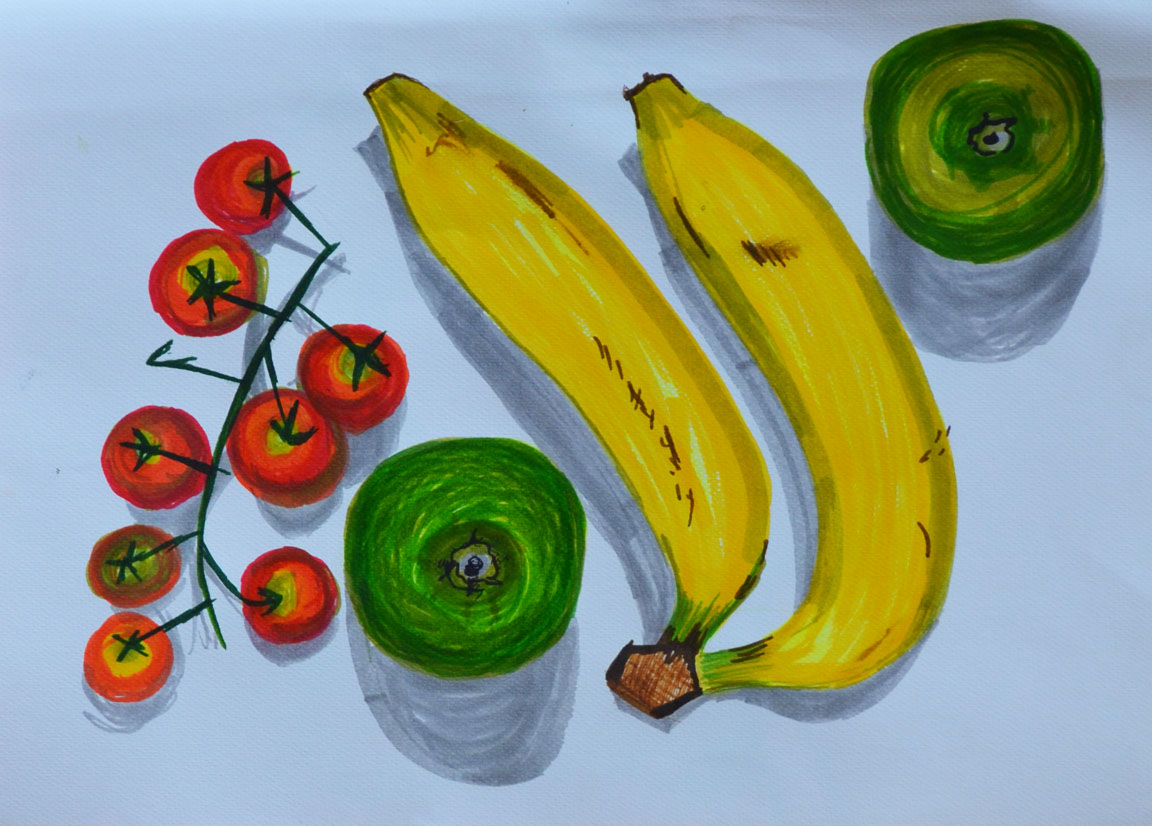
I started with markers as I already had a good choice of Kurecolor Markers, with a composition that consisted of vine tomatoes, bananas and an apple however I failed miserably looking down at the apple at that angle plus I didn’t have the right colour for the apple.
Using Markers First Composition
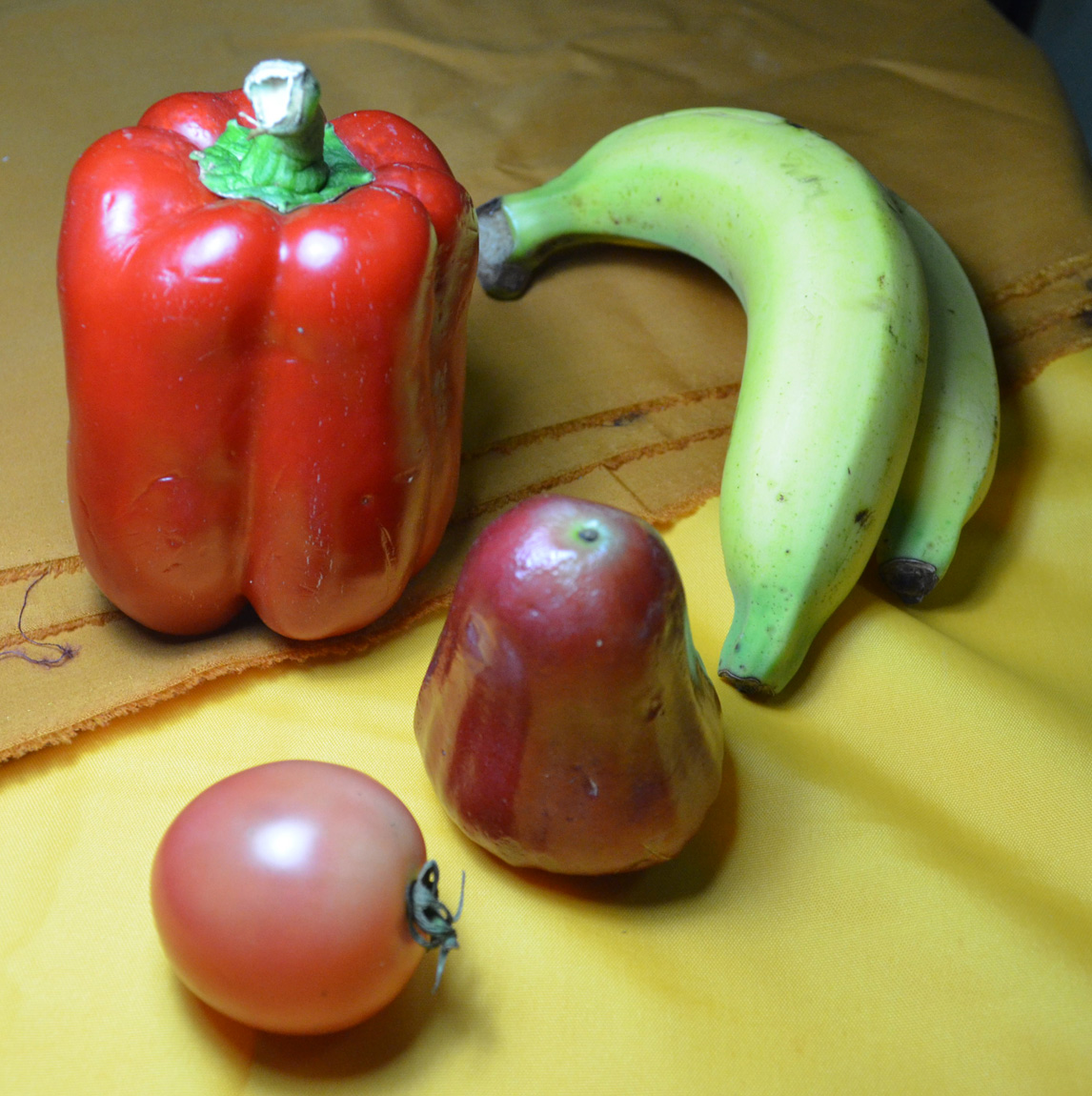
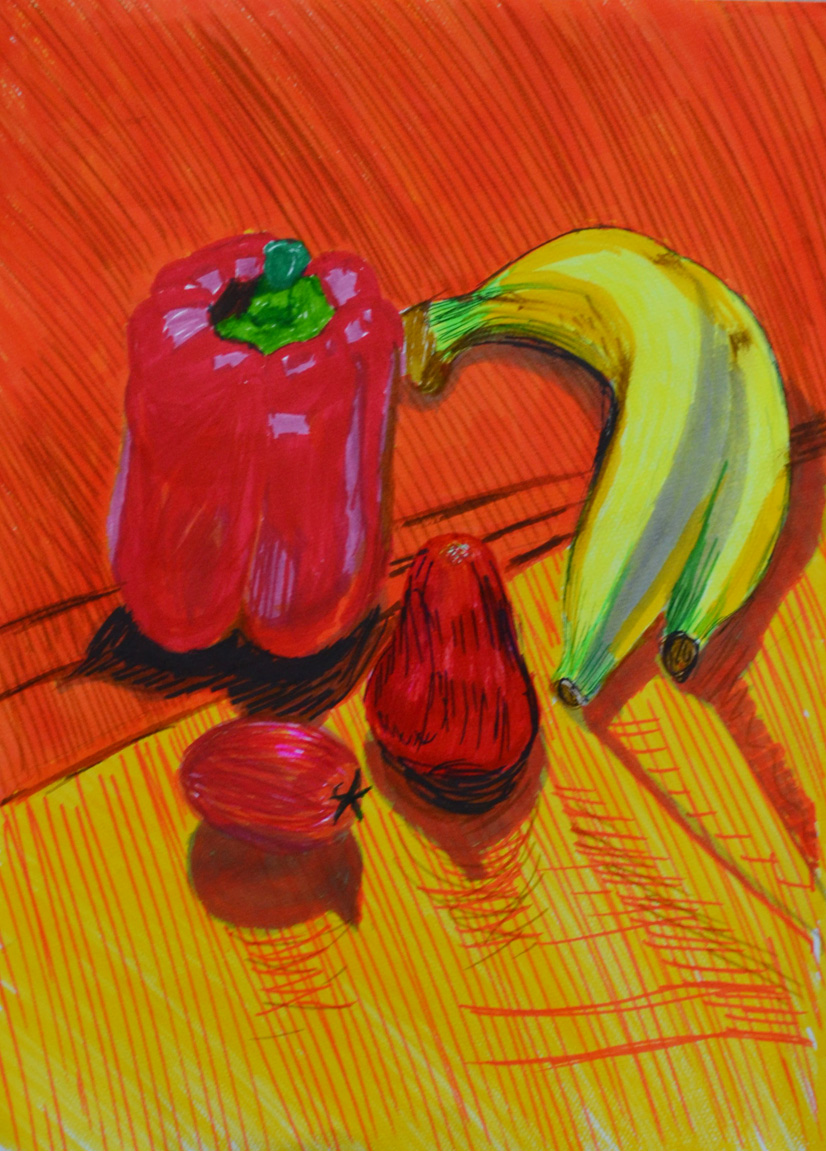
My second composition consisted of a red pepper, bananas a rose apple and plum tomato set on a back drop of two different coloured materials used to make monks robes; but then when I drew the composition in markers on the watercolour paper there was too much red in the picture and the colours weren’t brilliant enough for me.
Using Markers or Dip Pens - 2nd Composition
Using Markers or Dip Pens – 2nd Composition

Composition in Marker Pens
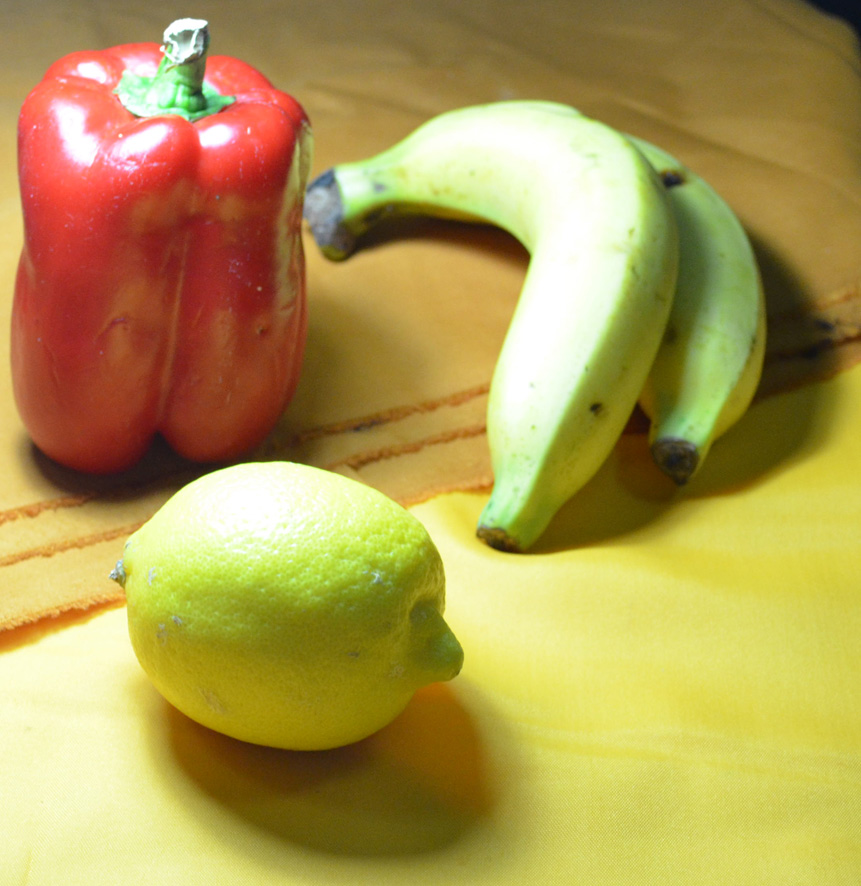
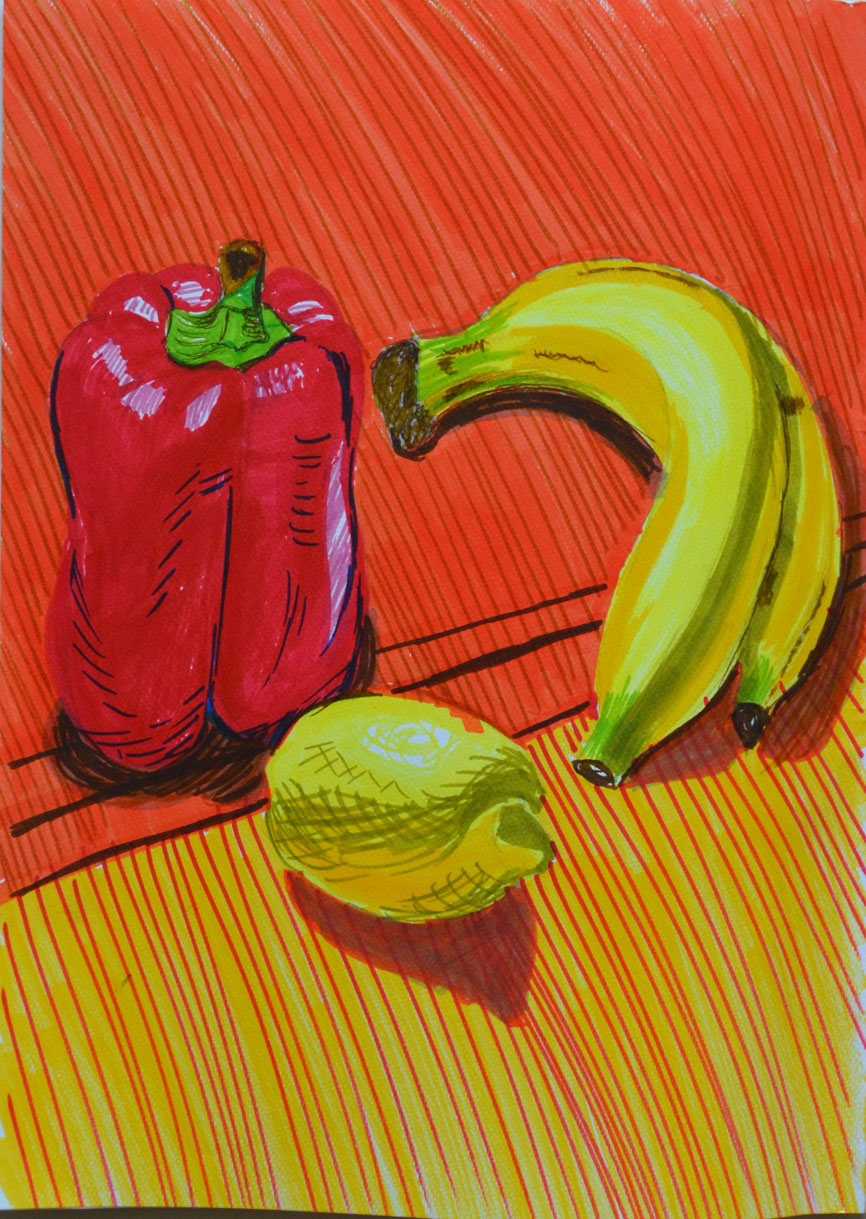
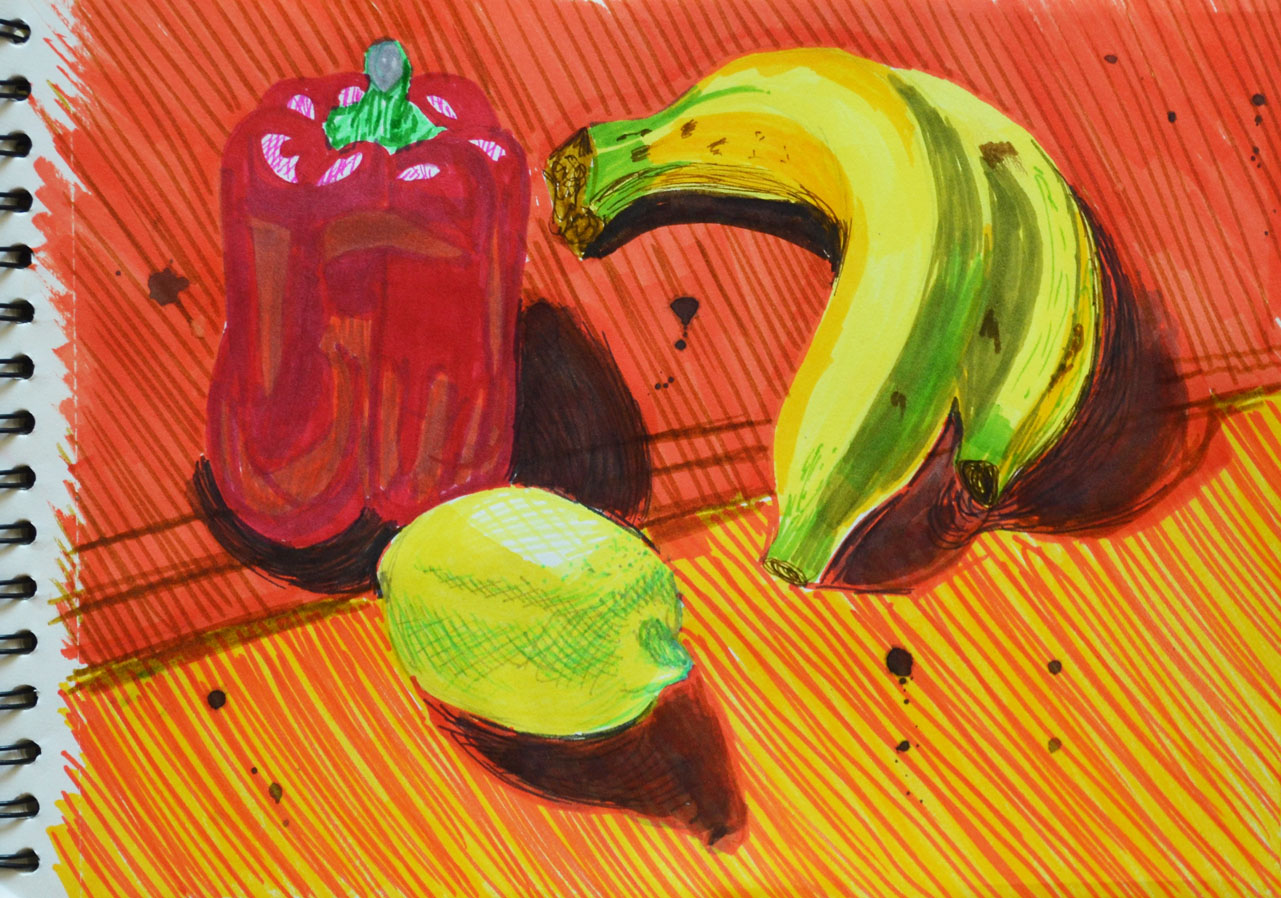
I setteled for a simple composition made up of the bananas, red pepper and lemon that I managed to find in an international supermarket as the Thai lemons are very small and green kind of like a lemon/lime hybrid.

Using Markers or Dip Pens - Final Composition
Using Markers or Dip Pens – Final Composition
Firstly I drew them in marker pens which wasn’t too difficult but getting the colours right before putting pen to paper was almost impossible as the markers reacted differently on the watercolour paper especially when layering at this stage I wasn’t really looking at the shadows and light formations of the surface of the pepper and just added a bit of depth with a dark blue which didn’t work well enough for me.
Chosen Composition in Marker Pens
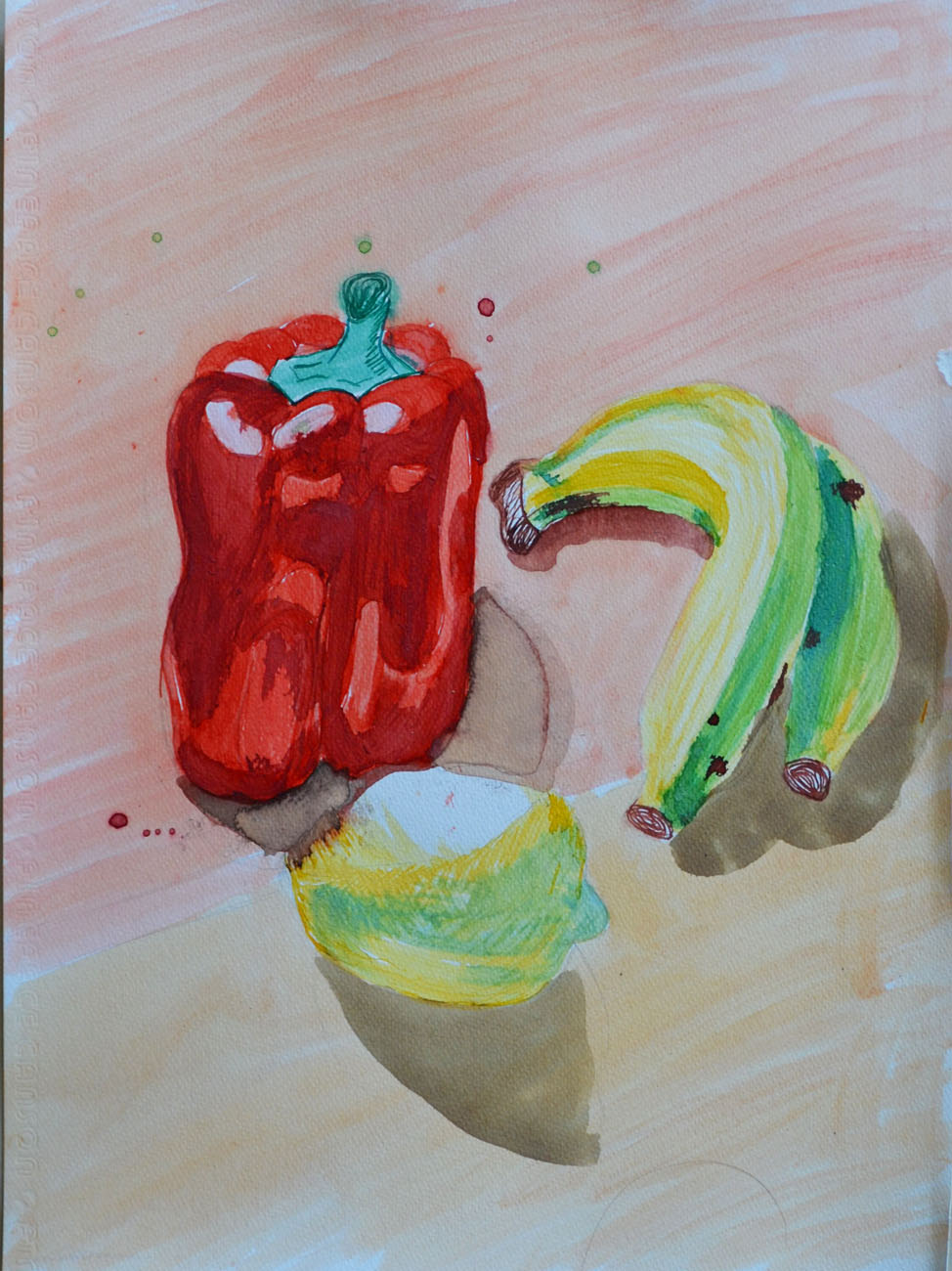
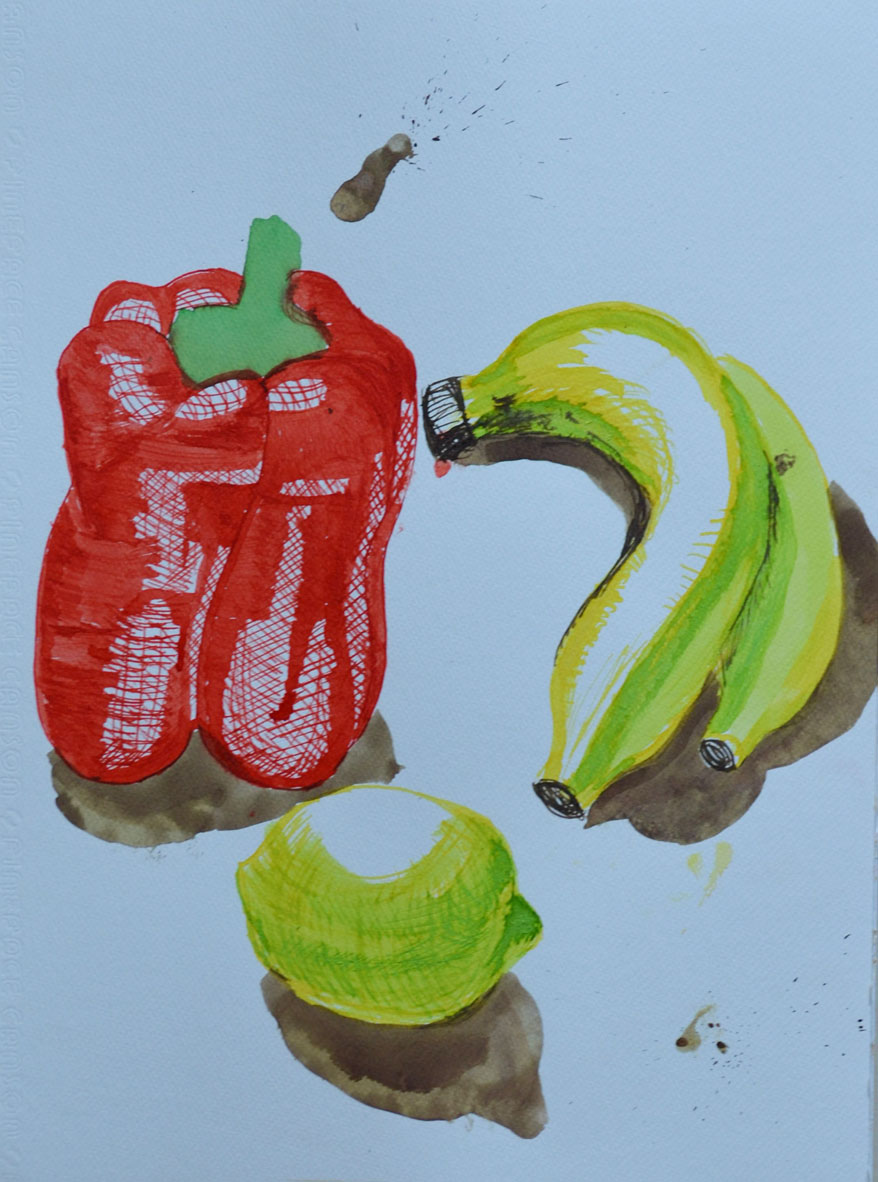
I finally got round to using dip pens and at this stage I felt like packing in. Firstly I started with liquid water colour which did not stay well on the pen nibs I made several attempts which all got binned before going out to look for higher quality watercolour paper that wouldn’t get saturated as easy and some proper drawing inks.
1st Attempt at Dip Pens
1st Attempt with Ink and Dip Pens
My first attempt with dip pens, ink was a disheartening mess and I was trying to work out what I was doing wrong, inks were running into each other and the paper was still getting saturated. Realising that I wasn’t giving the inks on each object enough time to dry before adding different colours I decided to have another go.
2nd Attempt at Dip Pens
2nd Attempt with Ink and Dip Pens
My second attempt with ink and dip pens was an improvement but I decided that I would use markers on the final piece as I could capture the reflected light and shadows on the pepper a lot better with different coloured marker pens and so started work on my A4 piece,
Final Drawing on A4
Final Drawing on A4
I did use a bit of ink on the final piece with a lemon yellow was over the lemon and a dark wash for the shadows which was a bad decision and a couple of ink splashes finished it off. The final piece is not brilliant but I do feel it is an improvement to the earlier drawings and I think I did really well to capture the patterns on the peppers surface.

Drawing 1, Part 2 Observations in Nature, Drawing Fruits and Vegetables in Colour, Using Hatching to Create Tone

For this exercise firstly I was to select some pieces of fruit and vegetables and draw each of them individually in my sketchbook in a medium of my choice paying attention to the shapes or planes that make up the objects outline.
I decided to use colour pencils for this exercise as I needed more practise and have yet to get used to blending. I initially chose an onion, a cucumber and some strange Asian mushrooms for my composition but all that was to change.
Then I was to write my thoughts and ideas next to the sketches including some notes about tonal values and ideas about the arrangement of a composition and use a view finder to crop some of the shapes in different positions.
Using Hatching to Create Tone - Initial choice of objects
Using Hatching to Create Tone – Initial choice of objects
As a view finder I used my camera sometimes looking at a photo of the composition you notice things that you wouldn’t notice with the naked eye. It took me at least two hours to decide on the composition and what fruits and vegetables to change and the angle from which I would draw from, trying my hardest to stay away from similar layouts to the compositions I had used in earlier drawings.
Using Hatching to Create Tone - Orange, apple and dragon fruit
Using Hatching to Create Tone – Orange, apple and dragon fruit
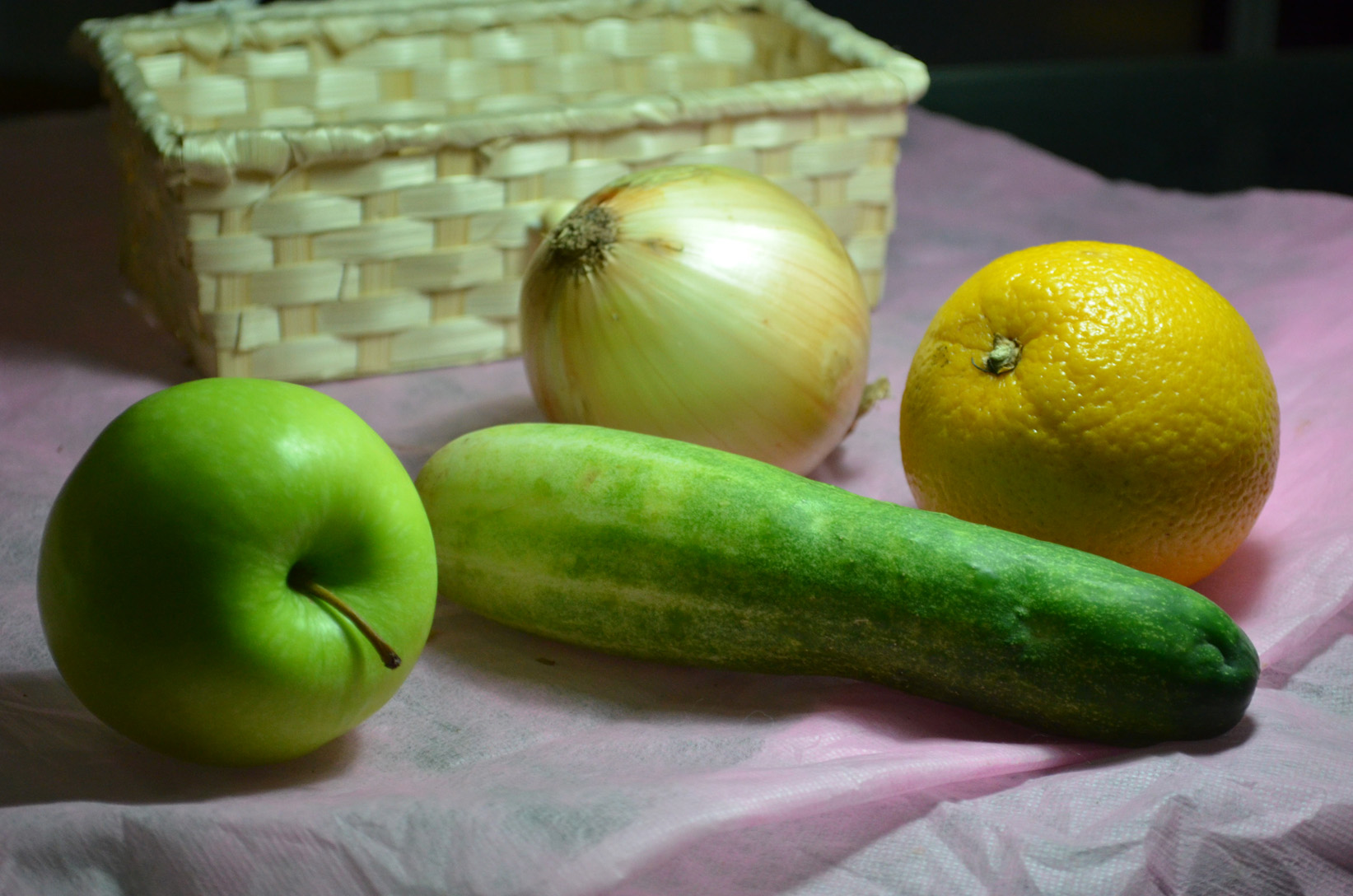
I swapped the Asian mushrooms/toadstools for an orange and an apple as I could use them in different positions and together with the onion the three spherical objects looked great with the cucumber. They also picked up the reflected light from the pink cloth that I decided to use as a backdrop very well.
Using Hatching to Create Tone - Composition
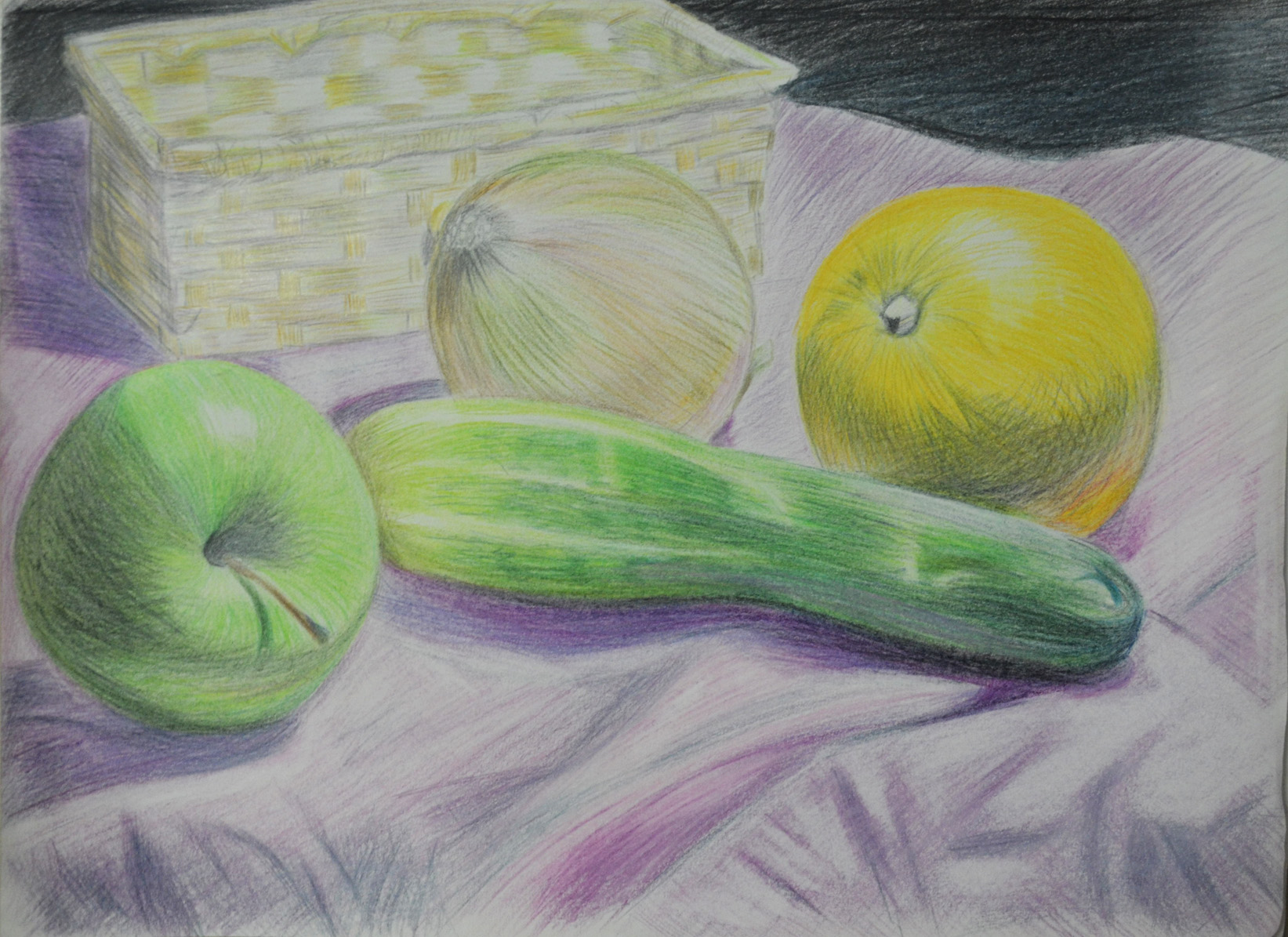
On an A3 sheet of paper I lightly sketched the outline of the objects with a 2H pencil and began to hatch working on the cucumber first but not finishing and then moving to the other objects to see how the cucumber looked against them this helped me decide on tone and colour of the cucumber being the more awkward of the 4 objects.
Using Hatching to Create Tone - Finished Drawing
Using Hatching to Create Tone – Finished Drawing
After working on the other 3 objects I came back to the cucumber which I had to reshape a little bit with an eraser. I’m quite happy with the finished drawing I think the composition fills up the picture plane quite nicely, and I think I did quite a good job with the hatching which I think is more fluid than anything I have done before. Probably the most difficult part of the drawing is the props I used the slightly transparent cloth and the straw basket.
The only think I am not satisfied with really is my photo skills and will try and get a better photo to send in for assessment.
View more Drawing fruits and Vegetables exercises on my my Drawing 1 working log

Tuesday, 7 October 2014

Drawing 1, Part 2 Observations in Nature, Still Life - Still Life Group in Tone

After the last exercise 'Still Life Group Using Line' this exercise sounded like it was going to be a breath of fresh air and indeed it was...
Still Life Group in Tone
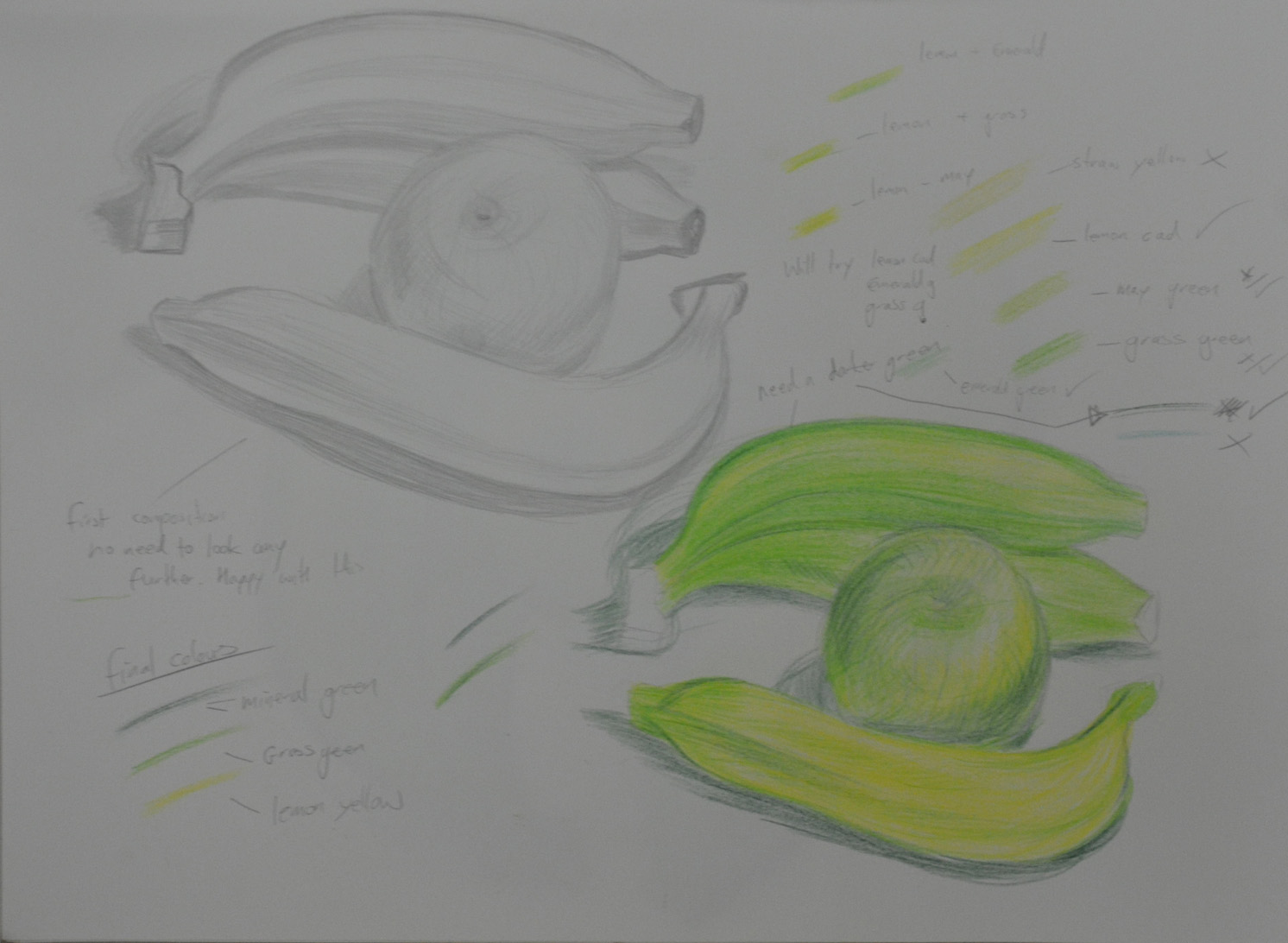
I started with a bit of a study to firstly get the right composition for this exercise and then to try out different colours so I could find three colours that would give me three different tones for this drawing. I feel like I cheated on this exercise as I chose objects that could be drawn easily enough with just three colours, a yellowy green banana, an apple and two green bananas but I just started a high fruit diet the week before and I used objects that were at hand.
Like it instructed me in the brief I screwed up my eyes to take a look at the dark colours only and lightly sketched them in and then chose a different colour to sketch in the mid tones, then another for the light tone. On completion of the initial sketch I decided that my darkest colour was too light and so changed it for my final drawing.
Still life group in tone
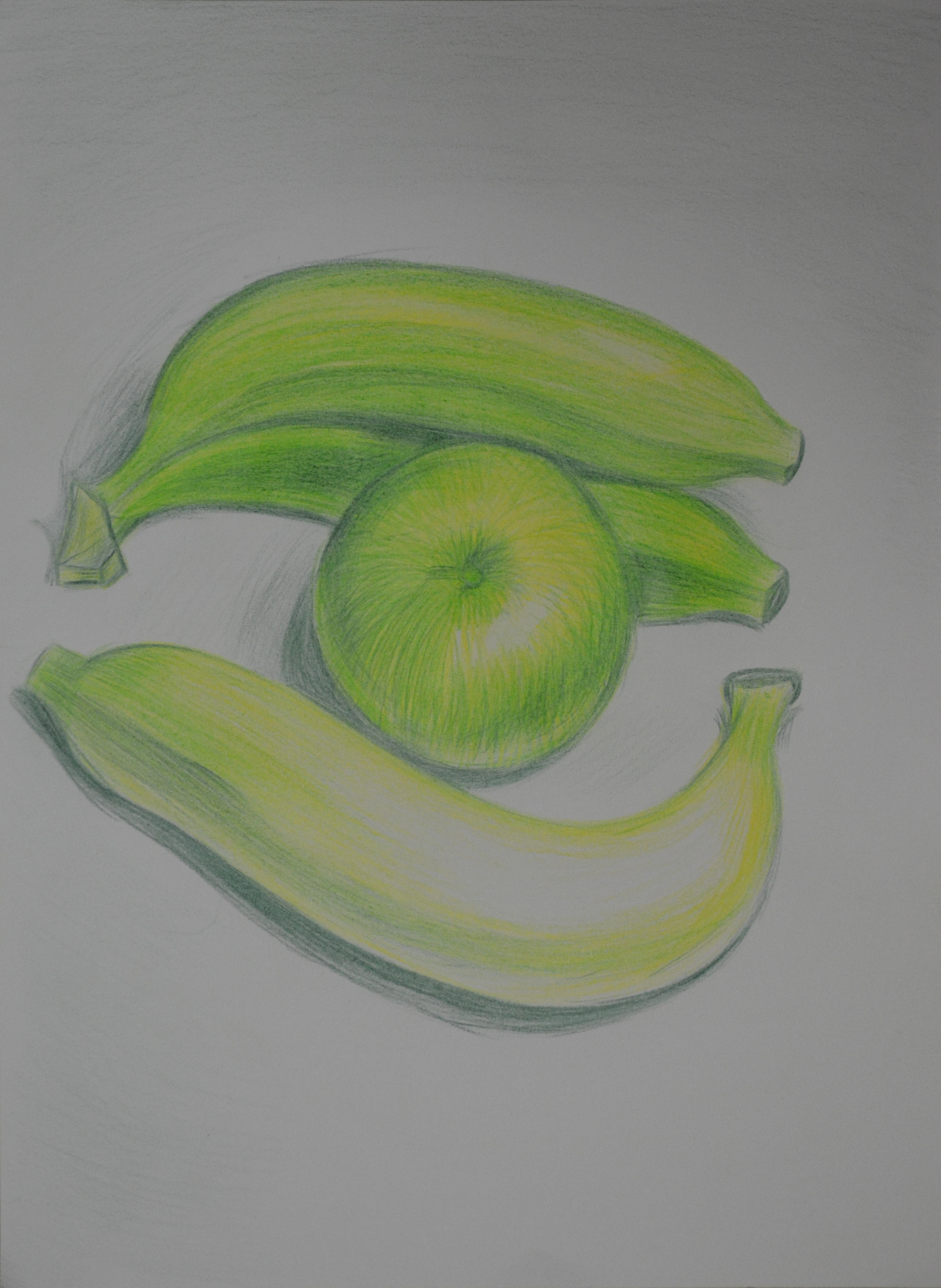
I changed the composition of my final drawing slightly so I could depict the full form of the apple and I'm glad I did. The final drawing took me less than two hours going at a really steady pace and I am really satisfied with the completed drawing and my choice of colours, It would have been nice to apply a fourth colour though and also maybe a variation in orange and reds.
The one thing I am not happy with is the amount of blank space I left on the paper but I tried to make up for this by shading with my darkest colour.

Drawing 1, Part 2 Observations in Nature, Still Life, Still Life Group Using Line

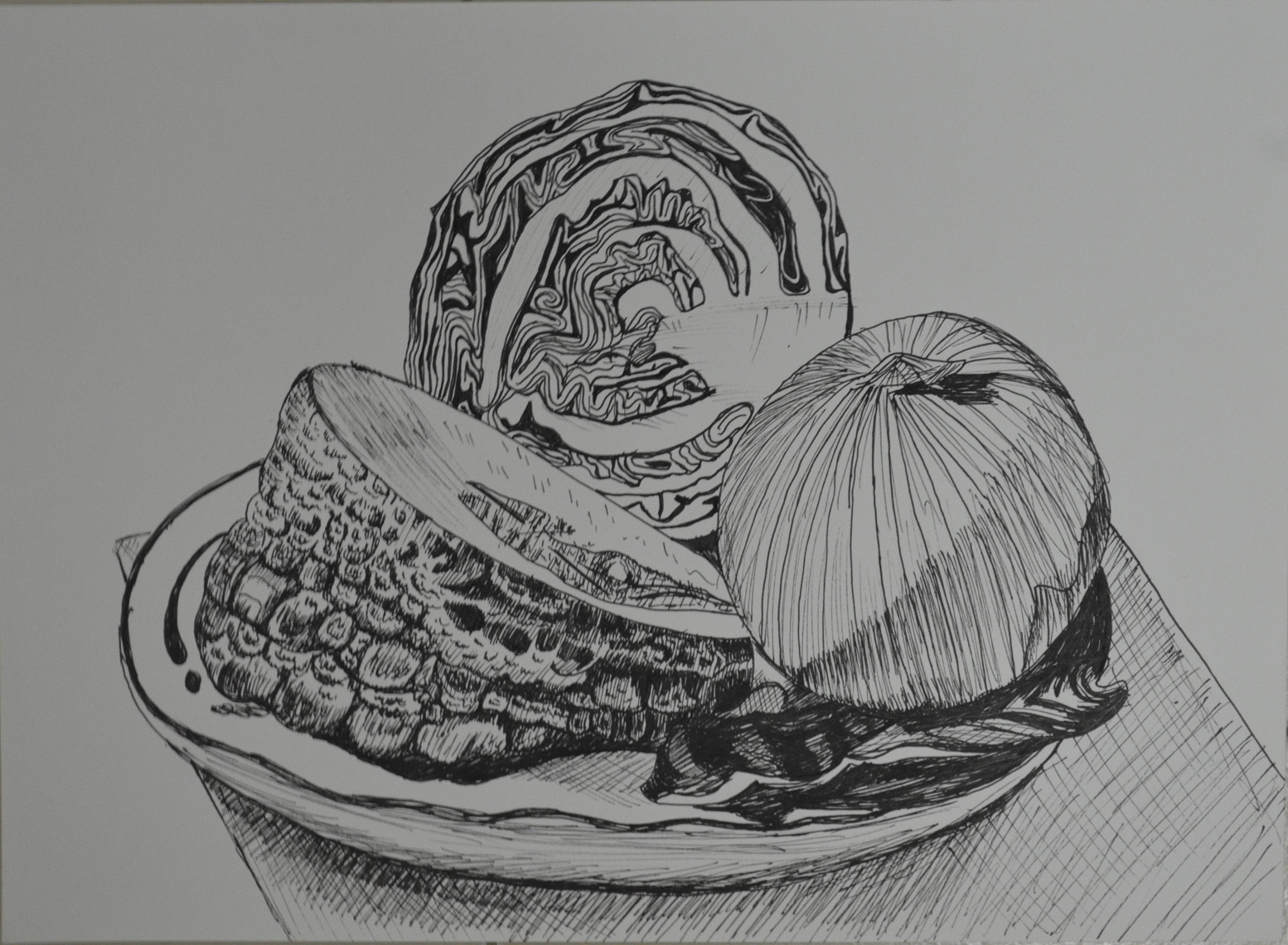
In the brief for this exercise I was to set up a still life group out of objects at my disposal, either objects that naturally connect together or deliberately contrast. For this I did a supermarket shop and purchased onions, a big chunk of knobbly Asian pumpkin and a red cabbage thinking about three objects that gradually went from rough to smooth.
I had to think about the following questions: 'How will I treat the objects?', 'How will their connections be clear?', 'How will I capture the differences between the objects?', 'How do the objects relate to their background? and 'How will I reference the colour in the group in this drawing?.
Then with these questions in mind I had to select a medium such as pen and ink, marker pens or fine black pen and A3 paper and begin to draw; which is exactly what I did. I wanted to use pen and ink for this drawing as I have kept delaying it but when i saw I would be using them in the next project I decided to use a Rotring 0.3 drawing pen.
My objects had already been in the fridge a couple of days so they wouldn't last long once I took them out and my SD card for my camera kept locking due to me removing it too often so I had to work fast as I couldn't get a photo to work from in case I didn't finish before evening came.
 Still Life Group Using Line 1st Drawing
Still Life Group Using Line 1st Drawing
There was no drawing this out in pencil first for me, I wanted to do start as I meant to go on and and put my Rotring drawing pen to paper. I started on the outline of the three objects together rather than drawing them individually then when the outline was complete I finished the shape of each object individually.
From there I started on the lines of the onion which were fairly simple and while I worked my way around the onion with a variation of light and dark lines (applying different pressures) I thought about how I was going to approach the different objects. Working from right to left I tackled the red cabbage next and it was extremely difficult; trying to view the patterns as a whole and then working on the lines individually was enough to drive me crazy.
The pumpkin was the next obstacle and because this was a still life group using line I had to exaggerate the texture of the pumpkin at certain parts where there was no real pattern at all. It looks like I have tried my hardest to depict tone here but actually I wasn't thinking about tone at all. I was just trying to complete the surface of the pumpkin with as many different line as possible, squiggly lines, short strokes, anything that came to mind.
The cabbage leaf on the right of the drawing was probably the most difficult object in this drawing and was very difficult to draw without hatching to depict it's smoothness which I wasn't very successful in doing so.
Then when I finished the composition I ruined the whole picture by doing some stupid speckle background and so I decided to have another go.
Still Life Group Using Line 2
This time I tried a slightly different angle and the finished drawing was cleaner but there are a lot more things that I am unhappy with. For one I don't know how the cutting board got so out of shape the cabbage leaf didn't turn out that great and the pumpkin surface was a little too exaggerated but certain parts of the pumpkin surface turned out a lot better.

Wednesday, 14 May 2014

Drawing 1, Part 2 Observations in Nature, Detailed Observation, Line Drawing Detail

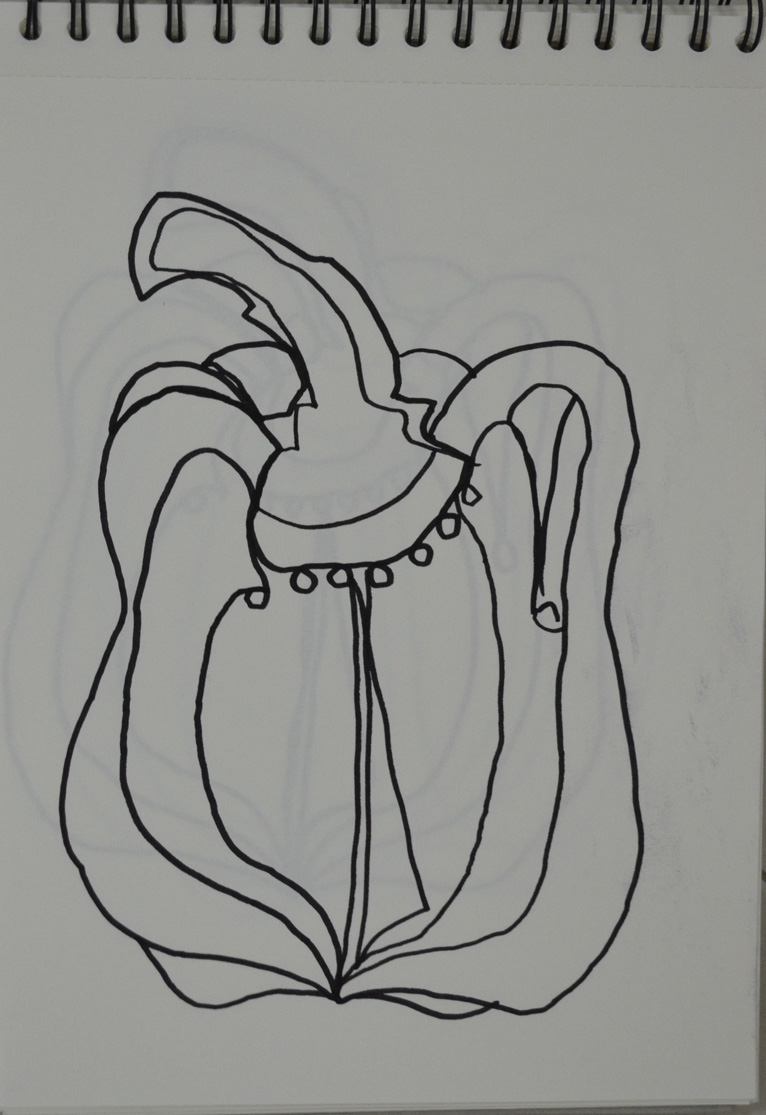
For this exercise I was to select an object with interesting detail such as a sliced through red cabbage or a fir cone. Then on a sheet of A4 paper create a line drawing of the object that I set up, taking time and effort to really look at the patterning, thickness of line, texture and shape of the overall composition. The brief also said that I was to position the drawing well on the paper and fill the paper effectively with a continuous line drawing and no shading which is what I TRIED to do...
I made a few attempts at this with two different subjects, both of which were green peppers but in the Bangkok heat they go off pretty quick. With the first pepper every attempt was a continuous drawing with minimum detail, I used the thick nib of a double tipped felt pen and although the subject fit well on the paper, I didn't give it a strong enough light source to pick up all the detail and too be honest the finished drawings at that line thickness all looked somewhat pathetic.
Exercise - Line Drawing Detail First Subject
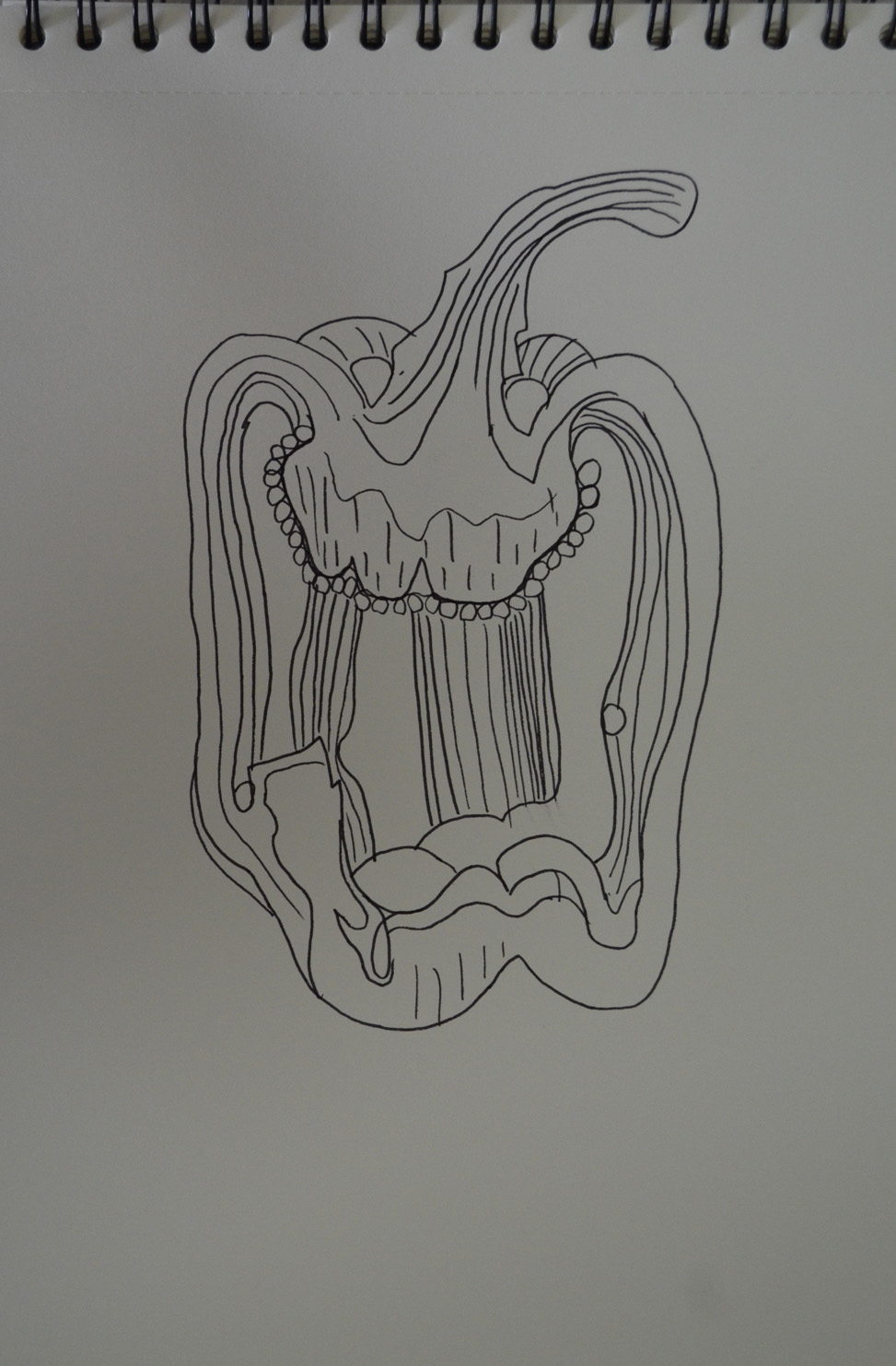
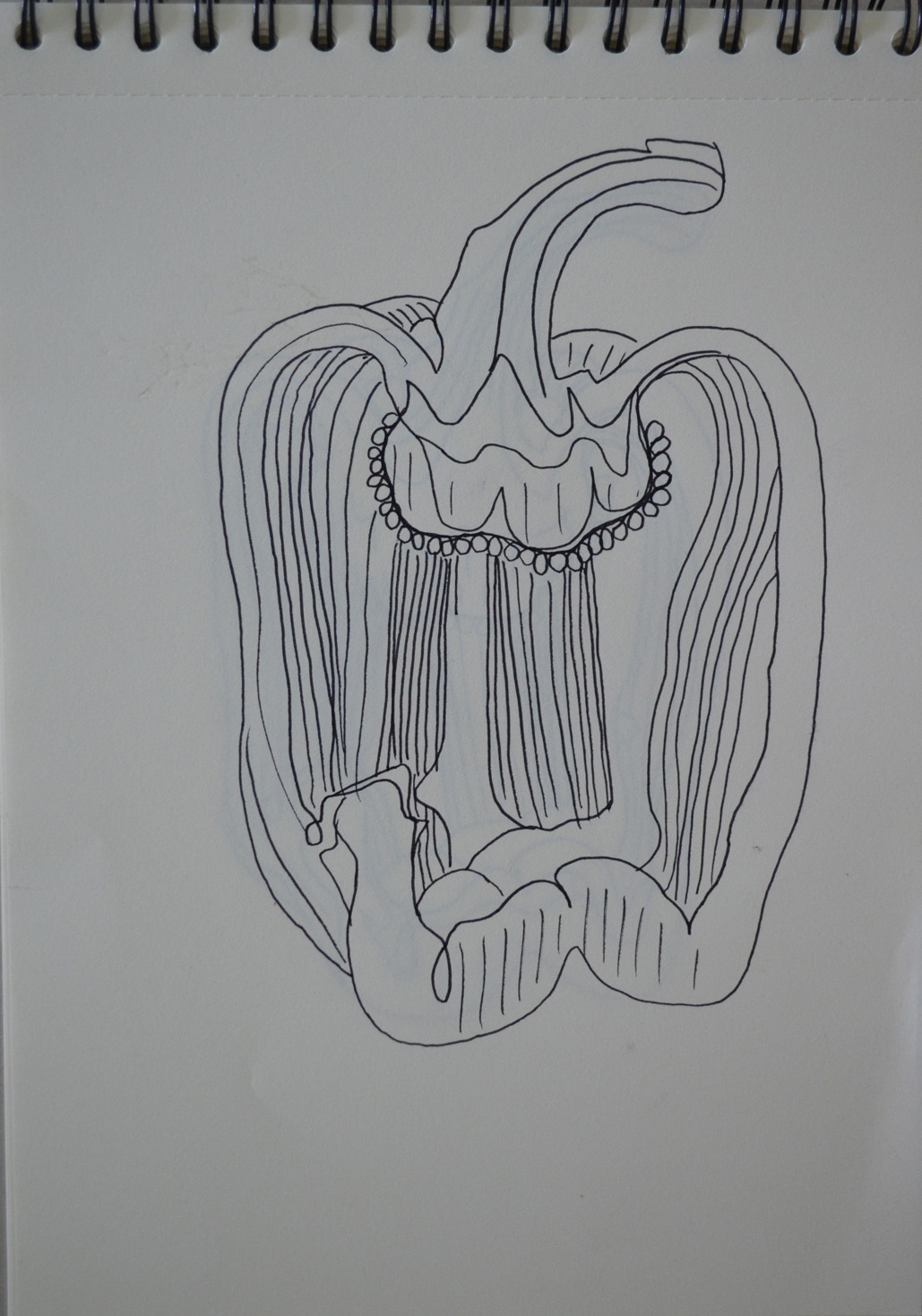
I gave it a week with another exercise in between before I had another go at this exercise. Visually the drawings with the second subject look a lot better, I used the finer nib of the felt pen and this time after I completed what I could do continuously without taking my pen off the paper I decided to add the detail which were the ribs on the inside of the pepper that I could see from wisely using a light source this time.
Exercise - Line Drawing Detail Second Subject 1
Exercise - Line Drawing Detail Second Subject - Image A
I probably did go a bit overboard and it does look like I have had a go at shading the object but this is all down to the closeness off the lines on the inside of the pepper. However I am quite happy with the results.
Exercise - Line Drawing Detail Second Subject 2
Exercise - Line Drawing Detail Second Subject - Image B
The thing that I am not happy with however is the positioning on the paper and how much space I left to the sides and underneath it. When drawing an object such as a pepper with a very irregular shape I think it's best if you know where to start, in Image A above I started at the core just above the seeds. With Image B I started at the tip of the stem Starting near the center of the image was better with this object but that would differ with something like a cabbage.

View my full Drawing 1 Learning log

Drawing 1, Part 2 Observations in Nature - Research Point: Masters of Detailed Drawing - Modern Artist, Eliot Hodgkin

For this research point I was asked to find two artists who exemplify mastery of detailed drawing 1 from the 19th century or earlier and a modern artist. I already researched the 19th century artist Thomas Hartley Cromek in 'Masters of Detailed Drawing 1, 19th Century, Thomas Hartley Cromek' and it was now time to find a Modern artist. Again I wanted to find an artist that I wasn't familiar with so I started my search on Google looking for British artists of the 20th century. A list of names of British artists came up on Wkipedia so I went down the names looking at their work 1 artist at a time.
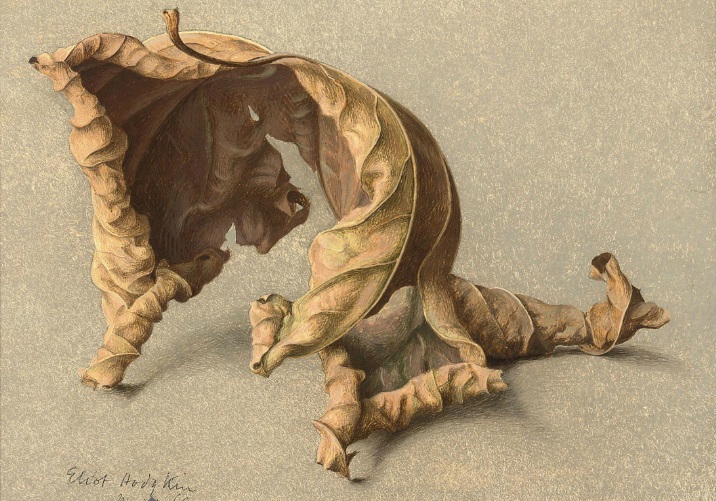
I came across the name Eliot Hodgkin, a name that I was very familiar with but I'm not sure from where so I took a look at his work to see if I recognised any of his paintings. I had never seen any of his paintings before but what I did see was truly inspiring and perfect for this part of the course. With the image below Large Leaf 2 particularly catching my eye as near my school there are some very similar large leafs that I would love to draw for this part of the course.
Eliot Hodgkin Large Leaf 2 Tempera on Card
Curwen Eliot Hodgkin was an English painter born into a Quaker family in Purley-on-Thames on 19 June 1905 and was the cousin of abstract painter Howard Hodgkin. Eliot Hodgkin was educated at Harrow School but his artistic life began at the Byam Shaw School of Art and then at the Royal Academy Schools where he studied under Francis Ernest Jackson.
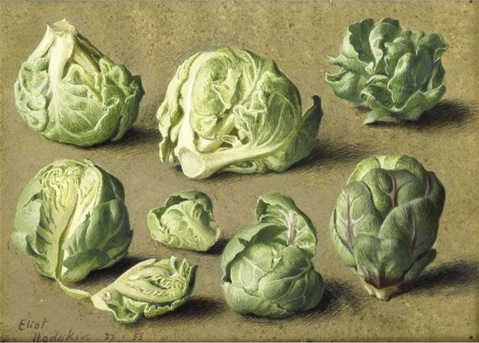
Eliot Hodgkin Seven Brussel Sprouts
Hodgkin had already established himself as a still life and landscape painter by the mid-1930s and regularly exhibited at the Royal Academy. In 1937 Hodgkin started working in egg tempera a recipe that was given to him by his close friend and former teacher Maxwell Armfield.
Hodgkin stated that he wasn't attracted to tempera as a medium as it was used by Italian primitives and their work did not do anything for him, he simply used tempera as it was the only medium that allowed him to express the unique character of the objects that fascinated him.
Hodgkin said that his conscious purpose was to 'show the beauty in natural objects'- that people would usually think unattractive such as 'Brussels sprouts, turnips, onions, pebbles and flints, bulbs, dead leaves, bleached vertebrae, an old boot cast up by the tide.'
When i did a search for his paintings and saw his work the first thing that went through my mind was how beautiful his paintings were and yet his compositions are so very simple. I have heard of tempera before but as far as I know I have never seen anything painted in it until now and I knew at firs glance that they were painted in a medium other than oil or acrylic.
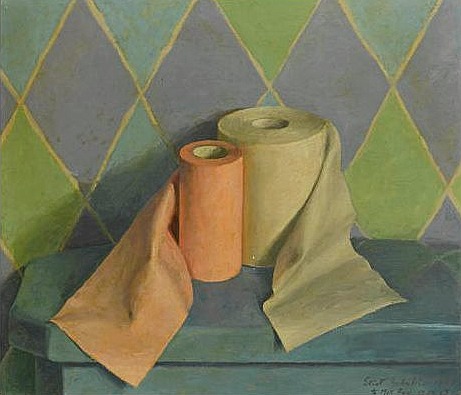
He depicts the texture of his objects wonderfully and his paintings are so crisp and life-like but still he manages to express them in a way that makes u aware of the beauty of these objects for the first time with wonderful contours and a brilliant balance of light and dark tone, whether it be a dead leaf or a toilet roll.
Toilet Rolls Eliot Hodgin
Like Eliot Hodkin Says ' People sometimes tell me that they had never really ‘seen’ something before I painted it, and I should like to believe this… For myself, if I must put it into words, I try to look at quite simple things as though I were seeing them for the first time and as though no one had ever painted them before.'
For me I agree with others that to see these objects in his paintings is to 'see' them for the first time with detail and beauty that you would never notice before. Hodgkin really makes you notice every part of the object, every leaf, every crease and every pattern on the objects surface.
Bibliography - Wikipedia

Sunday, 16 February 2014

Drawing 1, Part 1 Mark Making and Tone, Using Texture – Check and Log


Have you discovered any new ways of using your drawing tools to depict surface and texture?


Not as much as I wished I had, there were a few things that I couldn’t find here in this part of Bangkok such as a chunky sponge, I would have loved to have tried dripping or splashing ink for the texture of this. However I did discover new ways of hatching for as in the the fur of the teddy bear, hatching with small strokes in flowing patterns. I also discovered new ways of using my putty rubber to show texture such as twisting for the mop rug underneath my composition.
a Drawing with Textures - Second Drawing
a Drawing with Textures – Second Drawing
How successful were you at implying form with little or no tonal hatching?
I seemed to use some kind of hatching for nearly everything except the mop rug. The technique that I used to depict the mop strings (as I would call them) showed real depth. This was a mixture of squiggles, circles smudging and twisting with a putty rubber and it worked well.
What are your impressions of frottage as a drawing technique?
I really love the idea of using this as a drawing technique and I love the way that a surface of one thing can give you a totally different result to what you thought it would and how something as simple as the joint of 4 breeze blocks can give you an idea for a drawing of a crucifixion or graveyard scene. The best thing about frottage is that you can use it for texture in drawing you are already working on or it can give you an idea for a new drawing.
Yellow crayon on breeze block wall

Drawing 1, Part 1, Mark making and Tone, Using Texture, Experimenting with Texture – Part A


In this exercise I gathered together a a range of objects with different surfaces, some I bought and some I already had. The objects that I used were a takraw (Siamese football), shaggy teddy bear, a towel, mop mitten and  Scotch-Brite brillow sponge as well as a woven basket, PVC chair, wire wool, toilet roll and leather Lay-Z-Boy (not the whole thing) plus a couple of other different surfaces.


Experimenting with Texture 1
In my sketchbook I made a series of approximately 5 cm squares and used both pens and pencils to depict the textures in the squares. To depict the surfaces I used several different techniques such as hatching (takraw ball), irregular hatching squiggles and stippling (Scotch-Brite sponge) and very short hatching (towel) as well as some very irregular marks for my leather look PVC chair and the creases in the arms of my Lay-Z-Boy armchair. I also tried stippling with felt tips for a toilet roll tube but I could not get it to look anything like.
Experimenting with Texture 2
One surface that created something of a challenge was the shaggy teddy bear fur and so I chose this as well as the woven basket for the exercise ‘A Drawing with Textures’.

View My Drawing 1 learning log here www.mydrawingcourse.com