Showing posts with label Observation in Nature. Show all posts

Monday, 27 October 2014

Drawing 1, Part 2 Observations in Nature, Drawing Fruits and Vegetables in Colour, Research Point: Ben Nicholson

Born in to an artistic family in Denham, Buckinghamshire in 1894 Ben Nicholson was the son of artists William Nicholson and Mabel Pryde.  In 1896 the Nicholson family moved to London where Ben was educated at the Tyttenhangar Lodge Prepatory School in Seaford before becoming a boarder at the Gresham’s School for boys in Holt, Norfolk. Ben Nicholson began his training as an artist in London at the Slade School of art, where he studied from 1910 – 1911, then from 1912 to 1914 he travelled between France, Spain and Italy.
In 1920 Nicholson married is first wife, painter Winifred Roberts to whom he had three children, two sons, Jake and Andrew and a daughter Kate, who also became a painter. From 1923 Ben and Winifred split their time between England and Switzerland spending their winters in the southern Swiss town of Lugano and the rest of the year was divided between Cumberland, where they made their home for that decade and London While In London following an exhibition with his wife Winifred he was invited to join the 7 & 5 Society, he was made chairman of the society in 1926.
Nicholson’s early paintings were still-lifes influenced by the works of his father but then after his first solo show at the Twenty-one gallery he began experimenting with abstract painting influenced by Synthetic Cubism which he implied in all his works thereafter. His works throughout the 1920s were of deceptively simple table top still-life’s and landscapes painted in Switzerland, Cumberland and Cornwall, making his first visit there in 1928.
While visiting France in 1932 and 1933, Nicholson became familiar with the works of artists such as Hans Arp, Joan Miro, Piet Mondrian and Alexander Calder who had settled in Paris in the 1920s. Nicholson was successful in fusing the European trends into a new style that would become identified as his own.
He made these visits to Paris with Barbara Hepworth; Winifred and Ben were divorced in 1938 a break up that was brought on by his growing relationship with Wakefield born sculptor. Hepworth had kids to Nicholson in 1934, three triplets and after his divorce in 1938 she would become his second wife.
Together they moved to Cornwall in 1939 and in 1943 he joined the St. Ives society of artists. Following the Second World War Nicholson lost faith in the ‘utopian promise of geometric abstraction’ and resumed painting landscapes adding colour to his abstract reliefs to emphasize the fundamental unity between nature and abstraction. Hepworth and Nicholson were divorced in 1951.
Throughout the 1950s he achieved international recognition as an artist through a series of awards which included the first Guggenheim International Painting Prize in 1956 and the International Prize for Painting at the São Paulo Biennale in 1957. From 1954 – 1961 retrospective exhibitions of his work were held throughout Europe including shows at the Venice Biennale and Tate Gallery and in several cities in the USA in the 60’s and 70’s.
Nicholson married his third wife, German photographer Felicitas Vogler in 1957 and the two moved to Ticino in Switzerland in 1958 where he again began to concentrate on painted reliefs. In 1968 Queen Elizabeth awarded him the O.M. (Order of Merit) and in 1971 after the end of his third marriage he moved back to England where he died in London in 1982 at the age of 87.
Researching this Artist
I used many different websites researching this artist as the information I found was confusing and contradictory, with information differing from site to site and so I chose to gather information from the websites of establishments that I found out at shown his work, The British Council, Tate Gallery and the Guggenheim comparing the details with the biographywww.oxfordartonline.com.
I have never heard of Ben Nicholson before although his second wife Barbara Hepworth is very familiar to coming from Wakefield I have seen her works in West Bretton (Yorkshire Sculpture Park). Since I have been living in Thailand they have opened the Hepworth Center in her name in my home town so it was interesting to read about their relationships, both personal and professional.
Although I have never heard of the artist by name before, I did recognise a few his works, including 1934 (Still Life – Birdie) 1933 (Study of a Head) and 1932 (Head and Mug in a Greek Landscape).
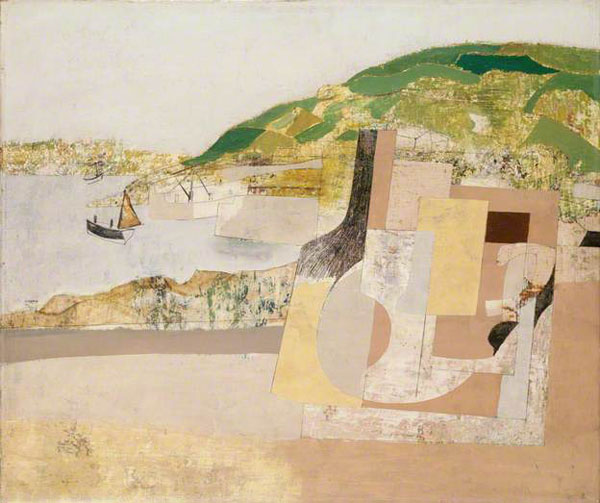
Ben Nicholson Mousehole 1947
Why does he simplify still life forms and negative space and superimpose them on a Cornish Landscape?
I think the answer to this lies in the above text where it says Nicholson ‘resumed painting landscapes and added colour to his abstract reliefs to show the fundamental unity between nature and abstraction’.  Which maybe reflected in what he said in a letter from Nicholson to Patrick Heron (9 February 1954) ‘All the “still lifes” are in fact land-sea-sky scapes to me.’
Bibliography:

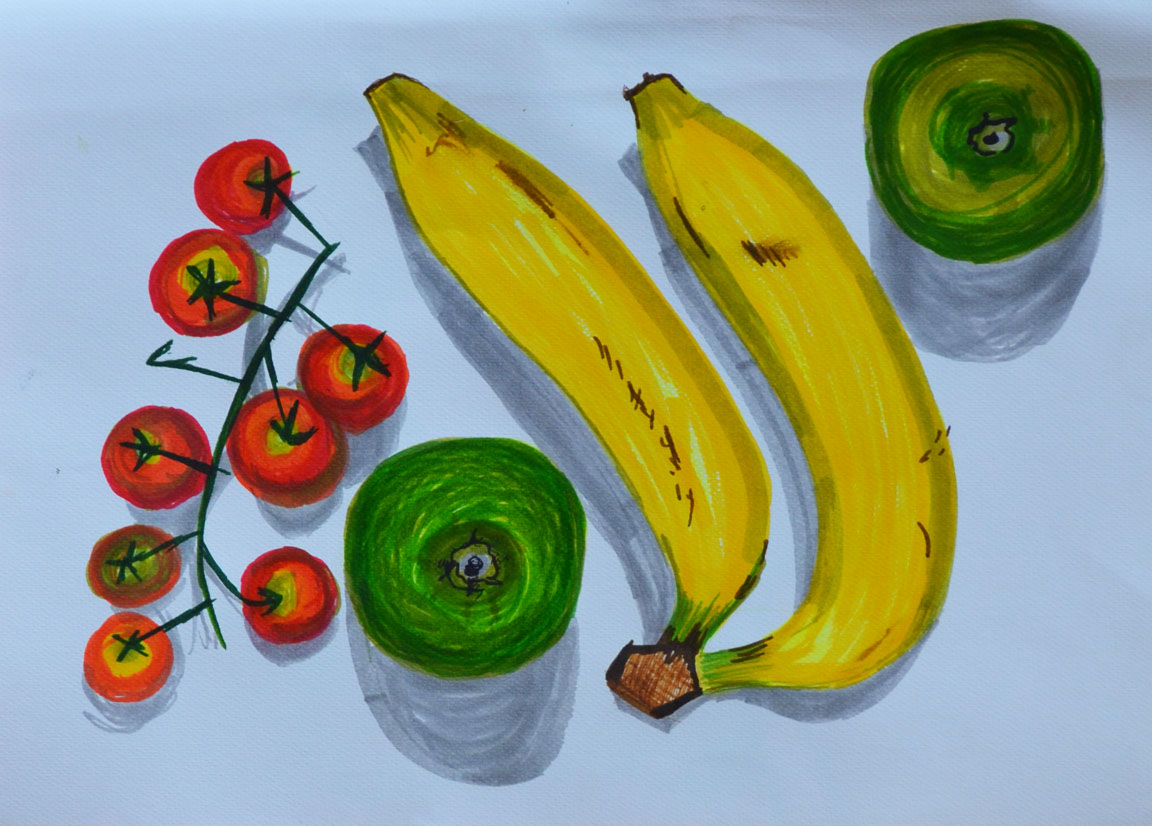
Drawing 1, Part 2 Observations in Nature, Drawing Fruits and Vegetables in Colour, Using Markers and Dip Pens

For me this was a stressful exercise that took me over two weeks to complete. I initially wanted to focus more on dip pens and ink for this exercise but it was a mediu I would continue to have problems with.
I started with markers as I already had a good choice of Kurecolor Markers, with a composition that consisted of vine tomatoes, bananas and an apple however I failed miserably looking down at the apple at that angle plus I didn’t have the right colour for the apple.
Using Markers First Composition
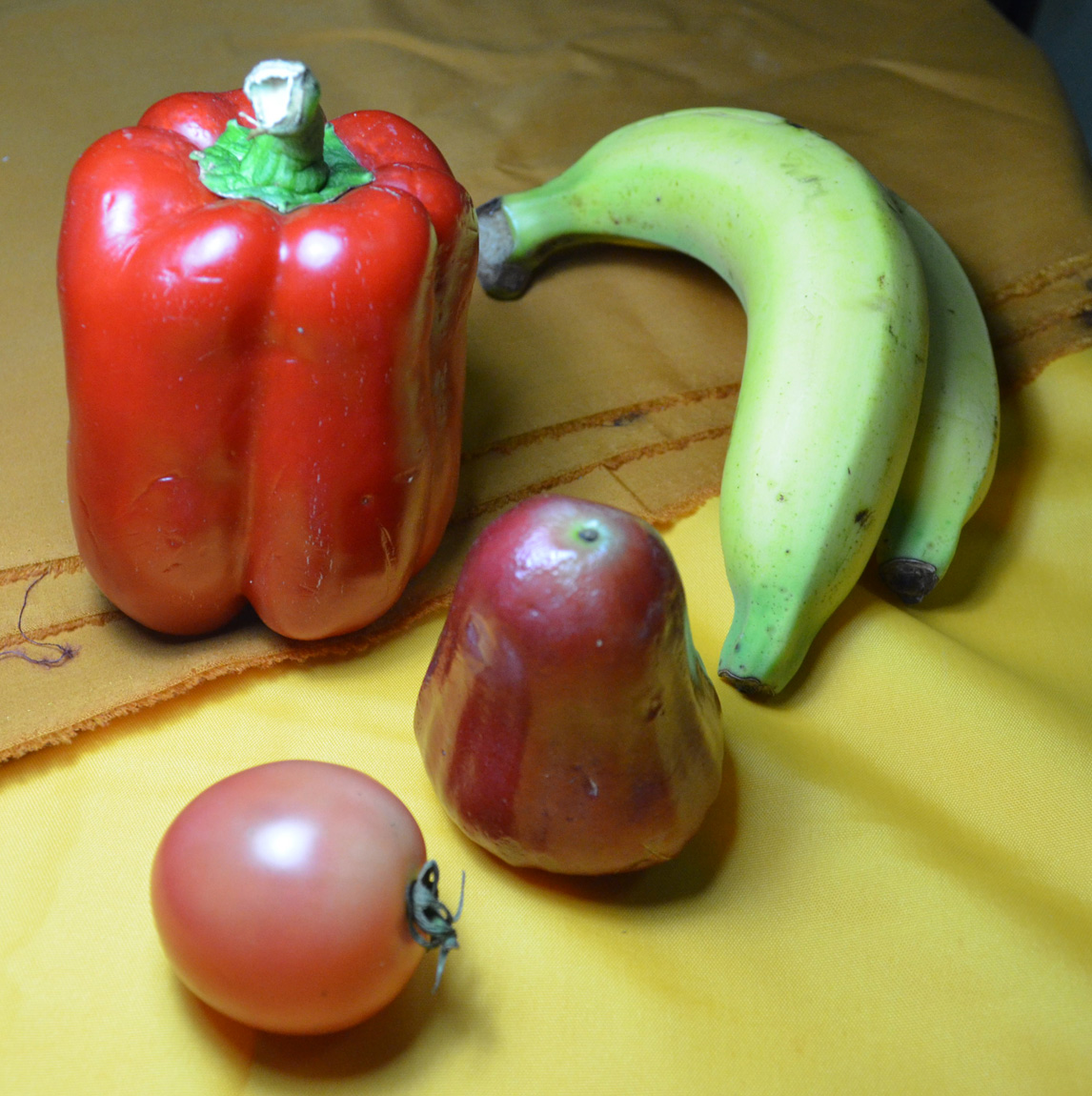
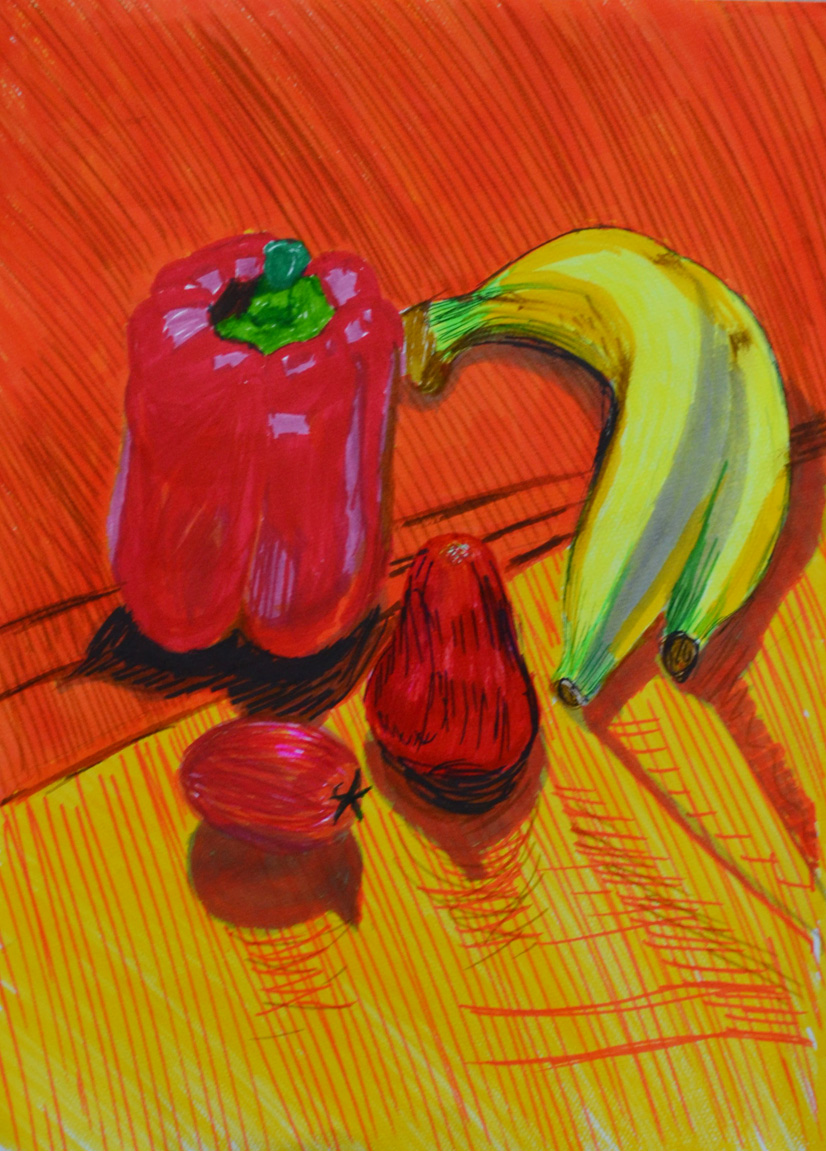
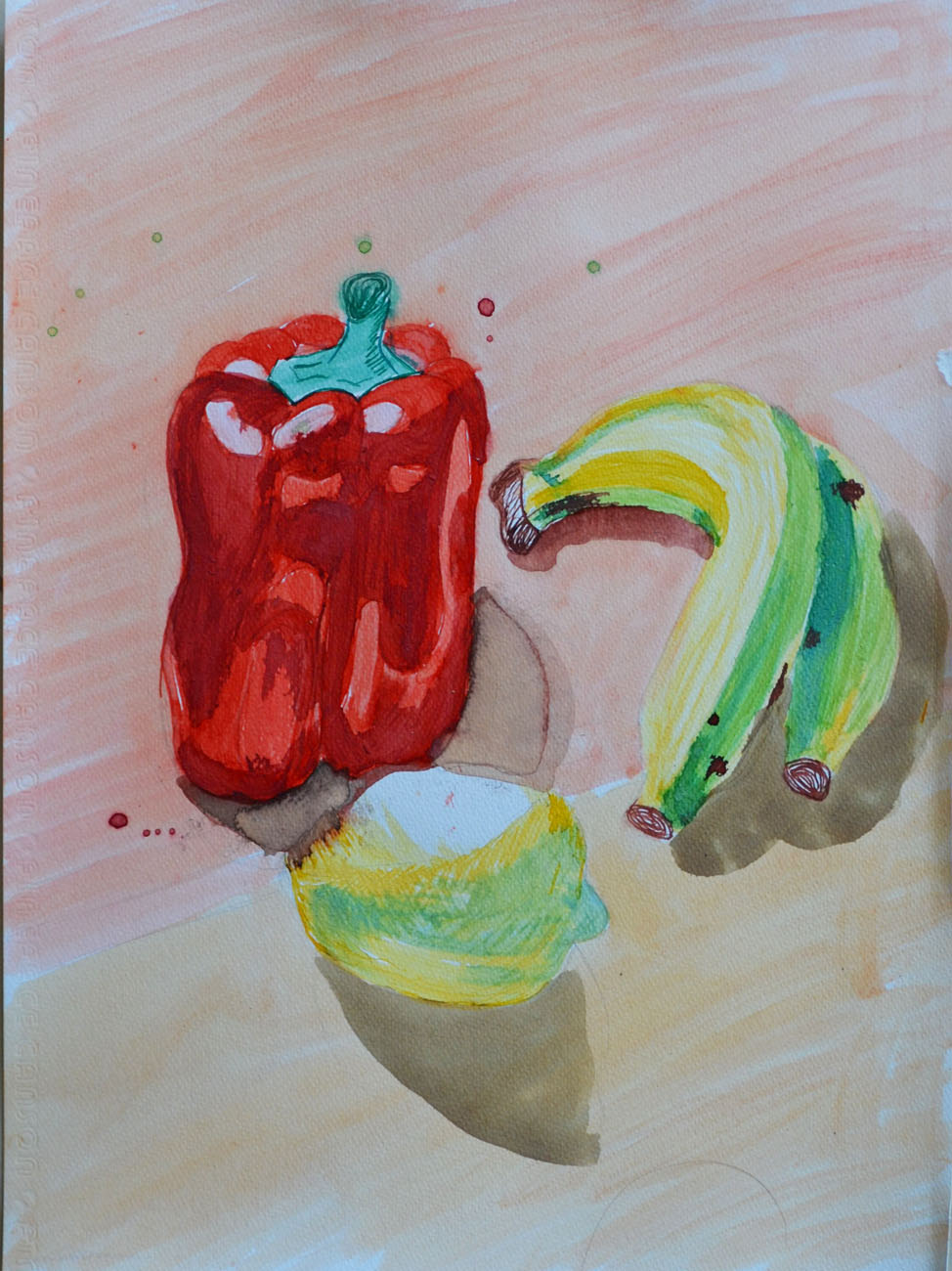
My second composition consisted of a red pepper, bananas a rose apple and plum tomato set on a back drop of two different coloured materials used to make monks robes; but then when I drew the composition in markers on the watercolour paper there was too much red in the picture and the colours weren’t brilliant enough for me.
Using Markers or Dip Pens - 2nd Composition
Using Markers or Dip Pens – 2nd Composition

Composition in Marker Pens
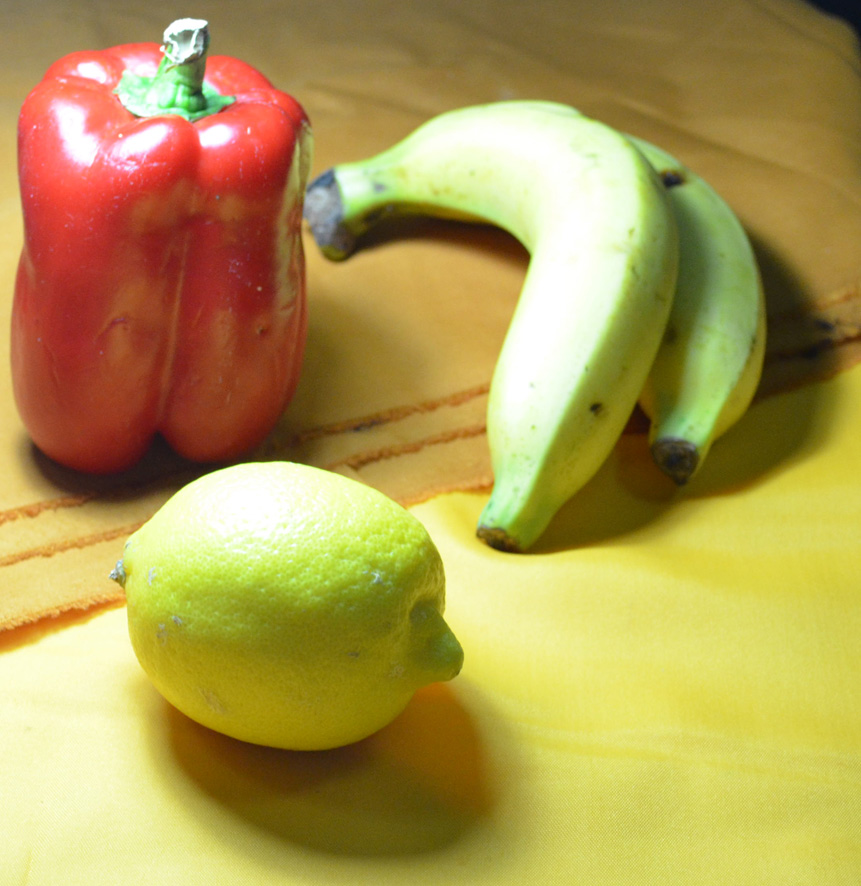
I setteled for a simple composition made up of the bananas, red pepper and lemon that I managed to find in an international supermarket as the Thai lemons are very small and green kind of like a lemon/lime hybrid.

Using Markers or Dip Pens - Final Composition
Using Markers or Dip Pens – Final Composition
Firstly I drew them in marker pens which wasn’t too difficult but getting the colours right before putting pen to paper was almost impossible as the markers reacted differently on the watercolour paper especially when layering at this stage I wasn’t really looking at the shadows and light formations of the surface of the pepper and just added a bit of depth with a dark blue which didn’t work well enough for me.
Chosen Composition in Marker Pens
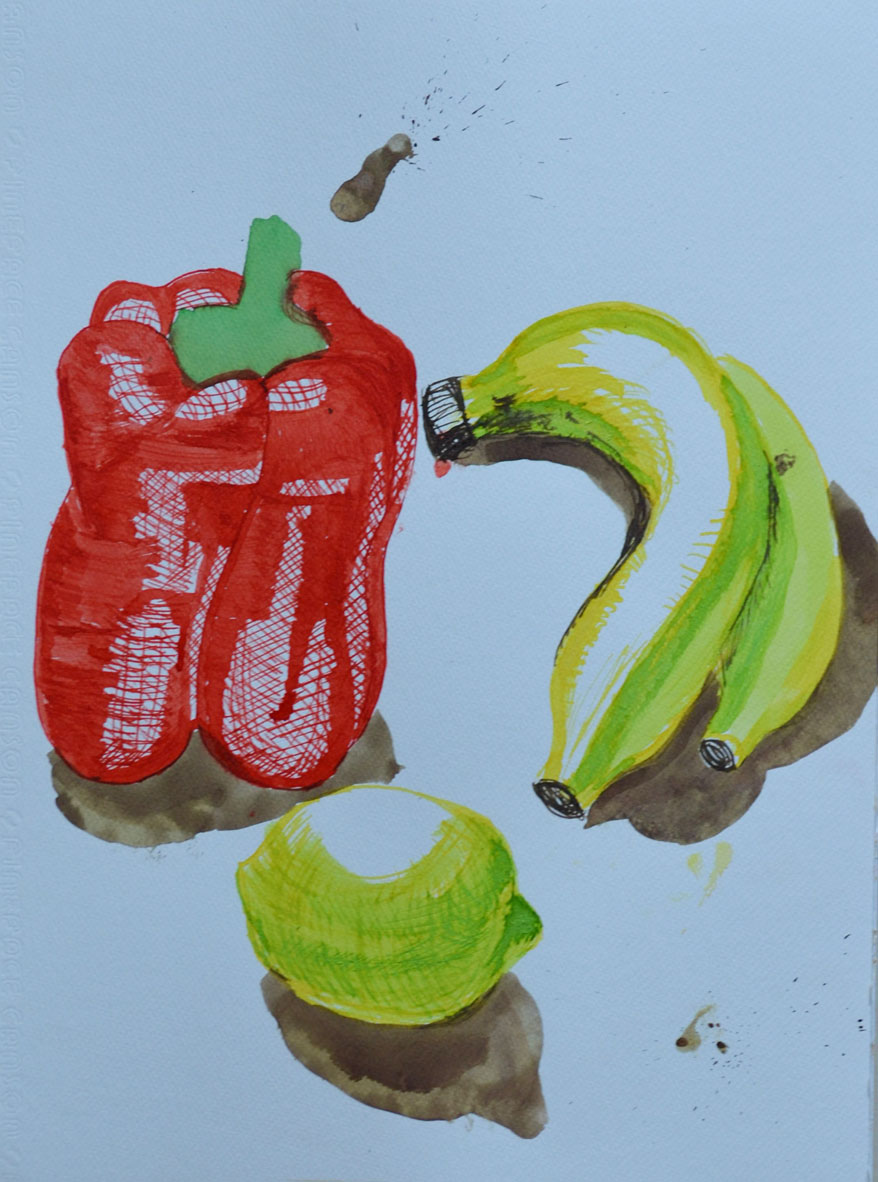
I finally got round to using dip pens and at this stage I felt like packing in. Firstly I started with liquid water colour which did not stay well on the pen nibs I made several attempts which all got binned before going out to look for higher quality watercolour paper that wouldn’t get saturated as easy and some proper drawing inks.
1st Attempt at Dip Pens
1st Attempt with Ink and Dip Pens
My first attempt with dip pens, ink was a disheartening mess and I was trying to work out what I was doing wrong, inks were running into each other and the paper was still getting saturated. Realising that I wasn’t giving the inks on each object enough time to dry before adding different colours I decided to have another go.
2nd Attempt at Dip Pens
2nd Attempt with Ink and Dip Pens
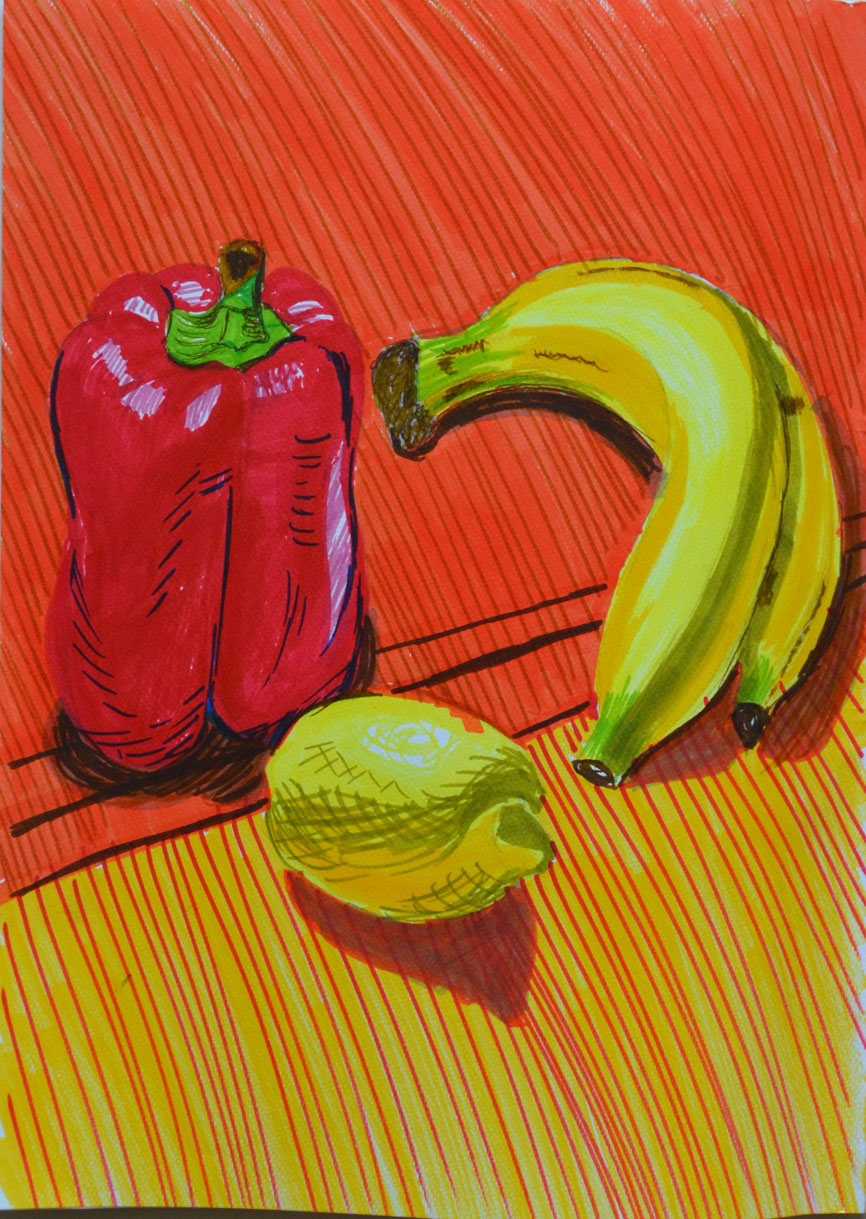
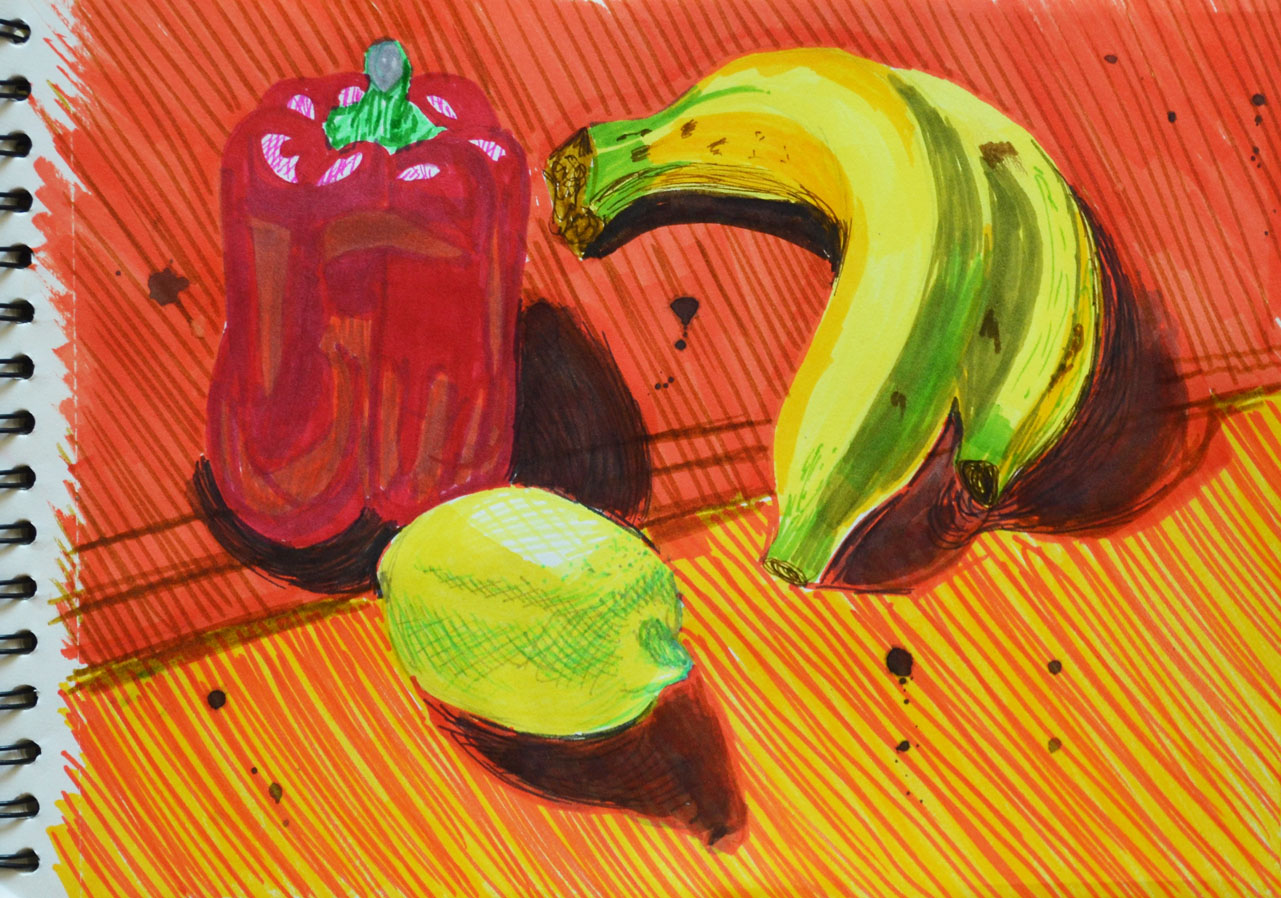
My second attempt with ink and dip pens was an improvement but I decided that I would use markers on the final piece as I could capture the reflected light and shadows on the pepper a lot better with different coloured marker pens and so started work on my A4 piece,
Final Drawing on A4
Final Drawing on A4
I did use a bit of ink on the final piece with a lemon yellow was over the lemon and a dark wash for the shadows which was a bad decision and a couple of ink splashes finished it off. The final piece is not brilliant but I do feel it is an improvement to the earlier drawings and I think I did really well to capture the patterns on the peppers surface.

Friday, 4 July 2014

Drawing 1, Part 2 Observations in in Nature, Detailed Observation - Getting Tone and Depth in Detail

In this exercise I was to practise building up dark medium and light tones principally using pencils and hatching and cross-hatching techniques. I was to select a single object such as a shell or piece of driftwood and get a varied effect by combining soft and medium grade pencils as well as altering the direction of the strokes I make. The brief also informed me that this exercise would be time consuming and indeed it was. I used a smooth sheet of A3 Canson paper and 2B, 3B, 4B, 5B pencils to complete this exercise as well as a putty rubber for the highlights which I used quite often to lighten strokes that were too dark as I made my way through my chosen subject. Living in Bangkok has it's downfalls especially when taking a drawing course but I'm very lucky to have a small park with some very exotic trees in front of the primary school that I teach at. I found a small branch that had fallen or been broken off one of the trees a few weeks ago that reminded me of the hammers in Pink Floyd the Wall with patches of bark still on it and some really nice contours,  so I decided to use it for this exercise.
My subject for this drawing exercise, a tree branch
I started on the end that I knew would be the most difficult to try and reproduce with pencils, the tree bark, going over it first hatching with a 2B pencil then, 3B, 4B and 5B to get the darker tones. I know the brief said use hatching and cross-hatching on this exercise but I threw everything I had at it, including stippling, squirkling and dashes and I think I depicted the surface of the bark quite well. Unfortunately my photographic skills aren't that great and the photo of the finished drawing is not as great as the drawing itself.
Getting Tine and Depth in Detail 1
The area that I thought would be the most difficult was actually the easiest, to depict tone on the areas of stripped branch with soft bare wood was the most difficult, but one thing it did teach me was to be more fluid with my drawing and for the first time ever I loosened up.
Getting Tine and Depth in Detail 2
I know there are flaws in the finished drawing, the shape is wrong in certain places and the shadow isn't brilliant but there are parts of this drawing that I am really proud of namely the  bark area which reminds me of a 'bio' tattoo for some reason. In fact I think the finished piece reminds me of an anatomy drawing and while I was working on it I kept thinking of the Marco Evaristti drawings of parts of suicide victims that I saw during my first visit to the national gallery. Overall I think I did quite well in this exercise, my tutor told me I should be more fluid and I think I managed it while working on this exercise. However, one thing I do have a problem with is drawing the very dark tones on a textured surface such as this which is something I will have to work on.